
Key Takeaways
- For Traditional SEO: The Semrush vs. Ahrefs debate centers on keyword databases and backlink analysis, where both are industry leaders.
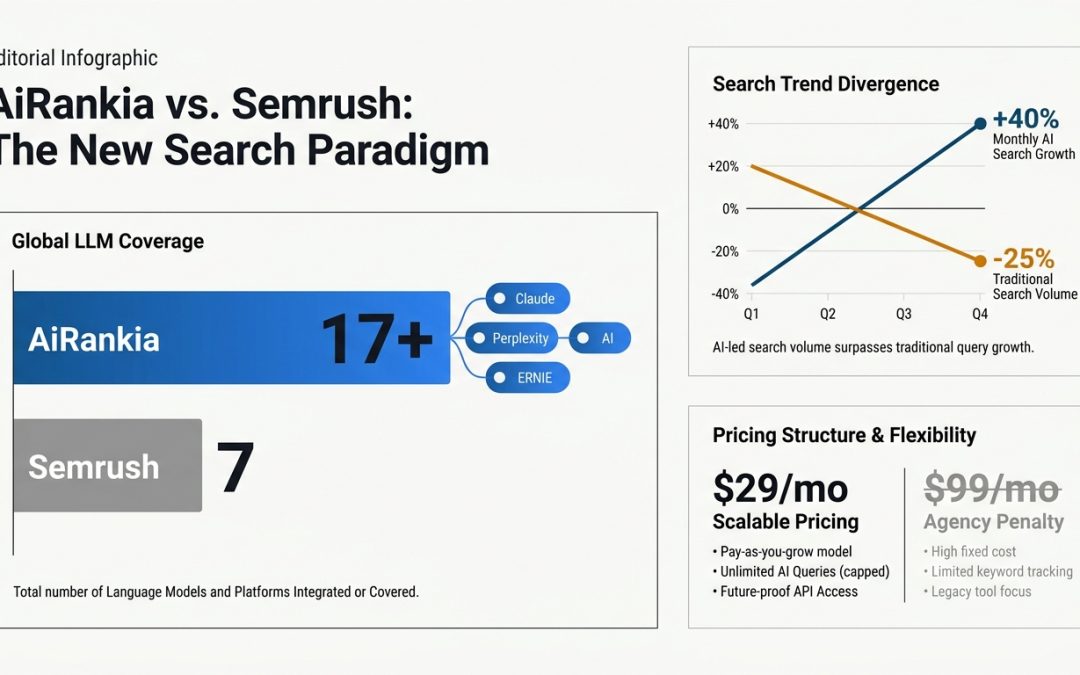
- For AI Search (GEO): Legacy tools fall short. Semrush’s AI toolkit focuses its core coverage on five main AI engines and uses a punitive agency pricing model ($99/mo per extra domain), making it unsustainable for scaling client services.
- The Superior Alternative for AI: AI Rankia is a native Generative Engine Optimization (GEO) platform built to address these gaps. It tracks 17+ global LLMs (including Claude, Perplexity, and international models like Baidu’s ERNIE), provides automated, prioritized action plans to improve visibility, and offers a scalable pricing model.
The Search Landscape Is Fracturing: From Keywords to Conversations
The era of predictable, keyword-driven search is ending. Forrester reports that AI-powered search is becoming a meaningful share of B2B organic traffic and is growing quickly [1]
. This shift is consistent with Gartner’s February 2024 forecast that traditional search engine volume would drop 25% by 2026 as users turn to AI chatbots, although Gartner now describes LLMs as a complement to traditional search rather than maintaining that figure as a current forecast [2].
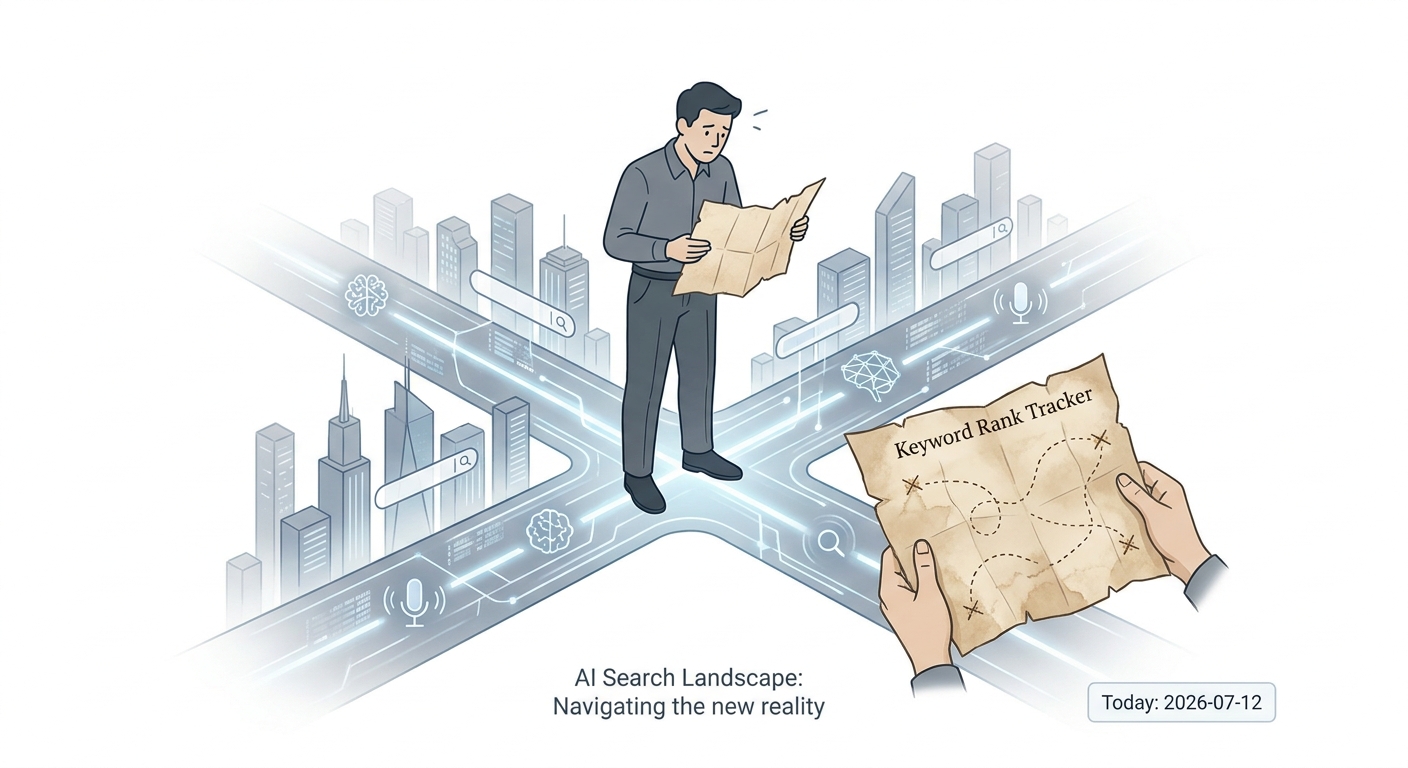
For marketing directors and SEO specialists at B2B SaaS companies and the agencies serving them, this isn’t a distant threat—it’s a present-day reality. With AI Overviews already reshaping results (zero-click rates for keywords with AI Overviews were 31.53% in Semrush’s study), relying on legacy keyword rank trackers is like navigating a new city with an old map.
While the Semrush vs. Ahrefs debate has defined SEO strategy for a decade, the rise of Generative Engine Optimization (GEO) demands a fundamentally new toolkit. This guide moves beyond surface-level feature comparisons to dissect the four critical gaps legacy platforms have when repurposed for AI search. We will demonstrate how limited model coverage, passive monitoring, and restrictive pricing create dangerous blind spots in your brand’s AI visibility and show how a native GEO platform like AI Rankia offers a more effective, scalable, and cost-efficient solution.
The nature of user queries is fundamentally changing, moving from short-tail keywords like “customer support software” to complex, conversational prompts such as, “We’re a 40-person SaaS company with a remote support team and Zendesk is getting too expensive. What should we switch to?” [20]. This shift demands a corresponding evolution in strategy. The primary goal is no longer to simply “rank #1” for a keyword, but to be consistently recognized as a credible, authoritative source by the AI models that generate answers for users [21].
Achieving this new form of visibility requires a focus on different optimization pillars. Success in GEO involves a deliberate effort to build topical authority by covering subjects comprehensively, implementing structured data to provide clear context for machines, and strengthening brand-entity associations to consistently link your brand with specific areas of expertise [21]. This is a departure from chasing individual keyword rankings and toward establishing a verifiable digital reputation that AI can trust and cite.
Modern toolkits must be equipped to measure and influence this conversational landscape. Semrush, for example, enables teams to define and monitor curated sets of prompts that reflect actual commercial intent, organized by product categories, alternatives, pain points, and specific buying scenarios [20]. This strategic monitoring is supported by an extensive database of more than 317 million AI prompts and 36 million brands (Semrush), offering a deep view into the AI search ecosystem [22].
For many marketing teams, a key advantage lies in integrating this new data into existing workflows. Semrush addresses this by presenting AI visibility metrics—including brand mentions, cited pages, and share-of-voice—directly alongside traditional SEO data like organic traffic, backlinks, and keyword rankings [22]. This unified dashboard prevents the need to jump between separate SEO and AI reporting tools, allowing for a holistic analysis of a brand’s total search presence and reducing tool fragmentation within the marketing stack [20].
AI Gap 1: Limited LLM Coverage Creates Global Blind Spots
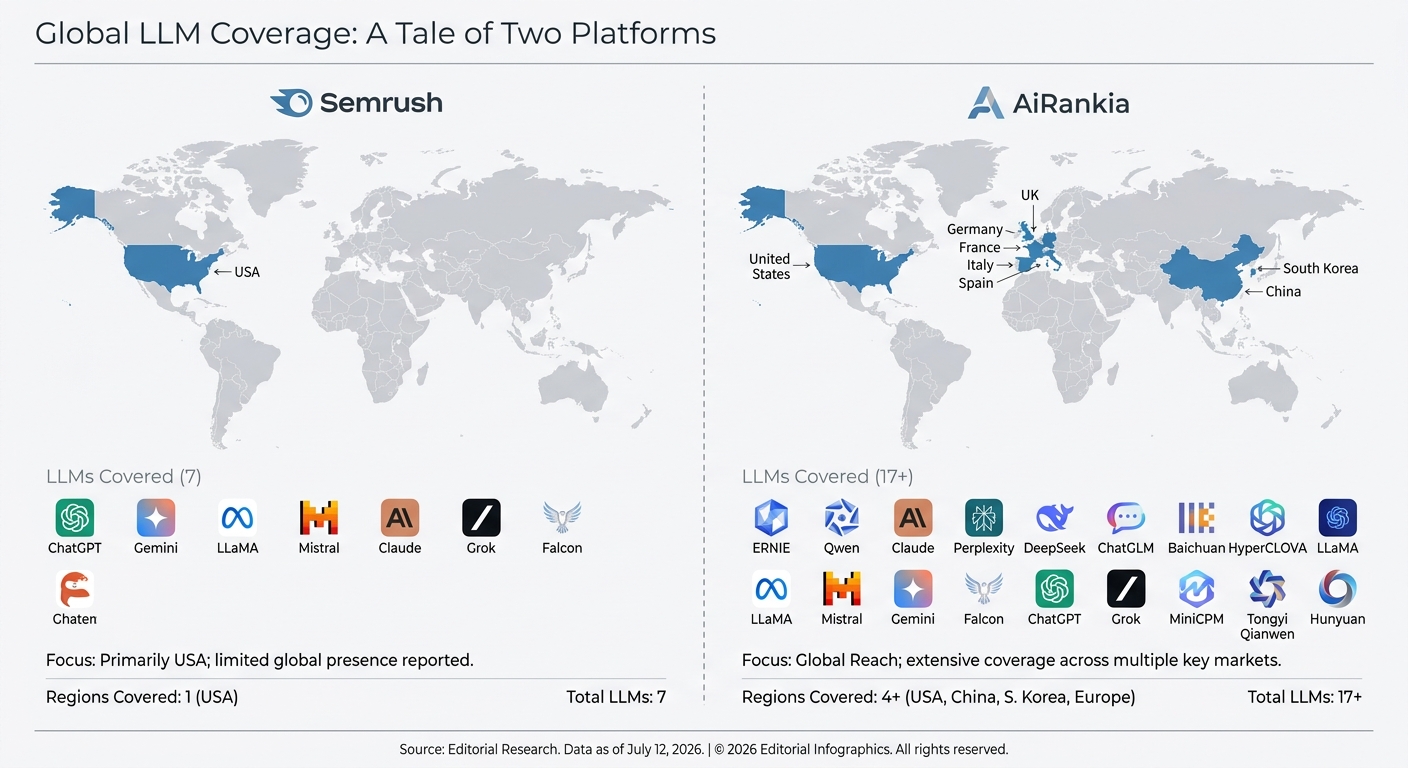
A primary function of any AI visibility tool is tracking brand mentions across Large Language Models (LLMs). Semrush’s AI Visibility Toolkit is a powerful entry into this space, with core coverage of ChatGPT, Google AI Overviews, Google AI Mode, Gemini, and Perplexity (wider coverage including Copilot, Grok, Claude and DeepSeek belongs to Enterprise AIO), against a database of more than 317 million prompts [5].
The critical issue is that this coverage is largely US-centric. For B2B SaaS companies with international customers, supply chains, or growth ambitions, this creates significant blind spots. Visibility in crucial regional engines like Baidu’s ERNIE (China), Naver’s Cue: (South Korea), and Alibaba’s Qwen is essential for global market penetration but is completely absent from legacy toolkits. This limitation is a common frustration voiced in SEO communities, where practitioners question the true value of tracking only a handful of the most popular English-language models.
AI Rankia was built to solve this problem, offering comprehensive tracking across 17+ global models. This allows a US-based company to monitor its entire international AI footprint from a single, unified dashboard.
| Feature Comparison | Semrush AI Visibility Toolkit | AI Rankia GEO Platform |
|---|---|---|
| Tracked LLMs | Core coverage of 5 engines (ChatGPT, Google AI Overviews, AI Mode, Gemini, Perplexity). | 17+ global models including ChatGPT, Gemini, Claude, DeepSeek, Baidu, Qwen. |
| Geographic Focus | Primarily English-language, US-centric models. | Multi-lingual, with dedicated tracking for key international engines in Asia and Europe. |
| User Intent | Monitors brand mentions in final AI outputs. | Measures AI Share of Voice and reverse-engineers how models source information. |
Platform Capabilities at a Glance
| Option | Pros | Cons | Score |
|---|---|---|---|
| Semrush AI Visibility Toolkit | Monitors brand mentions in the final outputs of its 5 core, US-centric AI engines. | Limited global coverage; provides passive data without actionable steps. |
7/10
|
| AiRankia GEO Platform | Tracks 17+ global LLMs and reverse-engineers how models source information to provide a true signal of brand presence. | Not a replacement for traditional backlink analysis tools. |
9/10
|
Effective GEO requires running targeted prompt sets across multiple LLM versions to establish a true signal of brand presence [6]. By using advanced prompt engineering across a wider array of models, AI Rankia provides a more complete and actionable picture of global AI visibility, ensuring your brand is present wherever your customers are searching.
AI Gap 2: Prioritized Action Plans vs. Passive Data Monitoring
Knowing you have a problem is not the same as knowing how to fix it. Legacy AI tracking tools are excellent at providing dashboards that show what

is happening—they can measure your AI Share of Voice, track brand mentions, and analyze sentiment. However, the strategic execution—the how—is left entirely to the user. A low “AI Visibility Score” in Semrush is a data point, not a solution [3]. This leaves marketing teams with valuable data but no clear, efficient path to improvement.
AI Rankia closes this execution gap by transforming passive data into an active strategy. Instead of just flagging a problem, the platform generates automated, step-by-step action plans designed to help you proactively manage your brand’s reputation across AI models. It creates a prioritized to-do list with specific, high-impact optimizations, such as:
🎯 Entity Reinforcement
Identify and strengthen key brand and product entities within your content to build topical authority for AI models.
🌐 Knowledge Graph Updates
Make structured data adjustments to feed AI models clearer, more accurate information about your business.
✍️ Schema & Content Adjustments
Pinpoint and optimize specific pages with LLM-friendly content to improve their citation probability.
- Entity Reinforcement: Identifying and strengthening key brand and product entities in your content.
- Knowledge Graph Updates: Recommending structured data adjustments to feed AI models clearer information.
- Schema & Content Adjustments: Pinpointing specific pages that need LLM-optimized content to improve their chances of being cited.
This approach aligns with expert guidance on building a clear technical structure and creating unique, people-first content to earn visibility in generative AI [8]. Case studies prove this methodology works. For example, CreativeWeb’s GEO work with Farringdons demonstrated that targeted entity reinforcement and LLM-optimized content drove significant, measurable gains in AI citations. In the AI era, success is no longer measured by keyword rankings but by GEO-specific metrics like AI Share of Voice
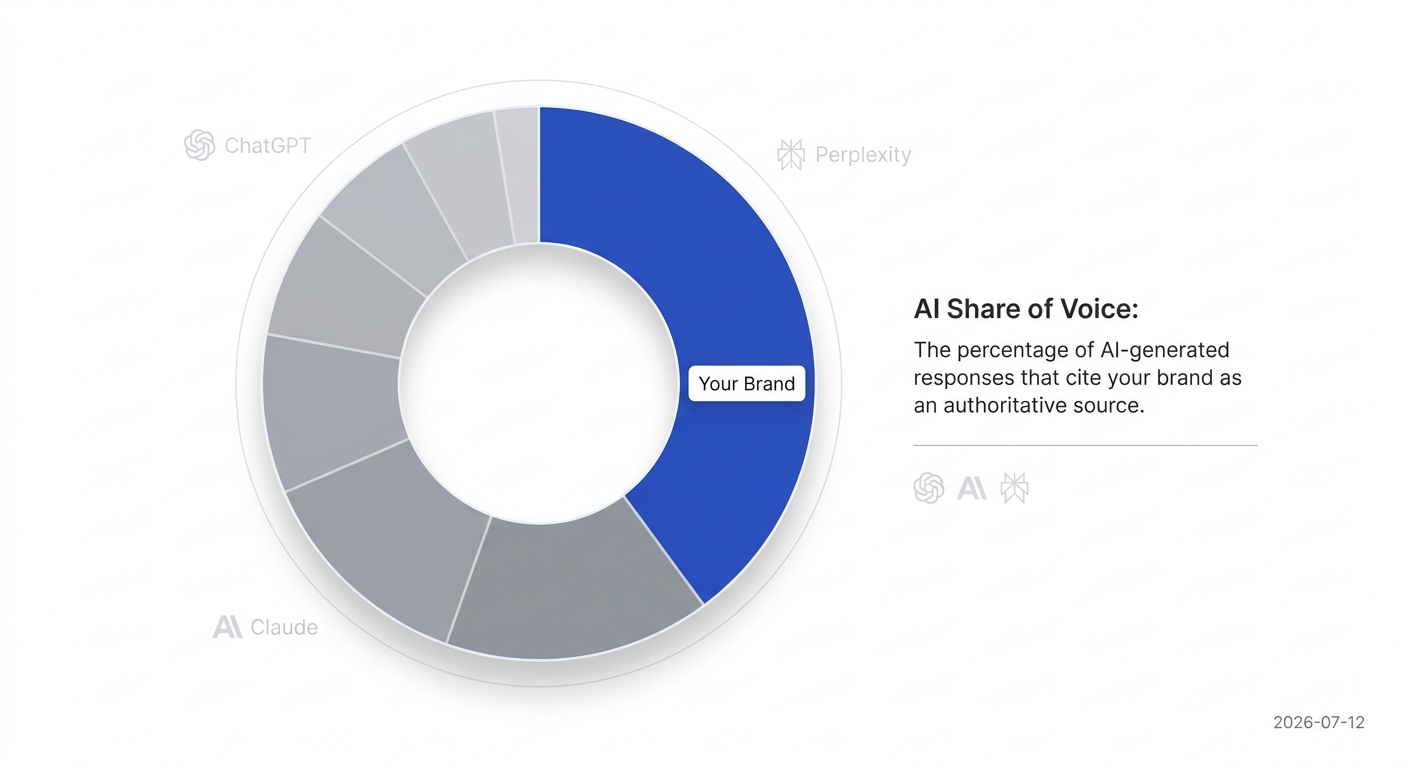
—a measure of how often your brand appears in AI-generated responses compared with competitors.
AI Gap 3: The Agency Pricing Trap for the US Market
When comparing tools, Semrush is often positioned as an all-in-one platform with AI visibility available as a convenient add-on. What these descriptions omit is the punishing cost structure for US agencies. Semrush’s AI Visibility add-on is priced per domain. Each additional client domain costs a steep $99 per month. For an agency managing 5, 10, or 20 clients, this pricing model is not just restrictive; it’s financially unsustainable. It makes scaling AI tracking services prohibitively expensive.
AI Rankia was designed with agency scalability in mind. It provides a cost-effective path to comprehensive AI tracking without the enterprise pricing traps.
Cost-Comparison Scenario: US Agency with 10 B2B SaaS Clients
- Semrush: Base Subscription + $990/month in domain add-ons for AI tracking.
- AI Rankia: For AI Rankia plans, see airankia.com.
Budget flexibility is a primary concern when agencies evaluate tools like SE Ranking vs. Semrush or Serpstat vs. Semrush. AI Rankia delivers enterprise-grade GEO capabilities without the enterprise price tag, empowering agencies to offer cutting-edge AI services profitably.
The per-domain pricing model is not unique to Semrush, but it represents a significant fault line in the AI visibility tool market. Competitors are actively targeting this agency pain point with alternative structures. The market is fragmenting into distinct models: flat-rate agency tiers, usage-based credits, and feature-gated subscriptions. For instance, Peec AI offers a specific agency plan (Essential) at $245 per month, while Knowatoa uses a two-tier system where essential reporting integrations are only available in its more expensive Growth tier . This forces agencies to evaluate not just the headline price, but the total cost of ownership required to actually service clients, a calculation where Semrush’s model quickly becomes an outlier.
Other all-in-one SEO platforms offer a different, though still complex, path. SE Ranking, for example, bundles its AI Results Tracker into its Pro plan but requires an additional AI Search add-on, starting at $89/month ($71.20/month billed annually) for 200 checks, where one check equals one prompt on one AI platform, to unlock core agency functions like competitor analysis . This shifts the scaling cost from a per-client basis to a per-usage basis (prompts tracked). While potentially more manageable than a rigid per-domain fee, it introduces unpredictability in monthly billing and requires careful management of prompt allocation across a client roster. This contrasts sharply with specialist tools built specifically for scaling AI visibility as a service.
Specialist platforms like AthenaHQ bypass the per-domain debate entirely, opting for a credit-based model that starts at $295 per month. Their enterprise plans are explicitly designed for agency growth, offering features like unlimited seats and API access without charging per client site . This model aligns the tool’s cost with the agency’s overall usage and revenue, rather than penalizing the agency for each new client it acquires. For an agency focused on delivering deep AI search optimization (AEO) services, this structure provides a predictable and scalable foundation for their practice.
This divergence in pricing philosophy presents a clear decision framework for agencies. The primary question is no longer just about features, but about aligning a tool’s business model with the agency’s growth model. An agency must determine if its cost structure should be tied to clients (per-domain), usage (per-prompt/credit), or users (per-seat). Evaluating whether competitor analysis, API access, and reporting integrations are included or treated as expensive add-ons is now a critical step in the procurement process, directly impacting profitability and the ability to scale an AI search service line.
AI Gap 4: Native GEO Architecture vs. a “Bolt-On” Feature
Generative Engine Optimization (GEO) is not a simple extension of traditional SEO. Legacy tools like Semrush and Ahrefs are built on massive keyword databases. Their approach to AI tracking is to “bolt on” a prompt tracker that scrapes the final output of an AI model for your brand name. This method is entirely reactive—it’s like checking if your ad appeared in a magazine after it was printed. It tells you if you were mentioned but offers zero insight into why you were (or were not) included in the AI’s synthesis.
A native GEO tool like AI Rankia is built on a foundation of prompt engineering and semantic retrieval. This proactive architecture is designed to influence the journalist before
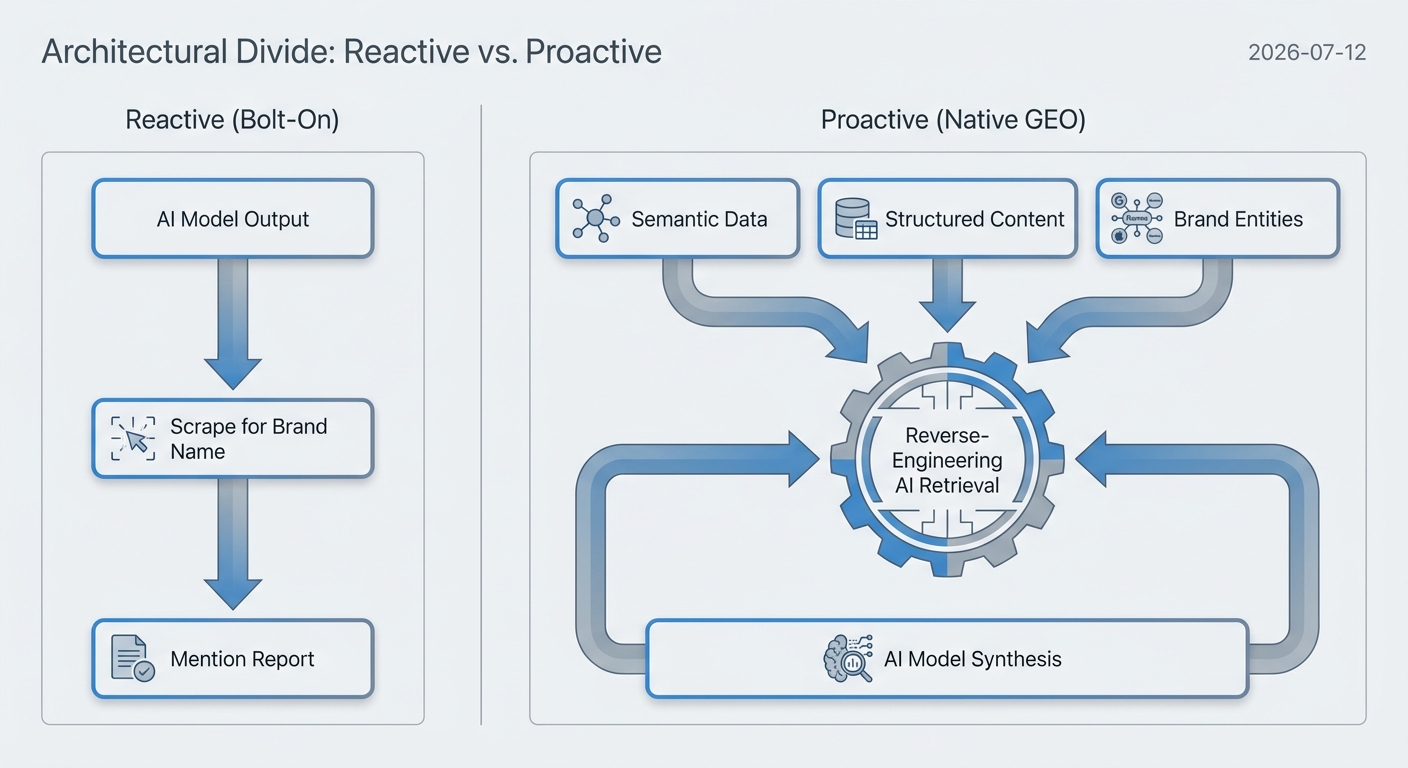
they write the article. As AI Rankia Co-Founder Pedro Spota explains, “To truly optimize for AI, you must deploy RAG pipelines and AI agents that reverse-engineer how LLMs retrieve and synthesize data.” This requires a deep understanding of LLM integration and semantic retrieval, a skill set completely different from analyzing keyword volume.
Unlike enterprise platforms such as Searchmetrics vs. Semrush or BrightEdge vs. Semrush, which are still adapting their legacy architectures, AI Rankia is purpose-built for this new search paradigm. It provides insights tailored specifically to how AI algorithms think, helping you understand how users phrase prompts [7] and what content structures are most likely to be sourced, drawing on a deep library of GEO strategies and generative engine case studies.
] and the data sources the models prioritize. This architectural divergence creates tangible gaps in features, data fidelity, and operational scalability. For instance, a bolt-on tool might track if your brand is cited, but a native GEO platform can often perform hallucination detection with source identification, a feature Semrush lacks . This capability is critical for understanding if an LLM is citing you based on valid source material or misattributing information, a distinction that a simple output scraper cannot make.
The differences become clearer when examining specific capabilities:
- Engine and Regional Coverage: While Semrush added AI features in 2025, its architecture remains fundamentally tied to Google’s ecosystem . Its AI tracking focuses on five major Western engines. Native GEO platforms frequently offer broader coverage, monitoring many more providers (AI Rankia, for example, monitors 17+ AI engines). This includes crucial regional engines like Yandex and GigaChat, which are necessary for Russian-market GEO but are not covered by Semrush AI .
- Data Fidelity and Methodology: The accuracy of bolt-on AI tracking has been questioned by users, with some reporting that keyword rankings in AI Overviews are not reflected correctly . In contrast, some native tools employ UI scraping to capture exactly what a user sees, including citations, search layers, and interactive widgets, providing a more faithful representation of AI search results than API-based methods can .
- Insight Granularity: While a legacy platform might offer basic sentiment analysis, a purpose-built tool can provide granular sentiment broken down by specific AI model, prompt, and time. This allows marketers to see not just if they were mentioned positively, but which models and prompts are generating that sentiment, enabling more precise optimization .
These technical differences have direct business implications, especially for agencies. The Semrush model, built on its existing per-project pricing, scales cost directly with the number of clients an agency serves. An agency with 20 clients could face costs exceeding $2,000 per month just for the base tool. In contrast, many native GEO platforms offer flat-rate pricing that does not increase with the number of clients, making it far more viable to offer GEO as a scalable service . This distinction highlights how a tool’s core architecture impacts not just its features, but also its fundamental business use case.
Frequently Asked Questions (FAQ)
What is better than Semrush?
✅ The Right Tool for the Job
For traditional SEO tasks like backlink audits and keyword research, Semrush and Ahrefs are industry leaders. For optimizing your brand’s visibility within AI chatbots like ChatGPT and Perplexity, a dedicated GEO tool like AiRankia is superior due to its wider LLM coverage and actionable insights.
For traditional SEO (keyword research, backlink audits), Ahrefs is a powerful competitor. For AI search visibility and Generative Engine Optimization (GEO), AI Rankia is better. It tracks 17+ global LLMs (vs. Semrush’s ~7) and provides automated action plans, not just passive monitoring dashboards.
What is the most accurate SEO tool?
Accuracy depends on the channel. For traditional search volume, Ahrefs and Semrush are highly accurate. For AI engines like ChatGPT and Perplexity, AI Rankia is the most accurate because its native GEO architecture is built to measure AI Share of Voice across a wider array of global models, reflecting real-world brand visibility.
Is Semrush really worth it for AI tracking?
Semrush is a valuable tool for traditional SEO. However, for US agencies needing to track AI brand mentions across multiple clients, the $99/month per-domain fee makes it cost-prohibitive. A specialized GEO platform like AI Rankia offers a more scalable and effective solution for AI visibility.
Is Ahrefs worth the money?
Ahrefs remains the gold standard for backlink analysis and technical site audits. If link building is your core strategy, it is worth the money. But as audiences migrate to AI search, you need a dedicated GEO tool like AI Rankia to supplement it for complete visibility.
Which SEO tool is best?

The “best” tool aligns with your primary growth channel. Semrush is best for all-in-one traditional marketing campaigns. Ahrefs is best for deep backlink research. AI Rankia is the best tool for optimizing and scaling brand visibility across global AI models.
What is the cheapest SEO tool for AI?
For traditional SEO, tools like Mangools and SE Ranking are budget-friendly. For AI search visibility, AI Rankia is a comprehensive option for AI search visibility; see airankia.com for current plans.
📊 Scalable AI Visibility
AiRankia offers a cost-effective and scalable solution for agencies to provide comprehensive GEO services without the punitive per-domain fees charged by legacy platforms.
This makes it highly scalable for agencies compared to expensive enterprise add-ons.
Choosing the Right Tool: Limitations & Professional Guidance
This guide focuses on the emerging field of Generative Engine Optimization. While AI Rankia excels at multi-LLM tracking and providing actionable GEO strategies, it is not a one-to-one replacement for a traditional backlink crawler or technical SEO suite.
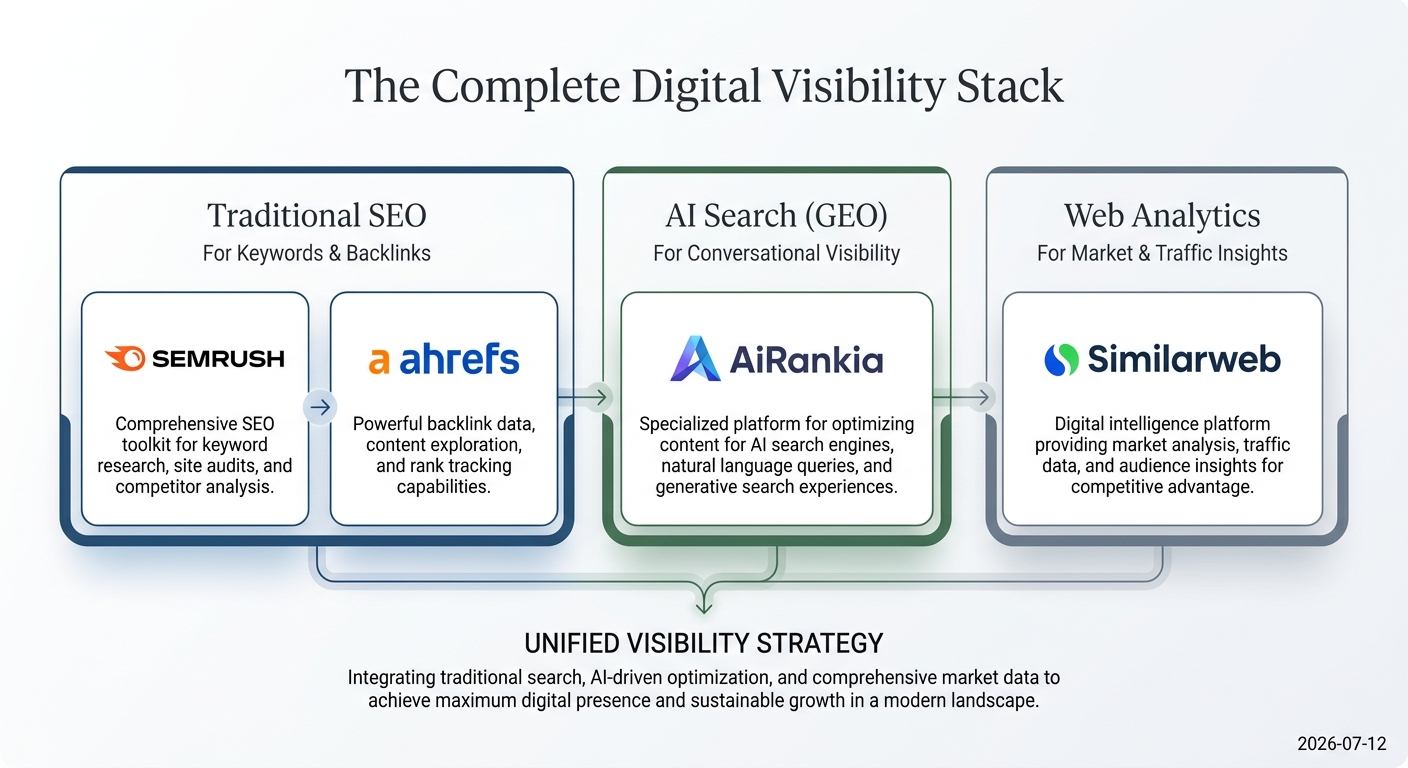
If your primary goal is analyzing competitor link profiles or running deep technical site audits, legacy tools like Ahrefs or Semrush remain essential. For comprehensive web traffic analytics, comparing Similarweb vs. Semrush is recommended. The modern, intelligent agency tech stack requires a hybrid approach: Ahrefs or Semrush for legacy search, and AI Rankia for the rapidly growing AI search channel. Always base your tool selection on your specific business goals and client needs.
Your selection process should begin by defining the primary workflow you need to enhance: monitoring or execution . Are you simply tracking visibility fluctuations, or do you need a platform that integrates with content creation and operational processes? Your answer will guide your shortlist. For example, a small-to-mid-size team might prioritize a single platform that combines traditional SEO with AI visibility tracking, whereas a large enterprise may require a dedicated content execution platform like Conductor . The scale of your operations and existing resources are critical factors; a self-service tool is practical for some, while others may need the white-glove onboarding offered by enterprise solutions [3, 4].
Beyond workflow, scrutinize the granularity of the data. A key limitation in some tools is tracking source citations only at the domain level. If your strategy requires knowing the exact page URL that an LLM cites, you need a tool that provides this level of detail, which some platforms like Semrush offer . Another critical differentiator is data freshness. Some platforms update AI visibility data daily, offering near real-time insights into evolving search presence, which can be a significant advantage over tools with a slower update cadence . Conversely, a tool might excel at daily updates but lack robust competitive benchmarking features, forcing you to analyze prompt performance one by one instead of seeing a summarized view against key industry players .
- If your primary need is an all-in-one platform with maximum AI search intelligence layered on top of comprehensive legacy SEO functionality, and budget is a secondary concern, a tool like Semrush is a strong contender .
- If your organization is a large enterprise focused on scalable content operations, prioritize platforms with built-in execution workflows over pure monitoring tools [3, 4].
- If you operate in a highly regulated industry or have stringent brand safety requirements, your evaluation must include enterprise-grade features like advanced security protocols, compliance tracking, and sentiment analysis, which are found in specialized tools .
- If your strategy relies on rapid response to changes in AI-generated answers, prioritize tools that offer daily data updates, even if it means sacrificing some depth in competitive analysis features .
Conclusion: Stop Reacting and Start Optimizing
💡 Proactive Optimization is Key
The shift to AI search is happening now. Relying on passive monitoring is a losing strategy. To secure brand visibility in a multi-LLM world, you must move from reacting to reports to proactively shaping how AI models synthesize information about your brand.
The transition from traditional search to AI-driven discovery is happening now, with AI search traffic growing rapidly [1]. While the Semrush vs. Ahrefs debate remains relevant for legacy SEO, this analysis demonstrates that neither platform is natively equipped to manage the complexities of a multi-LLM world without trapping agencies in unsustainable pricing models.
To secure your brand’s visibility in ChatGPT, Claude, Perplexity, and crucial international engines, you need more than passive data—you need prioritized, automated action plans. It’s time to stop reacting to AI-generated results and start proactively shaping them. Access a free trial of AI Rankia today and begin mastering your AI search visibility with a native GEO architecture built for the future of search.
About the Author & This Guide
Pedro Spota is the Co-Founder of AI Rankia and Director of Growth at ELOGIA (Viko Group). With over a decade of experience, Pedro designs data-driven growth systems for B2B and B2C companies. He orchestrates teams of 200+ AI agents focused on marketing, sales, and SEO, using advanced automation frameworks like n8n to optimize conversion lift and reduce cost-to-serve.
Transparency Disclosure: This guide was authored by a co-founder of AI Rankia. While it highlights AI Rankia’s specific advantages in Generative Engine Optimization (GEO), it relies on third-party data, objective pricing metrics, and community consensus to provide a fair and helpful comparison against Semrush, Ahrefs, and other legacy SEO tools.
References
[1] Forrester: AI Search Drives 2-6% of B2B Traffic
[3] Generative engine optimization (GEO): How to win AI mentions
[4] AI Mentions: How to Get LLMs to Mention Your Brand
[5] Rivo | Best AI Visibility Tracking Tools (2026)
[6] How to track brand mentions in AI search – PromptEye
[7] From Search to AI: Understanding the Shift from SEO to AEO
[8] Optimizing your website for generative AI features on Google Search
[9] AI Search Statistics (2025-2026): 55+ Data Points on GEO
[10] AI-Powered Search Engine Statistics: Market Share, Usage
[11] Semrush AI Visibility Toolkit vs SE Ranking AI Search Toolkit
[12] SE Ranking vs Semrush (2026) — Which is Better?
[13] 10 Buyer Checks to Compare AI Search Optimization Tools
[14] AI Search Tools Software Comparison: 7 Platforms 2026
[15] AI Search Visibility Tools 2026: 10 Compared & Priced
[16] AthenaHQ vs Semrush for AI Search Visibility: Which Delivers More ROI? | Action on AI Search
[17] Semrush One vs GEO Metrics: Which Is Better for AI Visibility in 2026?
[19] GEO Scout vs Semrush AI: Which AI Visibility Tool Should You Choose?
[20] Ahrefs vs Semrush AI Visibility: Which Tool Wins?
[21] 5 Key SEO / AI Visibility Tools Compared (2026)
[22] Conversational search: from keywords to conversations – Making Science
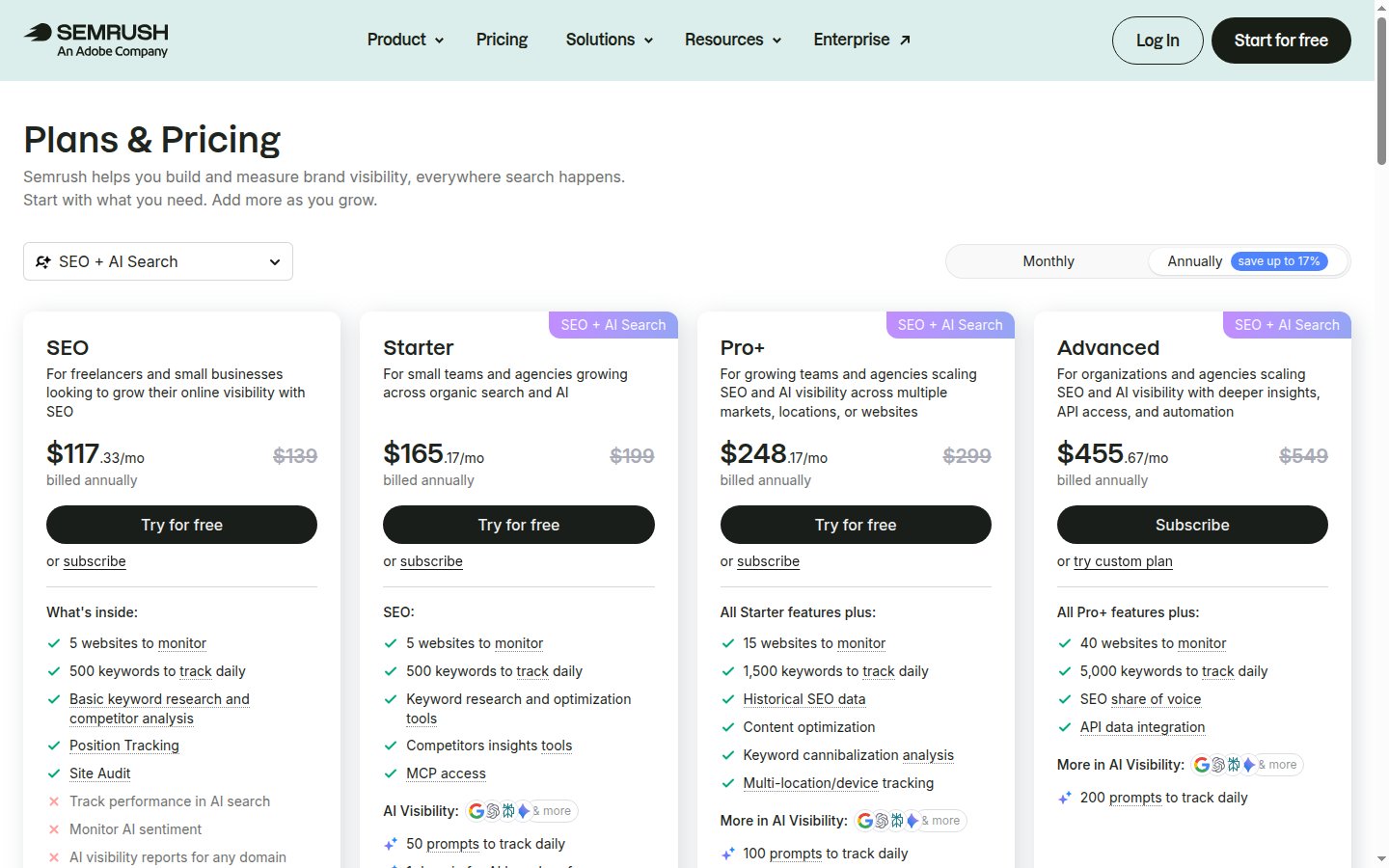
Published pricing (verified September 5, 2026)
| Tool | Plan | Price | Billing | What it includes |
|---|---|---|---|---|
| Semrush | SEO | 117.33 USD/mo | billed yearly | 5 websites, 500 keywords daily |
| Semrush | Starter | 165.17 USD/mo | billed yearly | 5 websites, 500 keywords, 50 AI prompts daily |
| Semrush | Pro+ | 248.17 USD/mo | billed yearly | 15 websites, 1,500 keywords, 100 AI prompts daily |
| Semrush | Advanced | 455.67 USD/mo | billed yearly | 40 websites, 5,000 keywords, 200 AI prompts daily |
| Semrush | Enterprise | on request | Custom pricing available | Unlimited projects & custom limits, custom AI prompt tracking |
Source: Semrush