Type a question and see the Google searches Gemini reports running to answer it, and the web pages it used to support the answer. Reported, not predicted. Why fan-out matters for SEO: our article on its impact.
 Gemini
best CRM for small businesses 2026best crm small businessOne question per run, up to 300 characters. We ask Gemini to search Google first, then list the searches it reports.
Our own calls to this tool's engine, sent the way the tool sends them (12 questions, each asked twice), not a study. With the question alone, Gemini searched in only 7 of 24 calls (Oct 10, 2026), so we now ask it to search.
Source: our 24 test calls, Oct 11, 2026.
Up to 300 characters, plus a country. One call to Gemini with Google Search on and Search Google for current information, then answer:
before your question. No retries.
The model "determines if a Google Search can improve the answer" (Google). We ask it to; it can still skip it. If it searches, it reports the queries.
Each search, the words it added to yours, simple tags (a year, a price, names) and the pages it grounded on.
Google says AI Mode issues "a multitude of queries simultaneously on your behalf" (source). Those queries aren't published. Many fan-out tools ask a language model to guess them (LLMrefs says its queries are "synthetic", source).
Asks a language model to imagine the sub-queries an AI engine might run.
Asks Gemini, with Google Search on, to search and answer, and lists the searches Gemini reports it ran.
| Limit | The number, and what it means |
|---|---|
| Engine and country | Gemini only. Not Google AI Mode, AI Overviews, ChatGPT or Perplexity: each engine searches its own way. We send the country you pick, but haven't measured how much it changes the searches. |
| One run, one sample | Searches change from run to run. The same question can give different searches on each run. A repeat within 10 minutes returns the cached result. |
| Runs per day | 1 free run, up to 3 with your email. Each run is a paid AI call for us, so the whole tool also has a daily cap. A run where Gemini doesn't answer still counts. |
| We ask Gemini to search | 7 of 24 → 24 of 24 test calls searched, without and with the line Search Google for current information, then answer:before your question. It may also change what Gemini searches, compared with your question alone; we haven't measured that. |
| Searches and pages shown | At most 20 searches and 30 pages. If Gemini reports more, the result says how many. In our 24 test calls it ran at most 5 searches and got at most 14 pages. |
| Time limit | 50 seconds. In our test calls 1 of 24 took longer (58 s); that shows as a failure and still counts as a run. |
| Sources | The pages Gemini grounded on. From the answer's grounding data: the pages its searches returned that Gemini used to support the answer, not the full results page. Links Gemini writes inside the answer text aren't listed. |
| The comparison | Word by word. "Added words" ignores small words and simple plurals, not synonyms: "cheap" and "affordable" count as different. |
Query Explorer's Fan-Out Gaps opens a sub-query you don't cover in Content Hub, where you add it to your topical map or mark it covered.
Search Google for current information, then answer:followed by your question; on Oct 11, 2026 it searched in 24 of 24 calls. The searches are still the ones Gemini reports, but asking it to search is our choice, not something a person typing the question into Gemini would do.
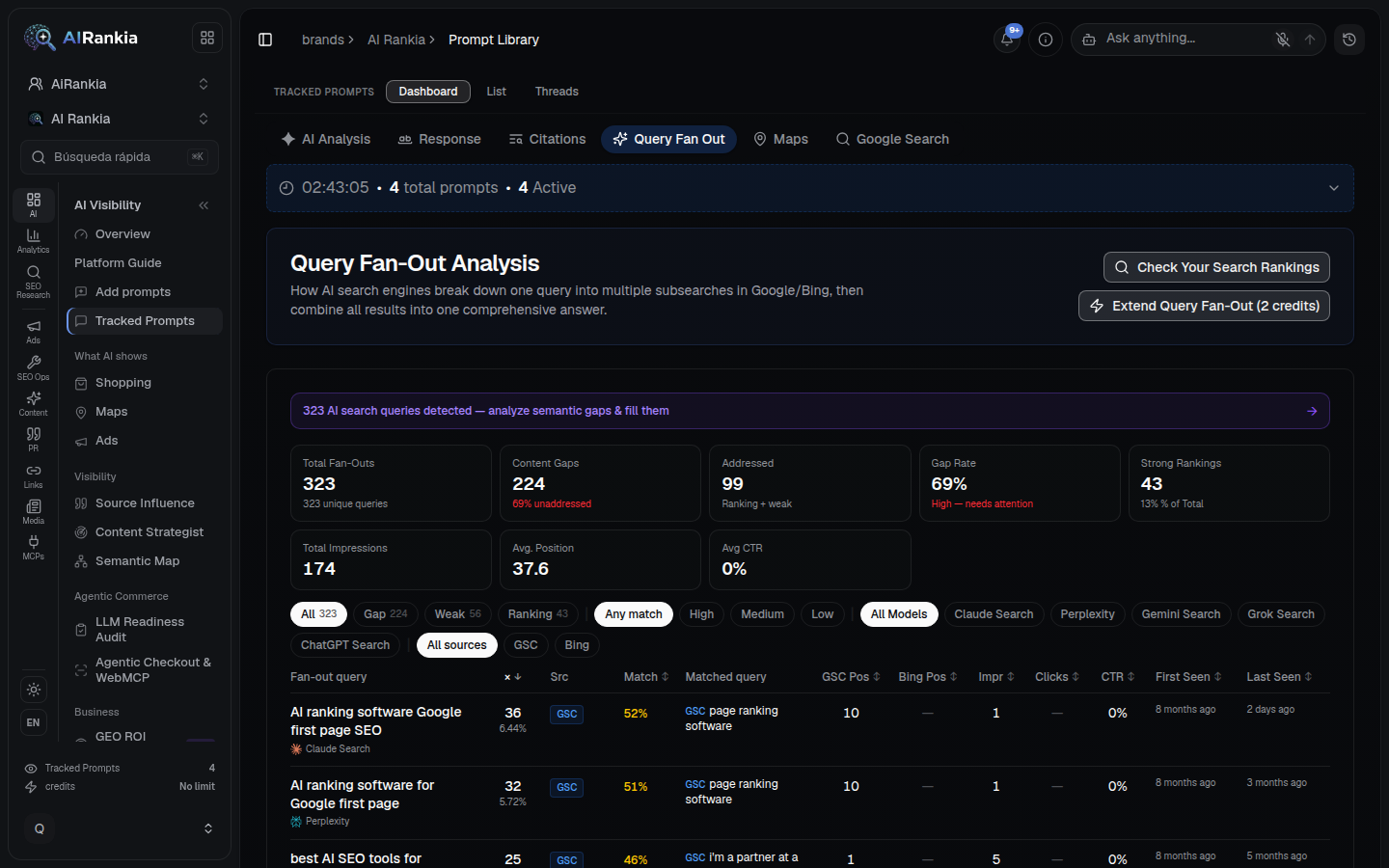
AI Rankia's Query Fan Out runs your tracked prompts on AI engines with live search, keeps the sub-queries each one ran, and matches them with your Search Console queries.
| A fan-out generator predicts | This tool reports |
|---|---|
| Where the queries come from | |
| A language model imagines what an AI engine might run | Gemini, with Google Search on, reports the searches it ran |
| Proof an engine searched | |
| Limitation:Not evidence of what an engine searched | YesThe searches Gemini reports; says so when it didn't search |
| Engines covered | |
| Doesn't search any engine | Limitation:One: Gemini |
| Each run | |
| A full list of plausible queries every time; good for brainstorming | 1–5 searches per run in our 24 test calls; changes from run to run |




 AI Rankia