Two checks, two results: whether AI answers name your brand, and whether AI crawlers can read your site. A score for one says nothing about the other. Run one or both.
 Google AI ModeGoogle AI Overviews
 Claude Haiku 4.5API
 Gemini 3.1 Flash-LiteAPI
Illustration, not a capture: the free-pass report with this page's worked example. Only the Google engines return cited sites.
Enter one URL. We check robots.txt and server access for AI crawlers, indexing, HTML basics, text in the HTML, structured data, sitemap and Core Web Vitals, with the evidence for each.
Around 15 requests to your site (more if your sitemap is split into several files) plus one PageSpeed Insights test. It usually takes under 30 seconds.
| Compared | Check 1Do AI answers name you? | Check 2Can crawlers read this URL? |
|---|---|---|
| Input | A domain | One URL |
| AI in the result | YesA model writes the questions; the AI answers are the result | NoneRequests and responses only |
| Repeat runs | Same domain within 10 minutes: the saved result. New scans are capped per network per hour | 1 run free a day per visitor (none from a VPN, proxy or Tor), up to 5 a day with an email; the same URL within 10 minutes doesn't use a run |
Fetched as a browser (mobile proxy or renderer if blocked). A model infers brand, category, country and language; US if unclear.
“Best X”, “which X should I choose”. Informational ones are filtered; any naming a known brand is replaced, up to three rounds.
AI Mode and AI Overviews from live Google results. Claude Haiku 4.5 and Gemini 3.1 Flash-Lite via the OpenRouter API, no web search.
Named: your name, its variations or your domain's main word in the text. Cited: your domain among the sources.
Answers go through the paid product's brand extractor and the dashboard's visibility formula (updateBrandScores).
One browser request, robots.txt, one request per AI crawler that publishes its User-Agent (as in the AI Crawler Checker), the sitemap, /llms.txt and a PageSpeed Insights mobile test.
Our weights, not a published formula.
Share of search and answer crawlers allowed by robots.txt and the server. Training crawlers aren't scored.
200 status, no noindex, Googlebot allowed by robots.txt: 5 each.
Title 4, meta description 3, canonical 3, viewport 3, lang 2.
Full marks from 300 visible words, proportional below.
From your home page, at one moment: eight answers are a sample, not your market.
Claude Haiku 4.5 and Gemini 3.1 Flash-Lite, told to name brands, answer from what they know, not today's web.
Not the crawlers' own IPs, so a firewall can treat us differently.
Google asks for an indexed, snippet-eligible page and "no additional technical requirements" (Google).
AI knows you from other sites (reviews, directories, press). Fixing the audit's fix items lets your own pages describe you too.
The cited sites are what the engines read: if the same domain comes up across engines, getting mentioned there is a concrete next step.
Start with the audit: while crawlers are blocked or the page is noindex, little else matters.
Access isn't the gap. The brands named instead of you are your AI competitors: with eight answers at most, that list says more than the percentage.
The paid product runs this check on the questions you choose, keeps the history and ranks every brand named.
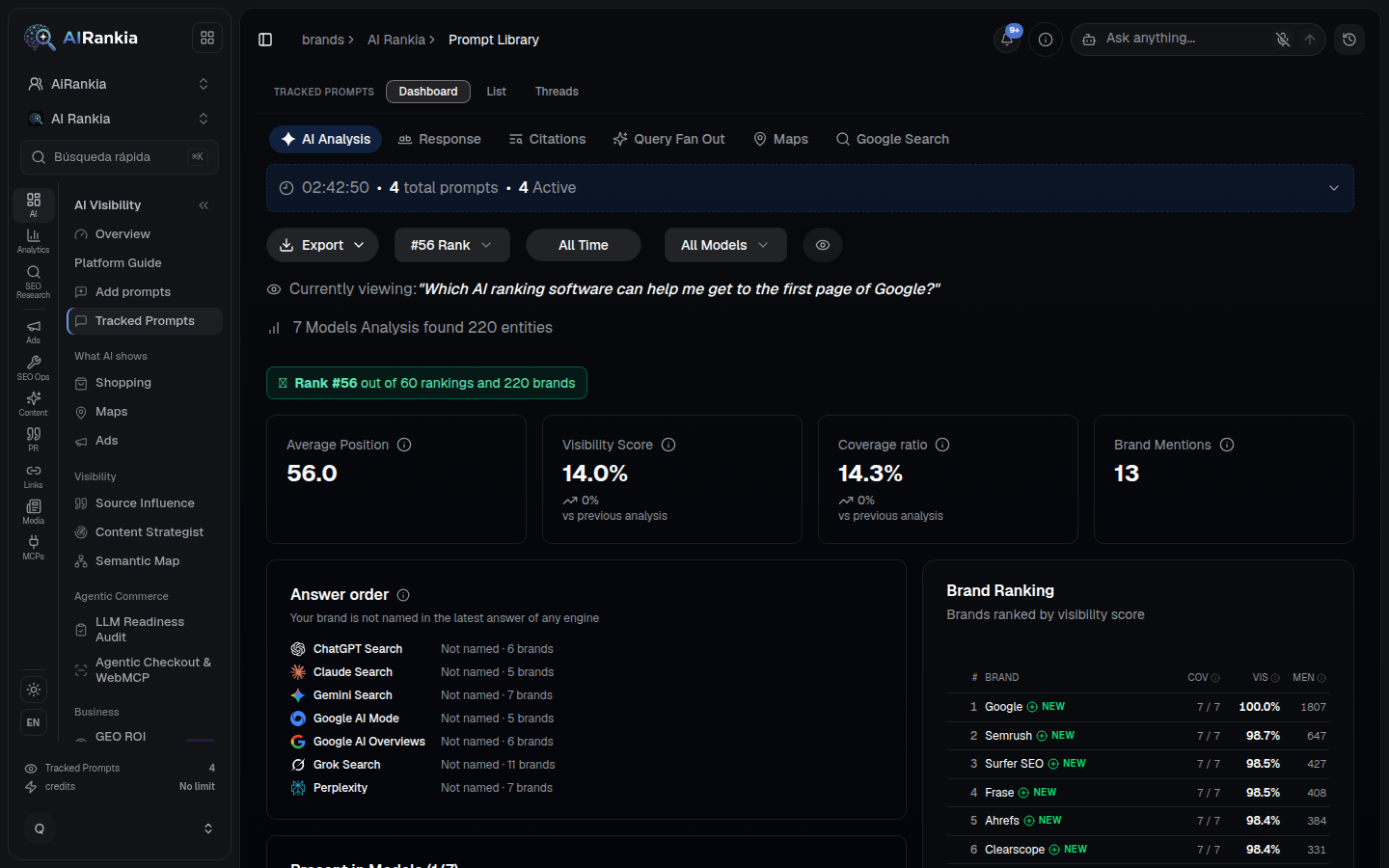
Create an account to track the questions that matter to you across 17+ AI engines, with the brands named and the sources cited for each answer.
Had a competitor been named by all four engines, five times, you would read 50%, relative to theirs.
Free pass, then full passLeave an email or sign in with Google: ChatGPT, through its web search, replaces Claude Haiku, and Gemini gets web search.
Google AI ModeGoogle AI OverviewsClaude Haiku 4.5APIGemini 3.1 Flash-LiteAPIGoogle AI ModeGoogle AI Overviews ChatGPTweb searchGeminiweb search
Free-pass API models: temperature 0.3, no web search, no cited sites.
JSON-LD present 5; no errors from the checks of our Schema Markup Validator 5.
Real-user data: FAST 10, AVERAGE 5, SLOW 0. Lab (no INP): LCP ≤ 2.5 s 5 (≤ 4 s 2.5), CLS ≤ 0.1 5 (≤ 0.25 2.5), per web.dev.
Found in robots.txt or at /sitemap.xml or /sitemap_index.xml.
HTTPS 3, at most one redirect 2.
Source: AI Rankia index, 13 Oct 2025 – 8 Oct 2026
Index scope: 8 AI engines, 2,078 tracked questions, mostly in Spanish from Mexico (1,099) and Spain (456), with 417 from the US. An indication, not your market's figure.
 AI Rankia