 AI Rankia
The GEO tool that measures AI answers, from prompt to page
AI Rankia is GEO software: it tracks whether AI answers name and cite your brand on the engines you choose from 17+, shows which sources they trust, and helps you fix the content and schema behind them. New to GEO? Read What is GEO? The complete guide.
 ChatGPT
 Google AI OverviewsGoogle AI Mode
 Gemini
 Perplexity
 Claude
 Grok
Grok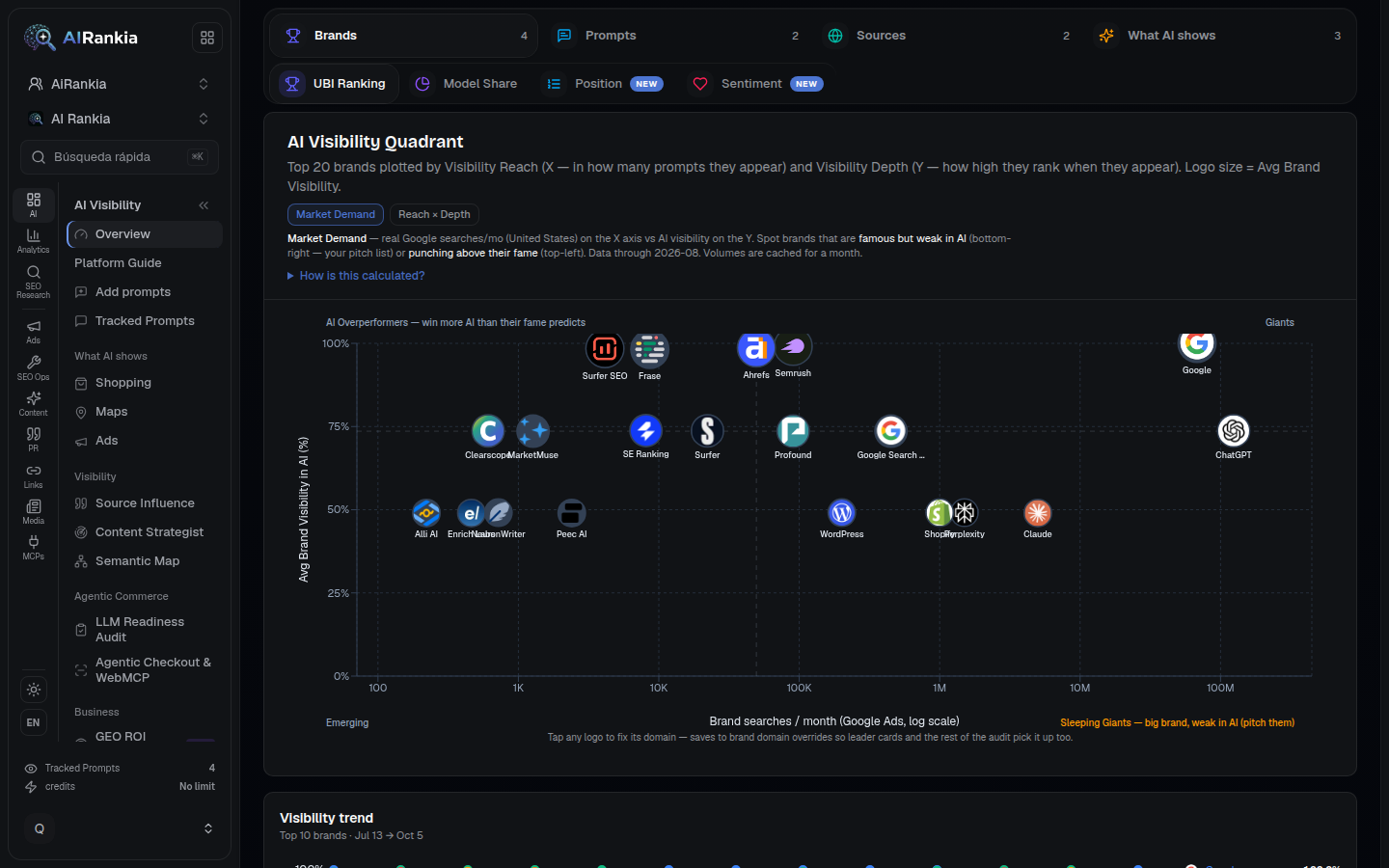
A 2023 paper named it. Google calls it SEO.
Researchers including teams from Princeton and IIT Delhi coined “generative engine optimization” for making content more visible in AI-generated answers (arXiv 2311.09735).
A list of links became one answer
A generative engine reads several pages and writes one reply. Your brand can be named, cited as a source, both, or neither.
You compete for a position.
You compete to be named and cited.
Measure, find, fix, measure again
Four steps in one account. The first never spends credits; the rest act on what it found.
Monitor
Your buyer questions run on a schedule on the engines you pick. Each answer: named or not, position, tone, sources.
Find the sources
Which domains and URLs each engine cites, and which of those pages mention you or your competitors.
Fix the content
Gaps from the sub-queries engines ran, a topical map, articles, and a semantic score against the pages that win.
Clear schema
JSON-LD scanned and enhanced, entities linked to Wikidata, deployed through WordPress or Cloudflare.
Each step, in the product
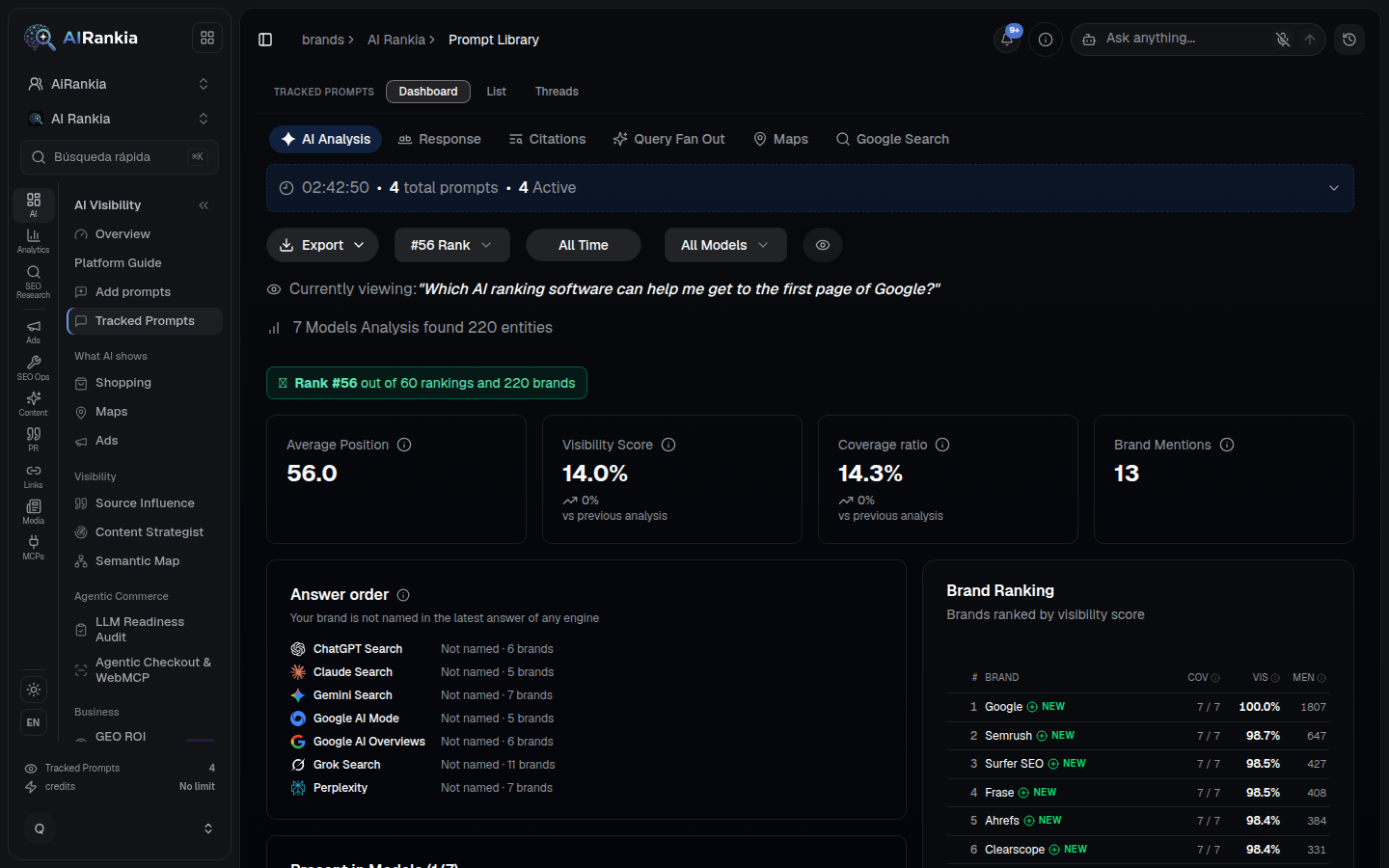
Is your brand in the answer?
One tracked prompt, every engine side by side: who is named, in what order, and where you rank among every brand found.
- Mentions, average position and visibility per engine
- Tone of each answer, with the quoted text
- Engines you choose from 17+; tracking spends no credits
The pages AI trusts, and who they name
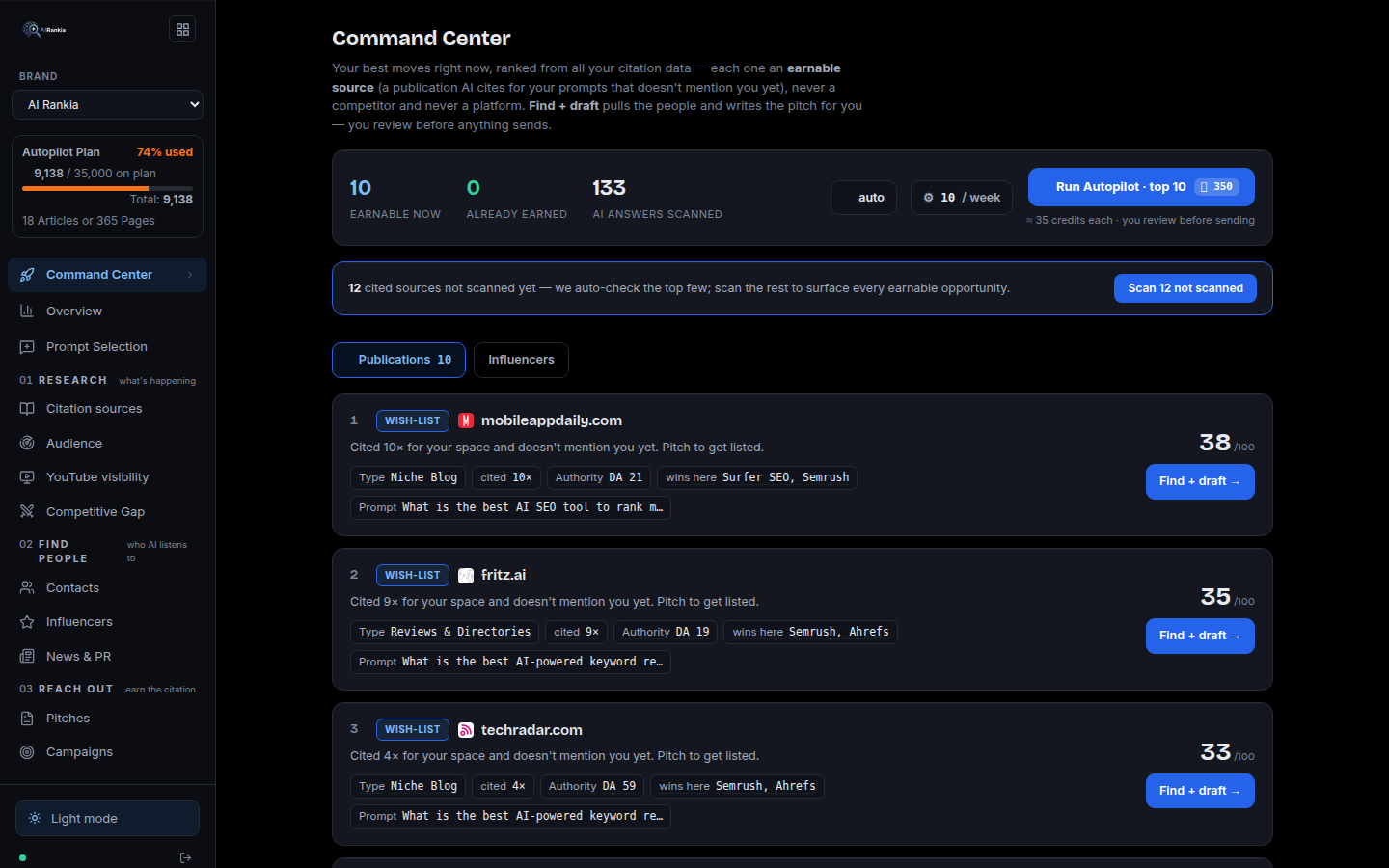
Get Cited reads the pages engines cite for your prompts and lists the ones that don't mention you yet, with who wins there.
- Authority, traffic and the engines that cited each domain
- Find editorial or commercial contacts and draft a pitch (uses credits)
- The same view for any competitor
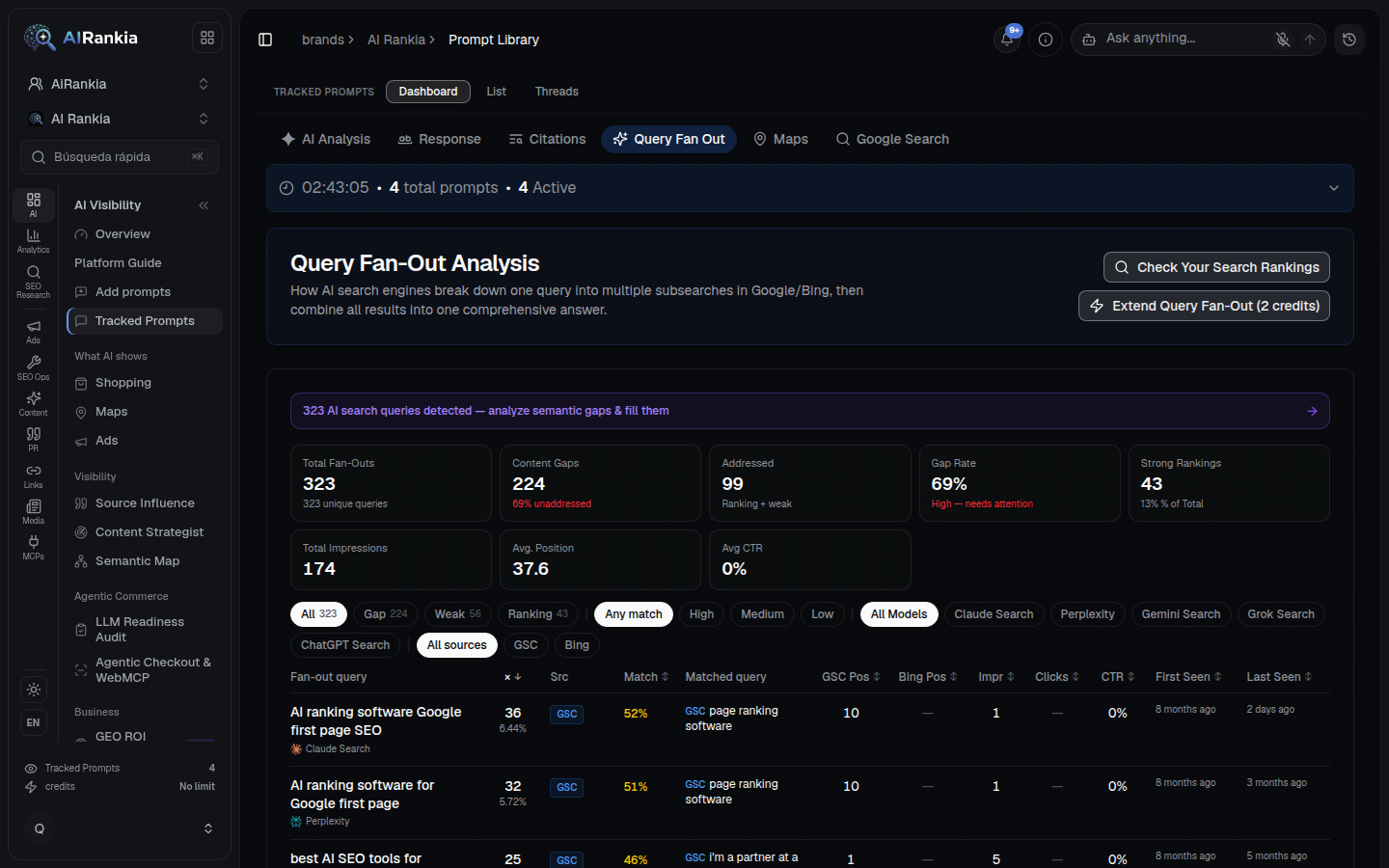
What the engines searched, and what you lack
Search-enabled engines often split a question into sub-queries. We match each one against your Search Console and Bing queries; a gap is a sub-query that matches none of them, so nothing of yours is showing for it yet.
- Gap, match strength, engine and source filters
- Your Google and Bing position for each matched query
- In Content Hub, gaps are crossed with your topical map to pick the next article
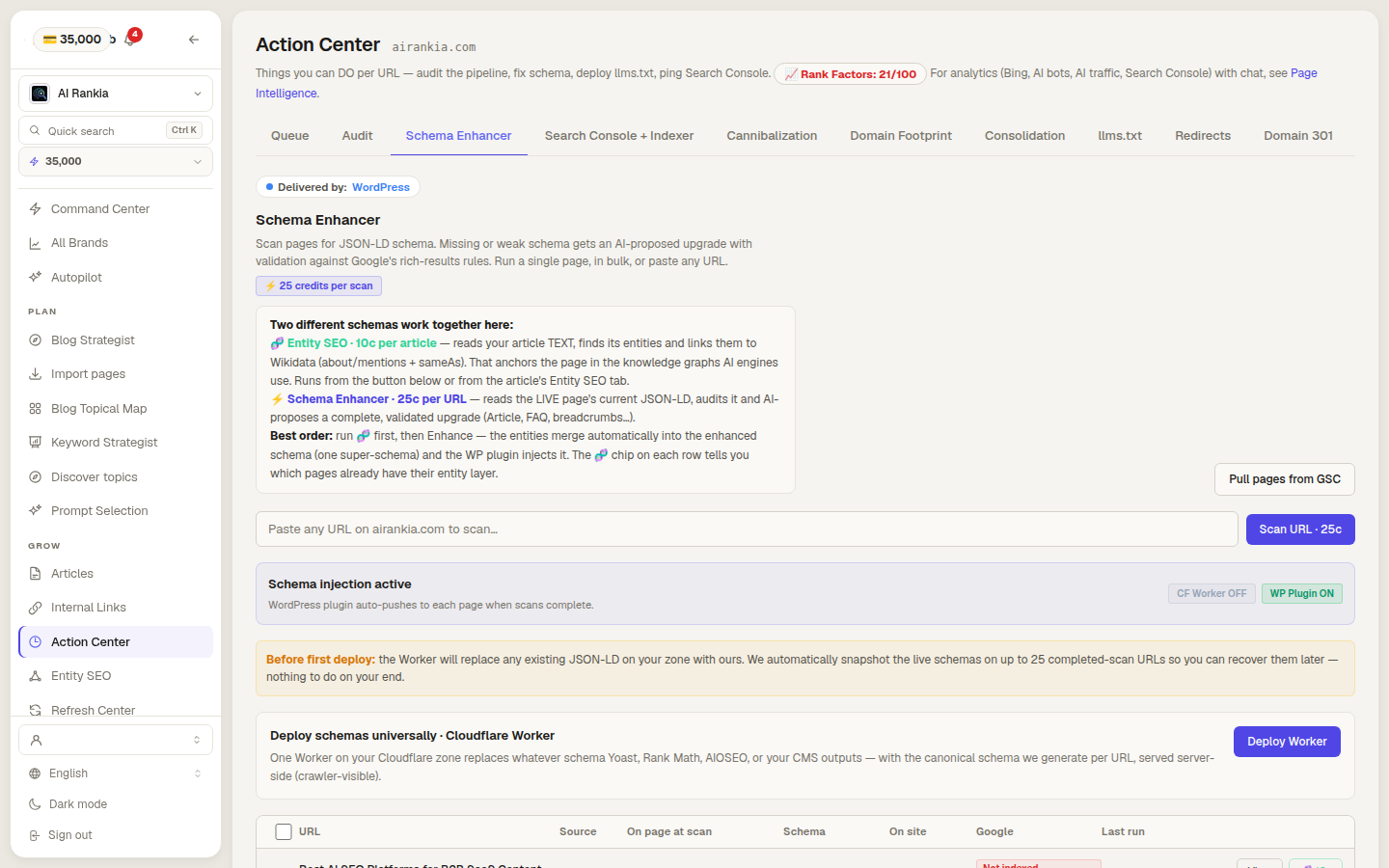
Say clearly who and what a page is about
Scan any URL for JSON-LD, then enhance it. Entity SEO links the concepts in an article to Wikidata and writes about, mentions and sameAs.
- Deploy through the WordPress plugin, or an optional Cloudflare Worker
- Every scanned page listed, with its schema
- Google says no special markup is required for AI search (Google): this is clarity, not a citation switch
Semantic Score against the winners
Topical map and articles
What AI bots and visitors do
The SEO base, as a fix queue
What the sources say, and what we do with it
Two primary sources, read on October 10, 2026. Where they say a tactic doesn’t matter, we say so too.
| What the evidence says | In AI Rankia |
|---|---|
| Methods such as adding statistics, quotations and cited sources raised visibility the most: the best beat the baseline by 41% on position-adjusted word count and 28% on subjective impression.Source: Aggarwal et al., KDD 2024 (GEO-bench) | We don't promise a lift. We measure mentions and citations on your prompts before and after a change, engine by engine. |
| Keyword stuffing, a classic SEO trick, gave little to no improvement in generative answers.Source: Aggarwal et al., KDD 2024 | Semantic Score compares your page's passages with Google's live top 10 by meaning (cosine similarity), not by keyword counts. |
| For Google, optimizing for generative AI search “is optimizing for the search experience, and thus still SEO”.Source: Google Search Central | Content Hub works on the SEO base: Search Console, IndexNow, site audit, cannibalization and internal links, next to the AI tracking. |
| “Structured data isn’t required for generative AI search, and there’s no special schema.org markup you need to add.”Source: Google Search Central | Schema Enhancer and Entity SEO describe who and what a page is about, linked to Wikidata. On this page we present them as clarity, not as a way to get cited. |
| “You don’t need to create new machine readable files, AI text files, markup, or Markdown to appear in Google Search.”Source: Google Search Central | The Action Center has an llms.txt tab. We don't present it as a ranking factor; Google says it isn't needed. |
| How Google Search finds and processes your pages “remains the core of how our AI systems access your data”.Source: Google Search Central | AI Traffic shows AI crawler hits and the 4xx/5xx errors they get, with Cloudflare, GA4 or your server logs connected. |
AI Rankia column: what the product does today, checked in our own code.
What GEO software can't do
- No tool can make an AI cite you.
Engines decide. We show where you stand, which sources win and what to change, then measure whether it moved.
- A sample, not every user’s answer.
We ask your prompts from our side. Real answers vary by user, history and location, and we have no consumer prompt-volume data.
- One run is an anecdote.
The same prompt can name different brands on the next run. Read trends over 30 or 90 days.
- The paper’s numbers are not ours.
The 40% is from a research benchmark with its own metrics. We have no published study of our own on GEO lift.
- Only search-enabled engines give sources.
A model answering from memory can name you but adds no URLs to track.
- Credits.
Tracking spends none. Articles, scans, contact finding and pitches in Content Hub and Get Cited do.
Which plan covers which step
Prices read from our billing code. Agency plans include both suites.
Monitor
$99/mo · 50 tracked prompts
Brand
$349/mo · 50 tracked prompts
Questions people ask
What does a GEO tool do?
Is GEO different from SEO?
How do you measure GEO?
Do schema markup or llms.txt help GEO?
What does a GEO tool do?
Can GEO guarantee that ChatGPT recommends my brand?
See where AI answers put your brand
Run the free scan, or create an account. Tracking starts at $99/mo; Content Hub and Get Cited come with Brand ($349/mo) and Agency plans.