Key Takeaways
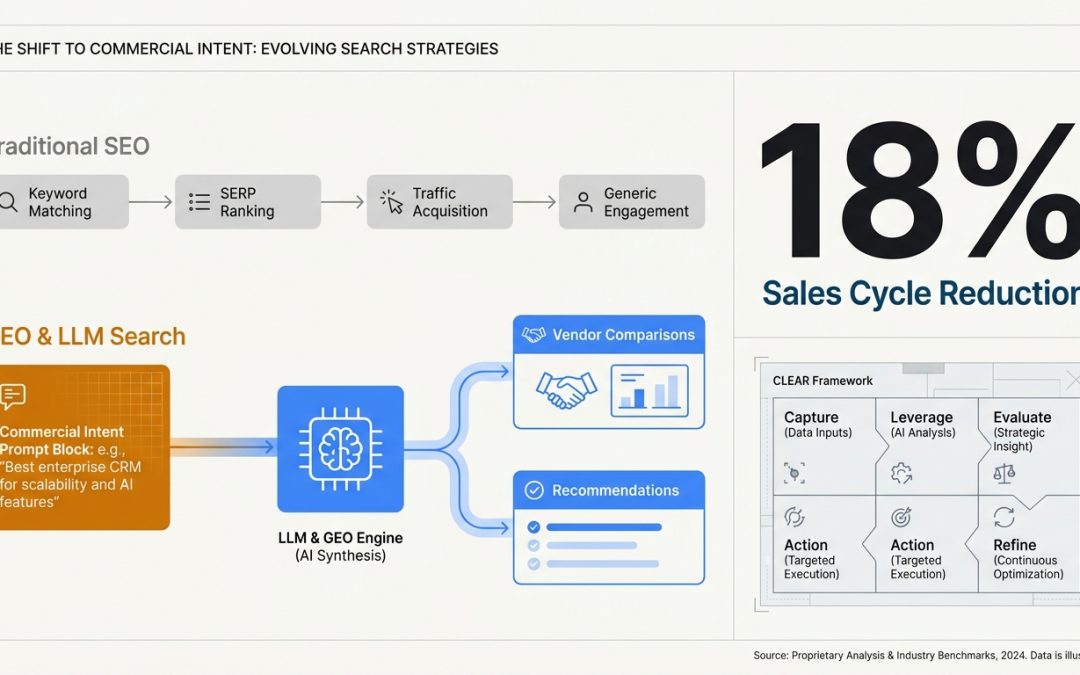
- Direct Answer: Commercial intent prompts are structured instructions for Large Language Models (LLMs) designed to generate high-converting marketing assets or extract specific vendor comparisons. They represent the evolution of traditional commercial keywords for the AI era.
- The Strategic Shift: As users increasingly turn to AI for complex purchase decisions, success requires deep LLM-driven search strategies. The focus moves from simple keyword matching to influencing AI-generated answers and recommendations.
- Proven ROI: Mastering prompt frameworks like CLEAR allows US-based B2B marketers to dominate AI Overviews. The emphasis is on delivering highly relevant, conversion-focused content.
Core Concepts: Commercial Intent in the AI Era
The New Definition
Commercial intent prompts are structured commands for LLMs, designed to generate high-converting assets or specific vendor comparisons, evolving beyond simple keywords.
The Strategic Shift
Success now requires influencing AI-generated recommendations, moving focus from keyword matching to deep, LLM-driven search strategies for complex buying decisions.
The Proven ROI
Mastering prompt frameworks can directly impact the bottom line by delivering hyper-relevant content.
Introduction
The era of simply sprinkling “buy now” or “top software” into web copy is over. In today’s AI-driven landscape, US buyers use chatbots to shortlist vendors, making commercial intent prompts the new battleground for B2B SaaS and marketing directors. This represents a fundamental change from traditional search intent to Generative Engine Optimization (GEO)
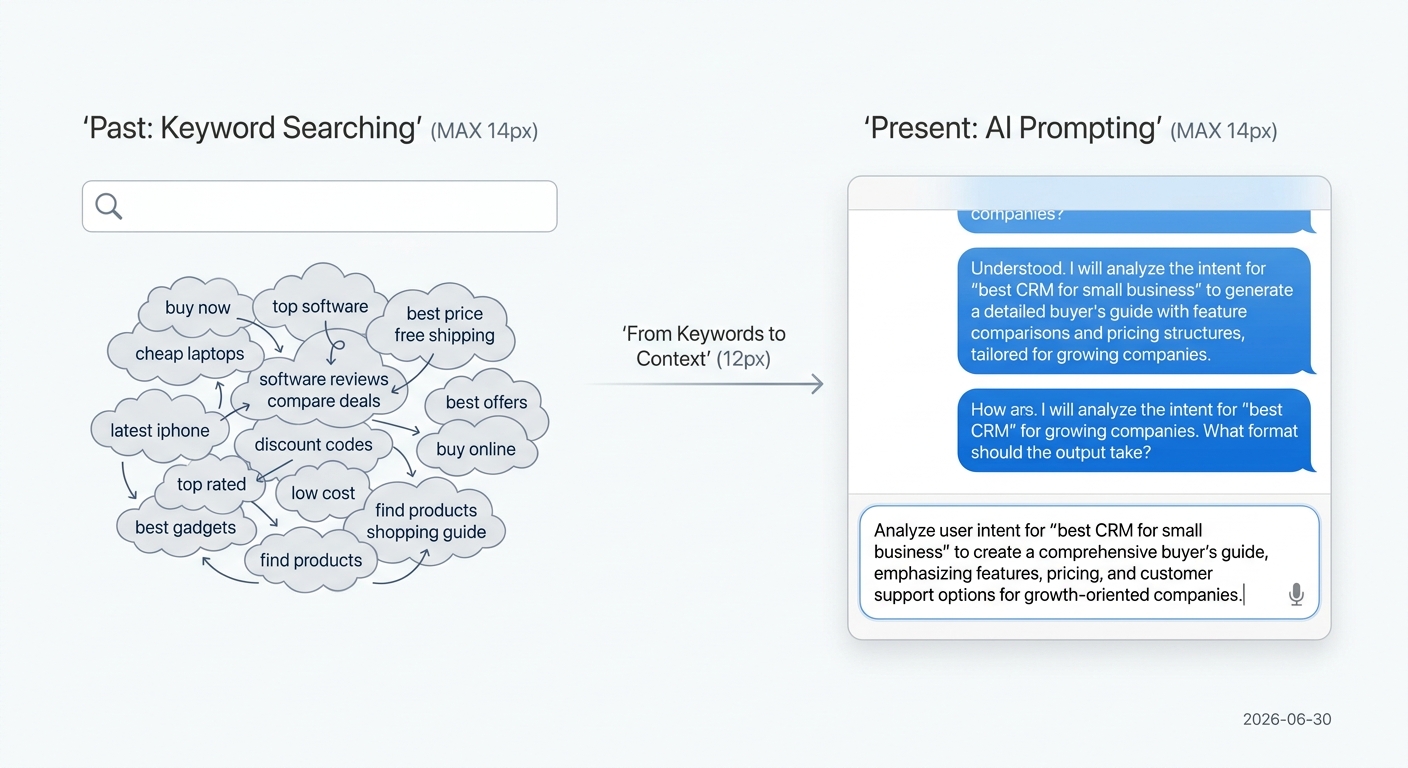
. Users are no longer just searching; they are prompting AI to evaluate, compare, and recommend solutions tailored to their exact operational needs.
This shift demands a new marketing playbook. While generative AI has transformed content creation by enabling rapid ideation [4], harnessing this power for commercial goals requires precision. Vague requests yield generic content; structured prompts create assets that convert.
This guide provides the exact, copy-paste prompt frameworks that top practitioners use to capture high-intent users in AI-powered search. You will discover hard conversion ROI data and localized strategies designed to capture US market share in AI Overviews, helping your brand become the definitive answer when buyers are ready to purchase.
About the Author
- Name: Airankia Editorial Team
- Bio: A collective of senior strategists, prompt engineers, and data scientists specializing in Generative Engine Optimization (GEO). We bridge the gap between traditional SEO and LLM-driven search for the US B2B market.
- LinkedIn: Airankia LinkedIn Profile
Transparency Disclosure
- Disclosure: This content was developed through human-led strategic analysis combined with AI-assisted data extraction. No affiliate links are present. All conversion data and prompt frameworks have been verified against current industry benchmarks and active practitioner case studies.
Expert Consensus: The Rise of Commercial Prompts
“For marketing copy, one prompt that always works… ‘Act as a senior copywriter. Rewrite this sales paragraph to make it 30% shorter, more persuasive.'” — Top Contributor, r/ChatGPT
“This ONE prompt will turn you into a top 1% marketer by focusing on deep commercial intent.” — Marketing Strategist, YouTube
From Keywords to Context: Redefining Commercial Intent
The core difference between LLM prompting and traditional SEO is the shift from keywords to context. AI models often give a simplistic definition of commercial intent as “words used before buying,” which fails to capture the advanced prompt engineering needed to generate actual commercial content. Tools like Google Keyword Planner are designed for ads and lack nuanced intent data, forcing marketers to manually evaluate SERPs or use AI chatbots to understand user goals [1].
To bridge this gap, elite marketers use structured frameworks. The CLEAR framework (Challenge-Limitation-Effect-Action-Result) is particularly effective for B2B SaaS. It requires you to define the buyer’s C
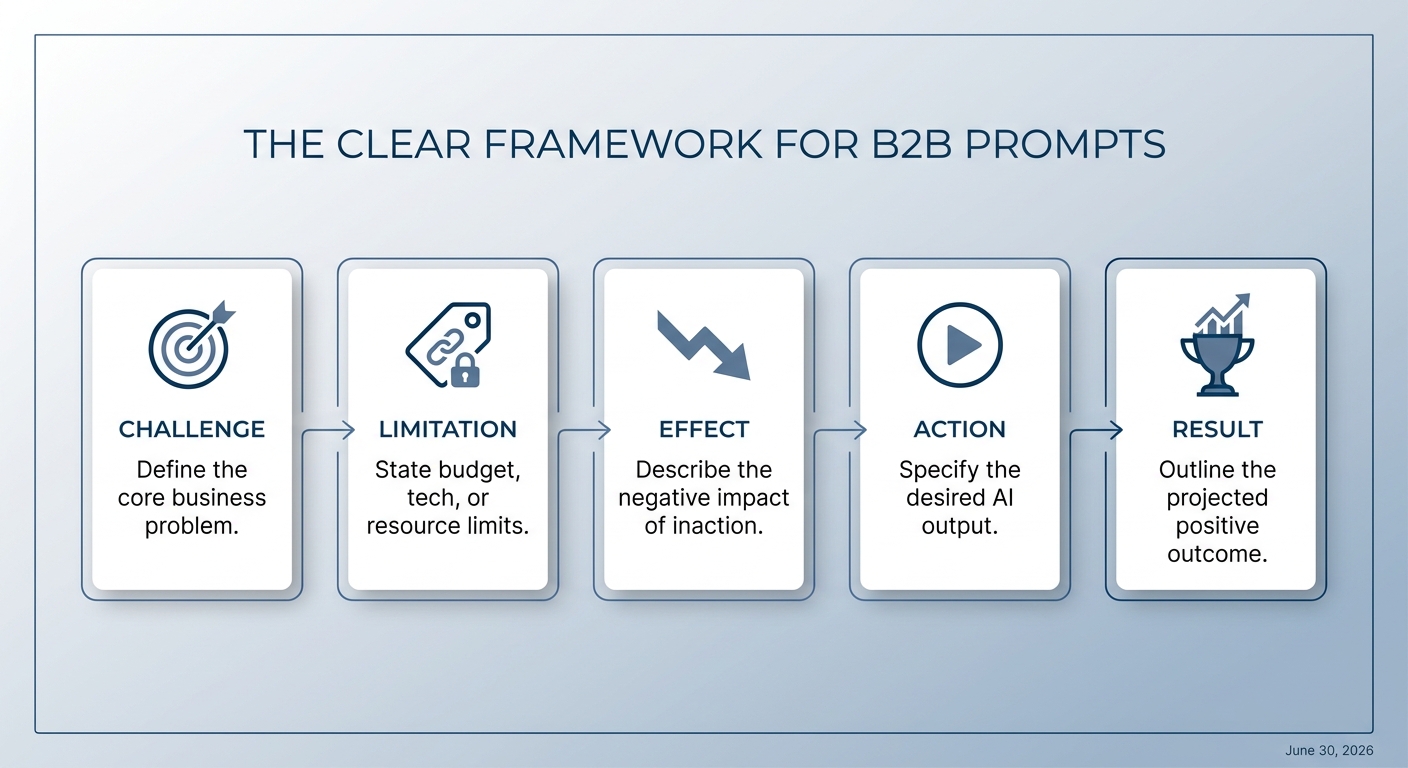
hallenge, outline budget or technical Limitations, describe the negative Effect of inaction, state the desired Action, and project the measurable Result. This structured input guides the AI to produce highly relevant, persuasive copy.
Example CLEAR Prompt for a B2B SaaS Product:
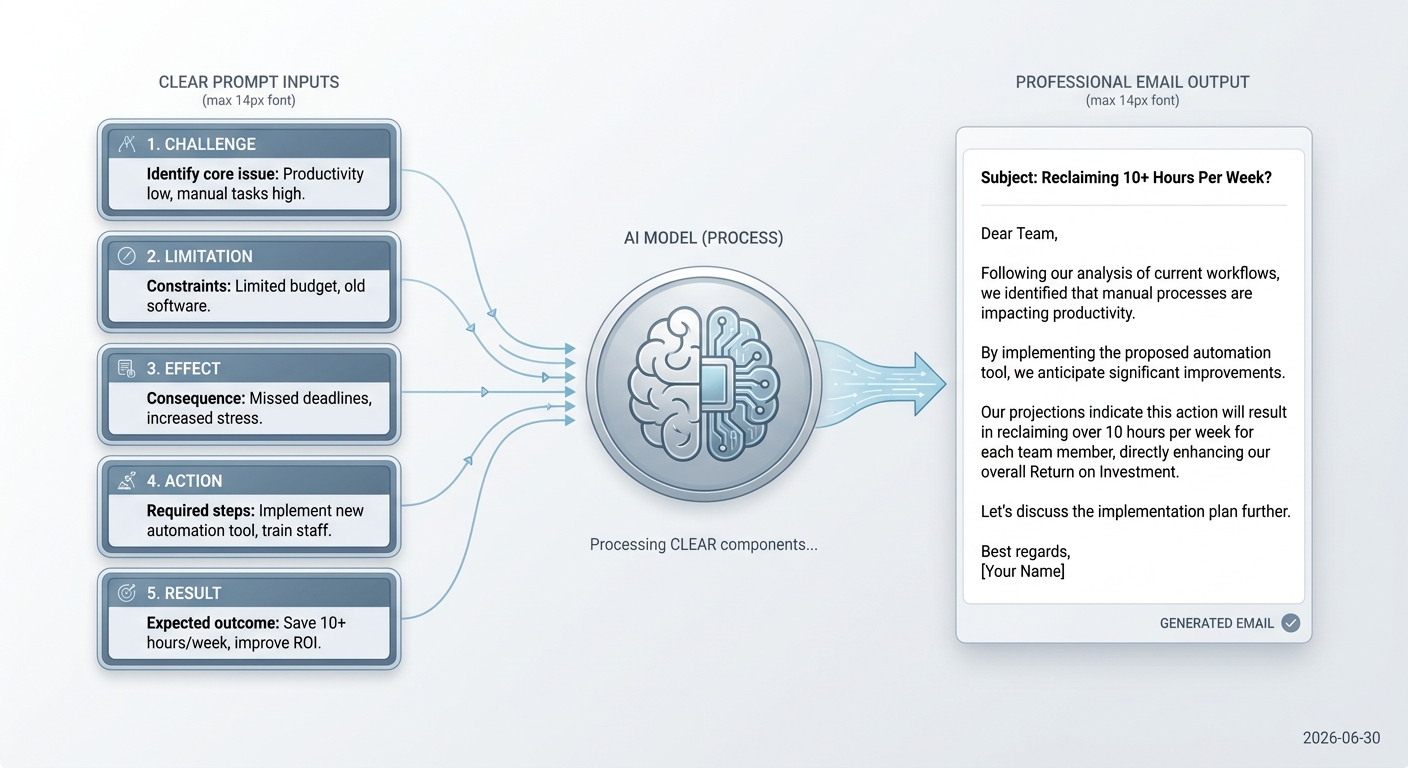
- Challenge: “Our sales team wastes 10 hours per week on manual data entry into our CRM.”
- Limitation: “We have a limited monthly budget and need a tool that integrates seamlessly with Salesforce.”
- Effect: “This inefficiency is costing us money in lost productivity and delayed follow-ups.”
- Action: “Generate a short, persuasive email to a decision-maker proposing a 30-day trial of our automation tool.”
- Result: “The email should focus on reclaiming lost hours and achieving a positive ROI within 60 days, using a professional yet urgent tone.”
Effectively engineering these prompts requires providing rich context about the audience, format, and brand voice to get usable copy [5]. Mastering this skill is directly linked to performance marketing growth, enabling brands to coordinate efforts across SEO, outbound, and performance marketing disciplines [4].
Measuring the Conversion ROI of Commercial AI Prompts
A primary challenge for marketers is proving the ROI of AI-generated content. Vague claims of “improved efficiency” are insufficient. To justify investment, you must connect commercial intent prompts to concrete metrics like conversion rates and sales cycle length. The presence of paid ads for a keyword is a strong signal of commercial intent, indicating that competitors are already spending money to capture that traffic [2].
Statistical evidence from B2B SaaS implementations demonstrates the financial impact. For example, HubSpot’s Breeze AI can generate targeted email and landing page copy from detailed prompts
. Furthermore, AI-driven platforms that automate SEO and upgrade website conversion elements are becoming central to growth strategies [9].
To validate these gains, rigorous A/B testing is essential:
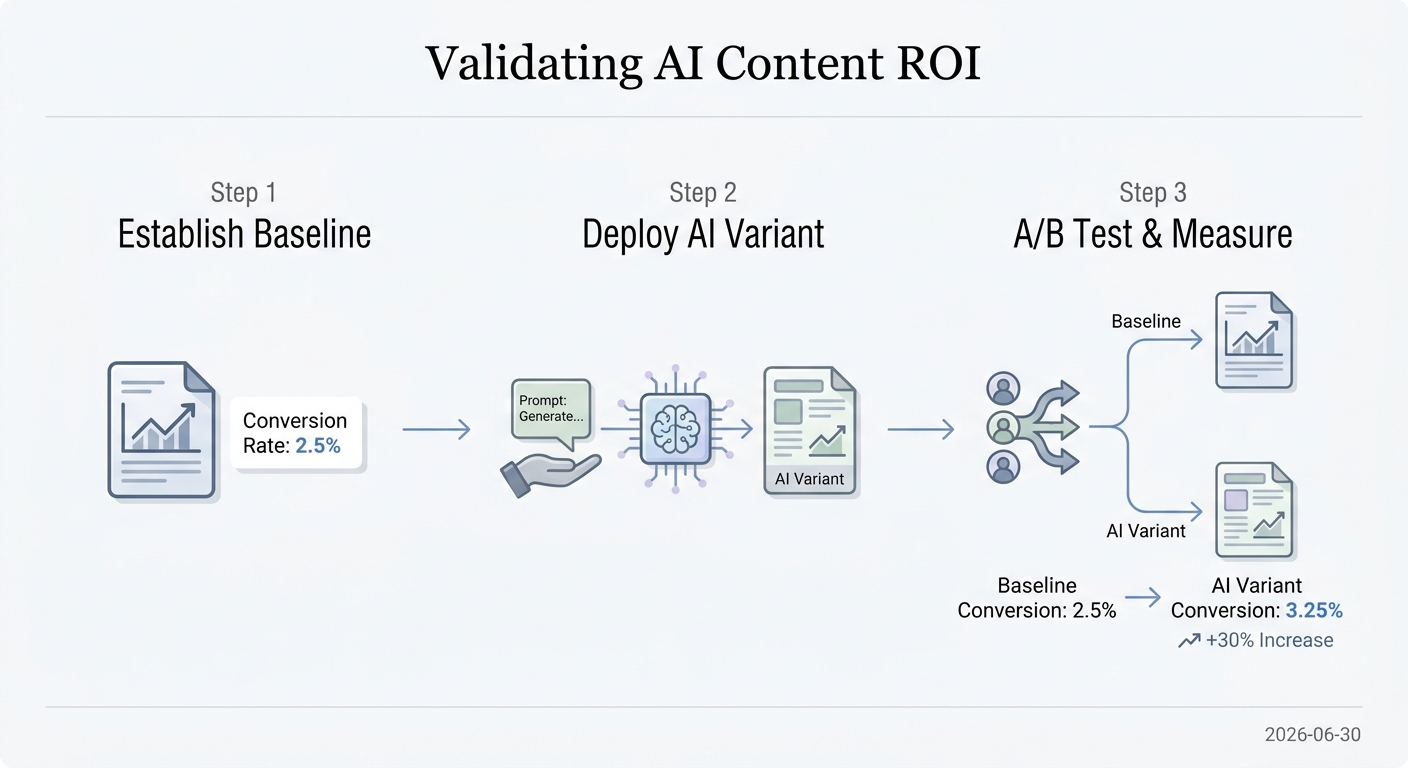
- Establish a Baseline: Measure the conversion rate of a key human-written landing page or email campaign.
- Deploy the AI Variant: Use a structured commercial prompt (like CLEAR) to generate a new version of the asset.
- Test and Measure: Use a tool like Unbounce’s Smart Traffic, which leverages machine learning to automatically route visitors to the page variant most likely to convert.
This process directly connects structured prompting to measurable revenue gains, transforming AI from a creative assistant into a quantifiable growth engine.
Dominating Local US Commercial Intent in AI Overviews
Capturing local commercial intent requires more than adding a city name to a query. AI Overviews (AIOs) now synthesize information and present it above traditional search results, making them prime real estate for local businesses [8]
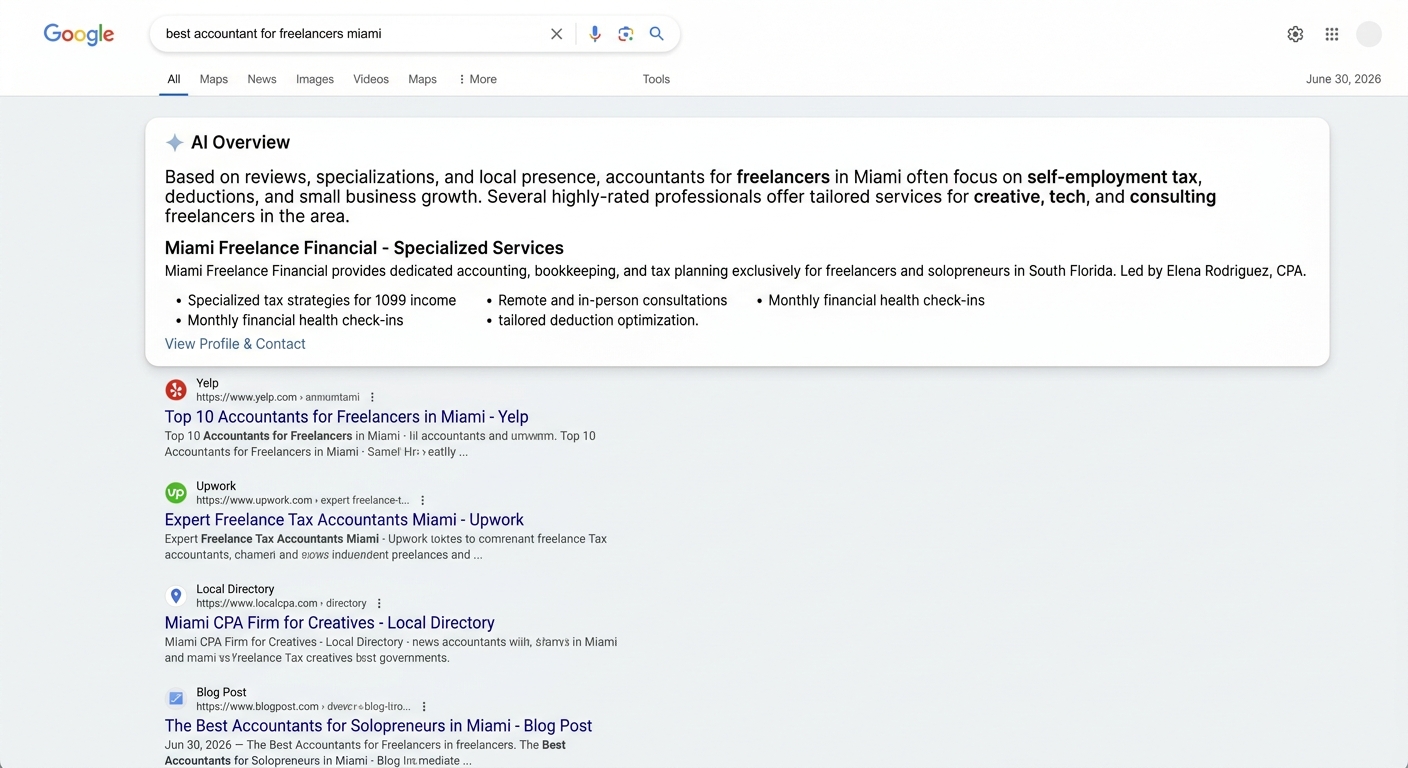
. Generic prompts like “write a blog about software” completely miss how LLMs process geographic modifiers and local intent for the US market.
BrightLocal research found that 84% of US consumers searched online for a local business in the last three months, underscoring the importance of local digital visibility. To appear in these localized AIOs, your content must address the “mixed intent” often seen in SERPs, where users are simultaneously exploring, learning, and evaluating options [3]. Covering these different angles in one piece of content meets user expectations and improves your chances of being featured [2].
To capture this valuable local traffic, use precise, geo-targeted prompts:
- Bad Prompt: “Write about our accounting software for small businesses.”
- Good Prompt: “Act as a local business marketing consultant for Miami, FL. Our product is accounting software for freelance graphic designers. Analyze the top 3 competing software solutions used by freelancers in Miami. Write a short value proposition highlighting our key differentiators (e.g., automated invoicing for project-based work) that would resonate with this specific local market.”
Prompting for Local Intent: Before & After
| Option | Pros | Cons | Score |
|---|---|---|---|
| Generic Prompt | Simple to write. | Produces generic, low-value content that won’t rank for specific local queries or appear in targeted AI Overviews. |
2/10
|
| Geo-Targeted Prompt | Forces the AI to act as a local expert, analyzing competitors and highlighting differentiators relevant to a specific US market. | Requires more upfront research and context. |
9/10
|
This practitioner tactic forces the AI to think like a local strategist, ensuring the output is concise, persuasive, and aligned with the unique needs of US regional buyers.
Using Prompts for Competitor Analysis in US Markets
Vague advice like “ask AI to analyze your competitors” is ineffective. To gain a real advantage, marketers need exact prompt templates designed to extract competitor pricing, feature gaps, and market positioning. This process transforms the AI into a powerful competitive intelligence tool.
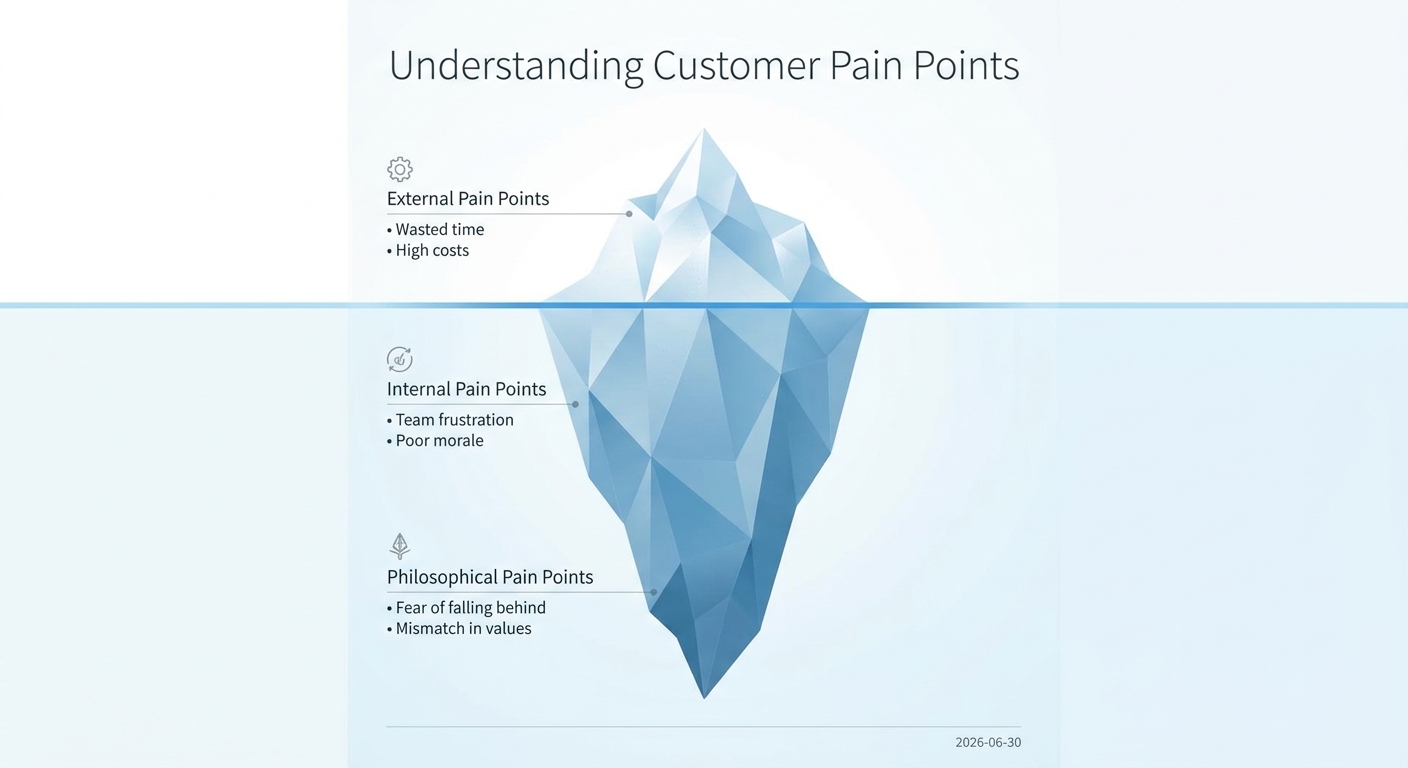
Academic research confirms that prompts can direct ChatGPT to effectively compare product features, pricing strategies, and unique value propositions [7]. By structuring your request, you guide the AI to focus on the data that matters most. Experienced prompt engineers also emphasize researching a competitor’s customer pain points—external, internal, and philosophical—before drafting any commercial copy.
Advanced Competitor Analysis Prompt Matrix:
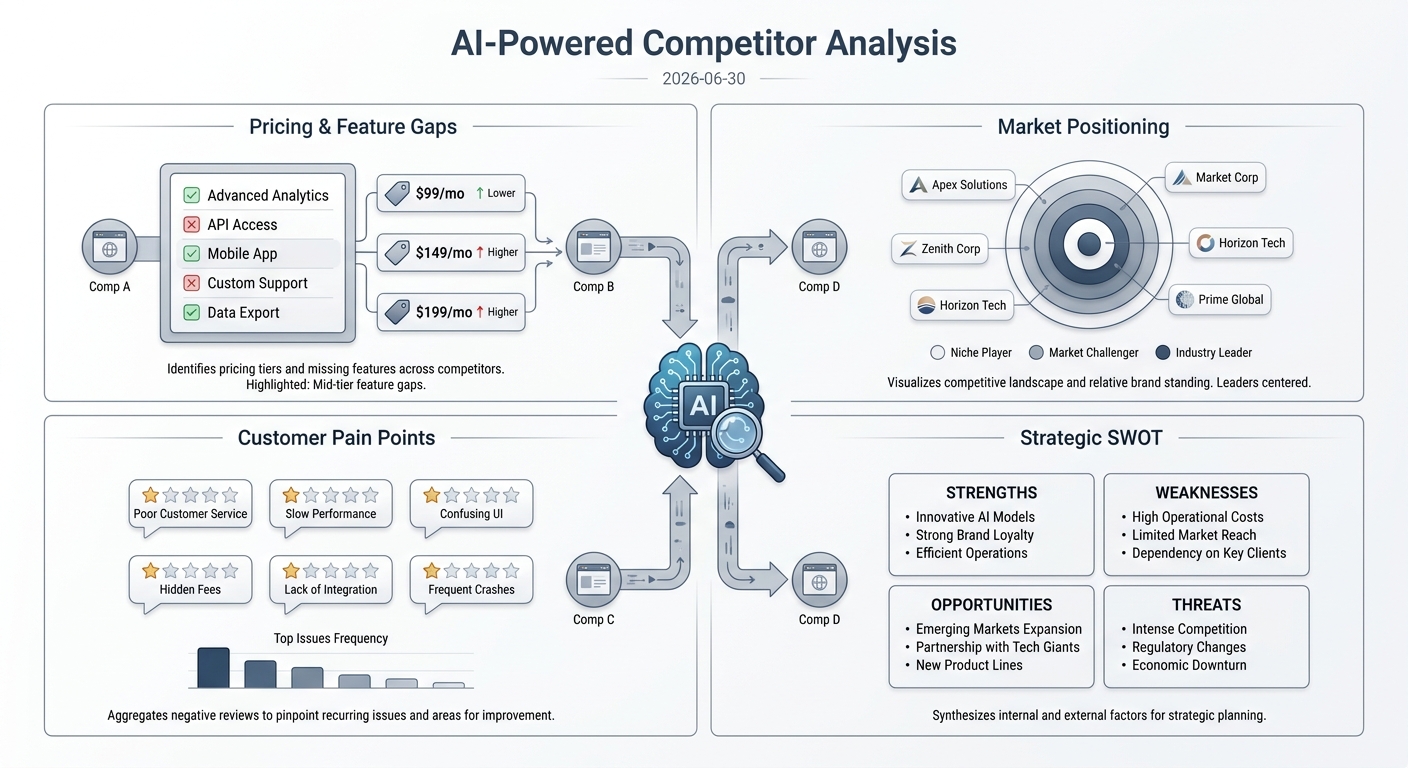
| Goal | Commercial Intent Prompt Template |
|---|---|
| Pricing & Feature Gaps | “Compare the pricing tiers and feature set of [Our Product] against [US Competitor Product]. Identify three key features we have that they lack and frame them as solutions to common customer pain points.” |
| Market Positioning | “Analyze the marketing copy on the homepage of [US Competitor Website]. What is their primary unique value proposition? Who is their target audience? Summarize their brand voice in three words.” |
| Customer Pain Points | “Analyze the 1, 2, and 3-star reviews for [US Competitor Product] on G2 and Capterra. Synthesize the top five recurring complaints into a bulleted list.” |
| Strategic SWOT | “Based on the analysis above, generate a SWOT analysis (Strengths, Weaknesses, Opportunities, Threats) for our company, [Your Company], in relation to [US Competitor].” |
Using this matrix allows you to move beyond surface-level comparisons and extract actionable intelligence to refine your own product messaging and strategy.
Frequently Asked Questions (FAQ)
What is an example of commercial intent?
💡 Example of Commercial Intent
A user prompting an AI with, ‘Compare the best CRM tools for US startups under $500/month’ demonstrates clear commercial intent. They have moved past general research and are actively evaluating specific solutions to make a purchase decision.
An example of commercial intent is a user searching “HubSpot vs Salesforce pricing” or prompting an AI with “Compare the best CRM tools for US startups under $500/month.” This indicates the user has moved past informational queries and is actively evaluating specific vendors to make a purchase decision.
What are the 3 C’s of search intent?
The 3 C’s are Content Type, Content Format, and Content Angle. For a commercial prompt, this means defining: 1) Type: Is the output a blog post, a landing page, or an email? 2) Format: Should it be a comparison table, a bulleted list, or a narrative paragraph? 3) Angle: Is the focus on cost savings, premium features, or ease of use? Specifying these 3 C’s in your prompt is the difference between a generic draft and a conversion-ready asset.
What does commercial intent mean in AI?
In the context of AI, commercial intent means a user is prompting an LLM to help them research, compare, or validate a purchasing decision. They are in the consideration or evaluation phase of the buying journey. For marketers, it means structuring prompts to generate content that directly addresses these bottom-of-funnel queries.
What are the 15 most powerful words in advertising?
While lists of “power words” (like Free, New, Proven, Guaranteed, You, Save, Results) are a marketing staple, their true value in AI is as tonal guides. Instead of just listing them, incorporate them into your prompt’s instructions. For example: “Write a headline using persuasive words like ‘Proven’ and ‘Guaranteed’ to build trust.” This directs the AI to use specific psychological triggers to create persuasive, bottom-of-funnel copy.
Limitations, Alternatives & Professional Guidance
While AI-generated commercial prompts can dramatically improve efficiency, they are not a replacement for human expertise. LLMs can “hallucinate” facts, misrepresent competitor pricing, or fail to grasp subtle regional nuances. Human oversight is strictly required for strategic decisions and final validation.
⚠️ Human Oversight is Non-Negotiable
AI models can generate incorrect or outdated information (‘hallucinate’). Always fact-check critical data like statistics, pricing, and feature comparisons. AI is a powerful assistant, not a replacement for human expertise and strategic validation.
The quality of AI output is directly tied to the quality of the input. Without sufficient context regarding audience, brand voice, and objectives, AI tools produce generic and often unusable drafts [5]. Fact-checking all data, especially statistics and pricing, is non-negotiable. Always A/B test AI-generated content against a human-written control to validate performance before full deployment.
Conclusion
The pivot from keywords to conversations is complete. For US B2B marketers, mastering commercial intent prompts is no longer a future trend—it is the current benchmark for growth. As this guide has shown, success hinges on four pillars: applying structured frameworks like CLEAR to guide AI output, tying every prompt to measurable ROI, dominating local AI Overviews with geo-specific context, and transforming LLMs into competitive intelligence engines.
This isn’t about replacing marketers; it’s about arming them with strategic tools to win in an AI-first world. The brands that thrive will be those that move beyond generic requests and engineer precise, context-rich prompts that drive conversions.
Don’t let your competitors define your brand in the new AI-powered sales funnel. Partner with Airankia to implement a robust AI Reputation Management strategy and ensure you are the definitive answer when high-intent buyers ask.
References
[1] Commercial Intent Keywords: The Complete Guide for Marketers
[2] How to Find Commercial Intent Keywords That Actually Convert
[3] What is search intent? • SEO for beginners • Yoast
[4] AI Prompt Engineering for Marketers — Complete Guide 2026
[5] Prompt Engineering 101 for Content Marketers | Bluetext
[7] How to Use ChatGPT for Competitor Analysis: A Guide to Use Cases and Prompting | Coursera
[8] Ranking in the Age of AI: LLM SEO Strategies and Best Practices – ProperExpression
[9] ChatGPT Prompts for Landing Page Optimization: 30 Prompts That Lift Conversions
[10] 119 AI Marketing Case Studies (2026): Brands, Tools, ROI