Key Takeaways
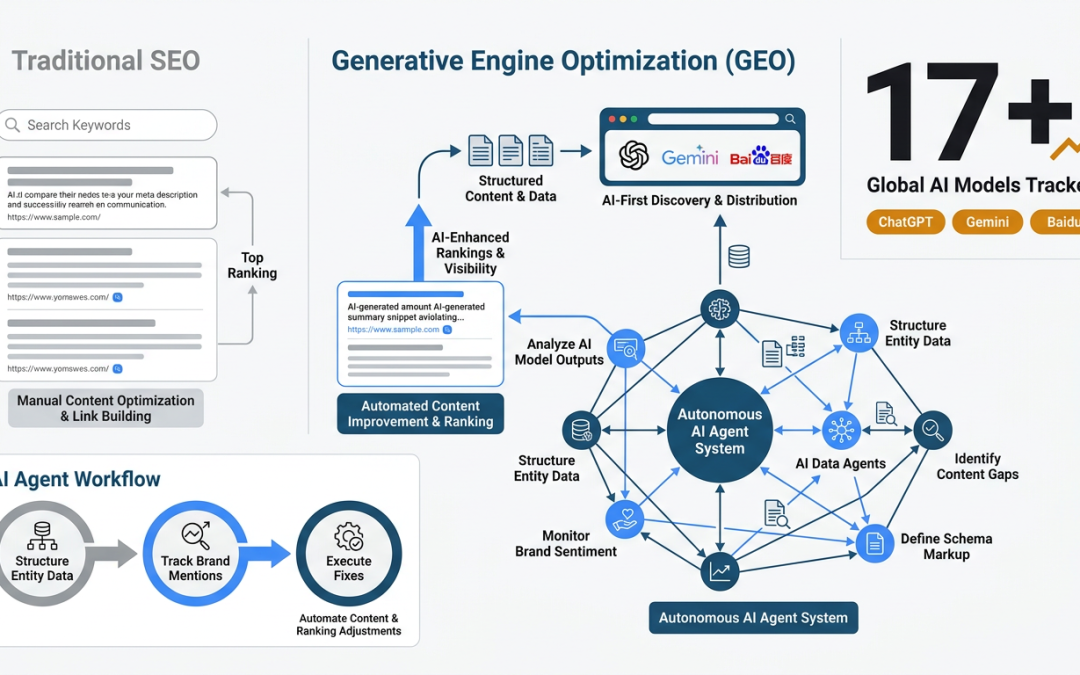
AI SEO platforms automate website content and improve rankings by shifting focus from traditional keyword tracking to Generative Engine Optimization (GEO). For B2B SaaS companies, these platforms use autonomous AI agents to execute prioritized action plans, moving beyond static dashboards. By tracking brand citations across 17+ global models—including ChatGPT, Gemini, and Baidu—enterprises can secure visibility in AI-generated answers, increase relevant organic traffic, and lower their overall cost-to-serve.
The End of Traditional SEO as We Know It
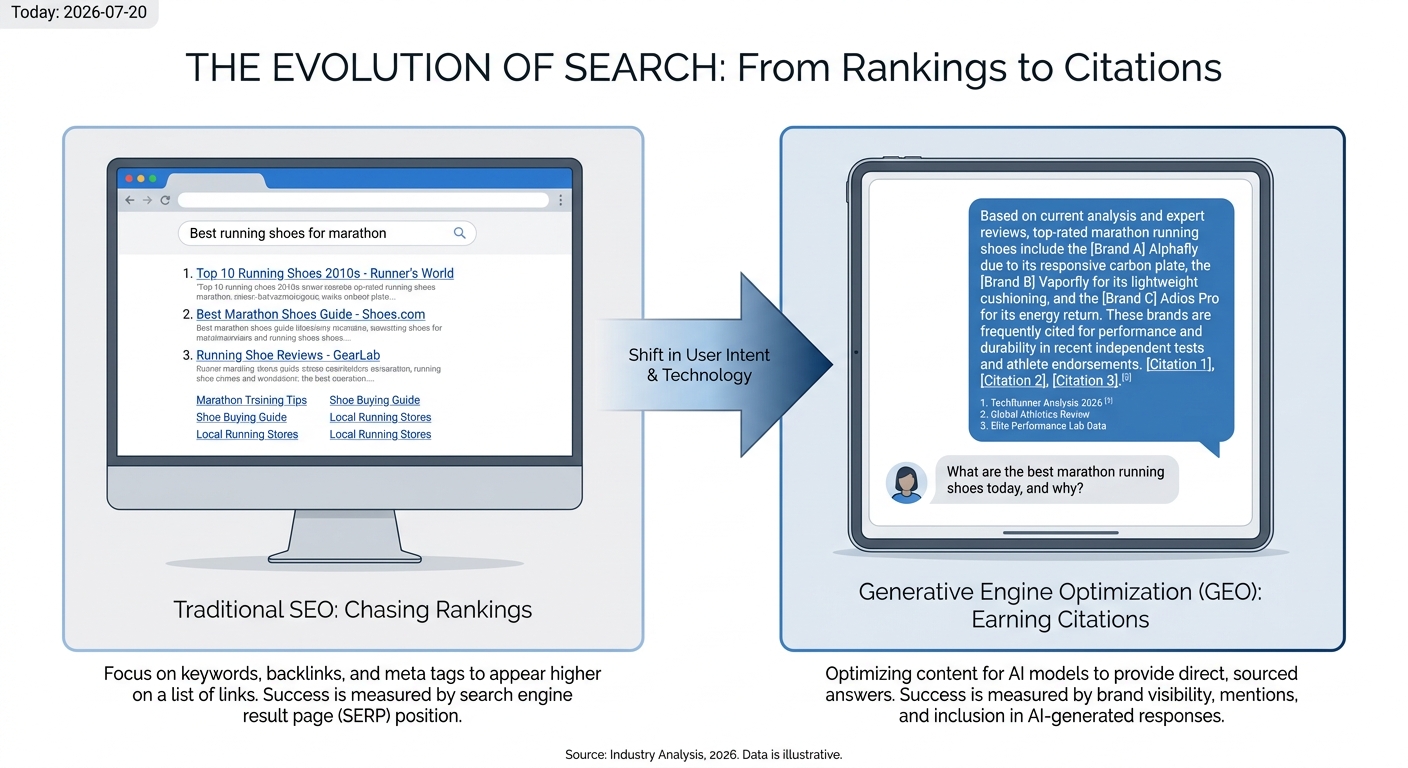
The digital marketing landscape is undergoing its most significant transformation in a decade. Search is rapidly evolving from a list of blue links on a results page (SERP) to a dynamic conversation with an AI answer engine. For marketing directors and SEO specialists, the decline in traditional search traffic is no longer a future threat; it’s a present reality. The core challenge is clear: how do you maintain and grow visibility when your audience gets answers directly from AI?
The solution lies in a new discipline: Generative Engine Optimization (GEO). This practice moves beyond keywords and backlinks to focus on structuring your website’s data so that AI models trust, cite, and recommend your brand in their answers. This requires a new class of tools.
Modern AI SEO platforms are not just writing assistants or rank trackers. They are autonomous systems that automate website content strategy, technical optimization, and performance monitoring. By deploying intelligent software agents, these platforms structure entity data, track brand mentions across a fragmented ecosystem of AI models, and execute technical fixes without requiring manual intervention for every task. For B2B SaaS companies in competitive global markets, this level of automation is the key to achieving scale, securing multi-model visibility, and tying SEO efforts directly to revenue growth.
💡 About the Author & Methodology
This guide is authored by Pedro Spota, Director of Growth at ELOGIA, who actively orchestrates over 200 production AI agents for marketing, sales, and GEO. The insights are based on firsthand experience, peer-reviewed research, and verified industry data.
About the Author & Our Methodology
Pedro Spota is the Director of Growth at ELOGIA and Co-Founder of AI Rankia. With over six years of experience building data-driven growth systems, he orchestrates more than 200 production AI agents focused on marketing, sales, and SEO. He leverages advanced frameworks like n8n to optimize conversion lift and lower cost-to-serve for enterprise clients. As he notes, “I’m orchestrating 200+ production AI agents focused on marketing, sales, GEO, Sem, most workflows integrated via n8n and most advanced agentic frameworks.”
This guide is authored by industry practitioners actively deploying these systems at scale. It incorporates peer-reviewed academic research on GEO, verified industry data, and firsthand intelligence from SEO directors. All statistics and claims are tied to cited, verifiable sources.
Challenge 1: Overcoming Invisibility Across 17+ Global AI Models
The first and most critical challenge is the fragmentation of the AI landscape. Relying solely on Google for visibility is a failing strategy. Your audience is now getting information from ChatGPT, Perplexity, Gemini, Claude, and region-specific models like China’s Baidu ERNIE Bot. Manually tracking your brand’s presence across these platforms is impossible.
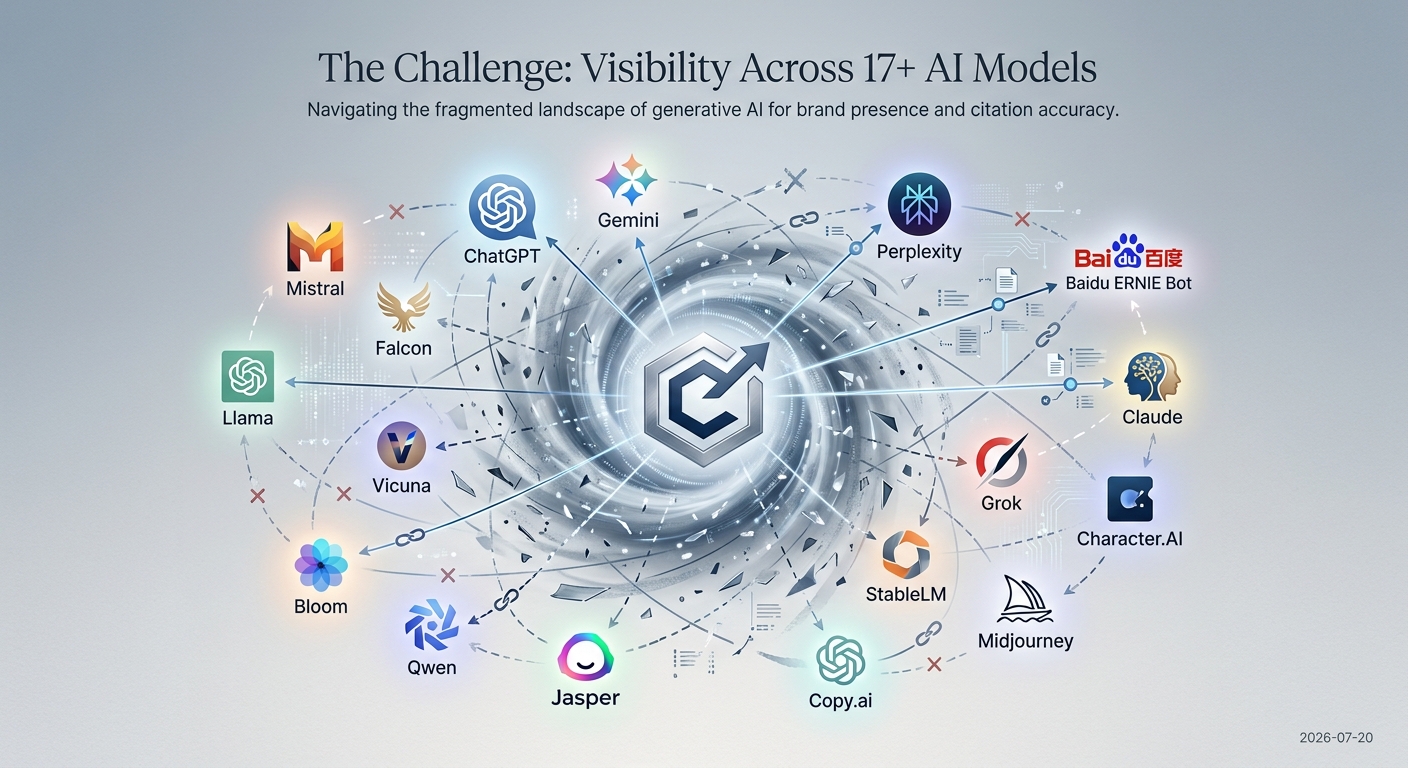
This is where AI SEO platforms provide their first major advantage: multi-model citation tracking. The academic field of Generative Engine Optimization (GEO) is defined as the effort to “increase content’s presence, likelihood of citation, or influence in answers produced by generative engines” [1]. Citation is the new ranking. It is a direct measure of an AI model’s trust in your brand as an authoritative source.
✅ Citation is the New Ranking
In Generative Engine Optimization (GEO), the primary goal is to be cited by AI models. A citation is a direct signal of trust and authority, more valuable than a traditional SERP ranking because it integrates your brand directly into the user’s answer.
To earn these citations, your content must be structured with pristine entity clarity and factual accuracy. This involves:
- Consistent Entity Naming: Using the same name for your company, products, and key personnel across your entire digital footprint.
- Robust Internal Knowledge Graph: Building a network of internal links that logically connects related concepts and establishes topical authority.
- Advanced Schema Markup: Using Schema.org vocabulary to explicitly tell AI models who you are, what you do, and what topics you are an expert on.
How to Build Trust with AI Models
Consistent Entity Naming
Use the exact same name for your company, products, and people across your entire digital presence.
Robust Internal Knowledge Graph
Build a network of internal links that logically connects concepts and establishes your topical authority.
Advanced Schema Markup
Use Schema.org vocabulary to explicitly tell AI models what you do and what you are an expert on.
Practitioners on technical forums frequently voice frustration over this fragmented landscape, with one user asking, “How are you guys tracking Baidu… The fragmented LLM landscape makes manual checking impossible.” While 72% of SEOs report that AI-generated content can rank competitively in traditional search [2], earning a citation in an AI answer requires a deeper level of trust. This trust is built through high-quality, well-structured, and consistently monitored content across all relevant models [3].
Challenge 2: Moving from Passive Dashboards to Automated Action
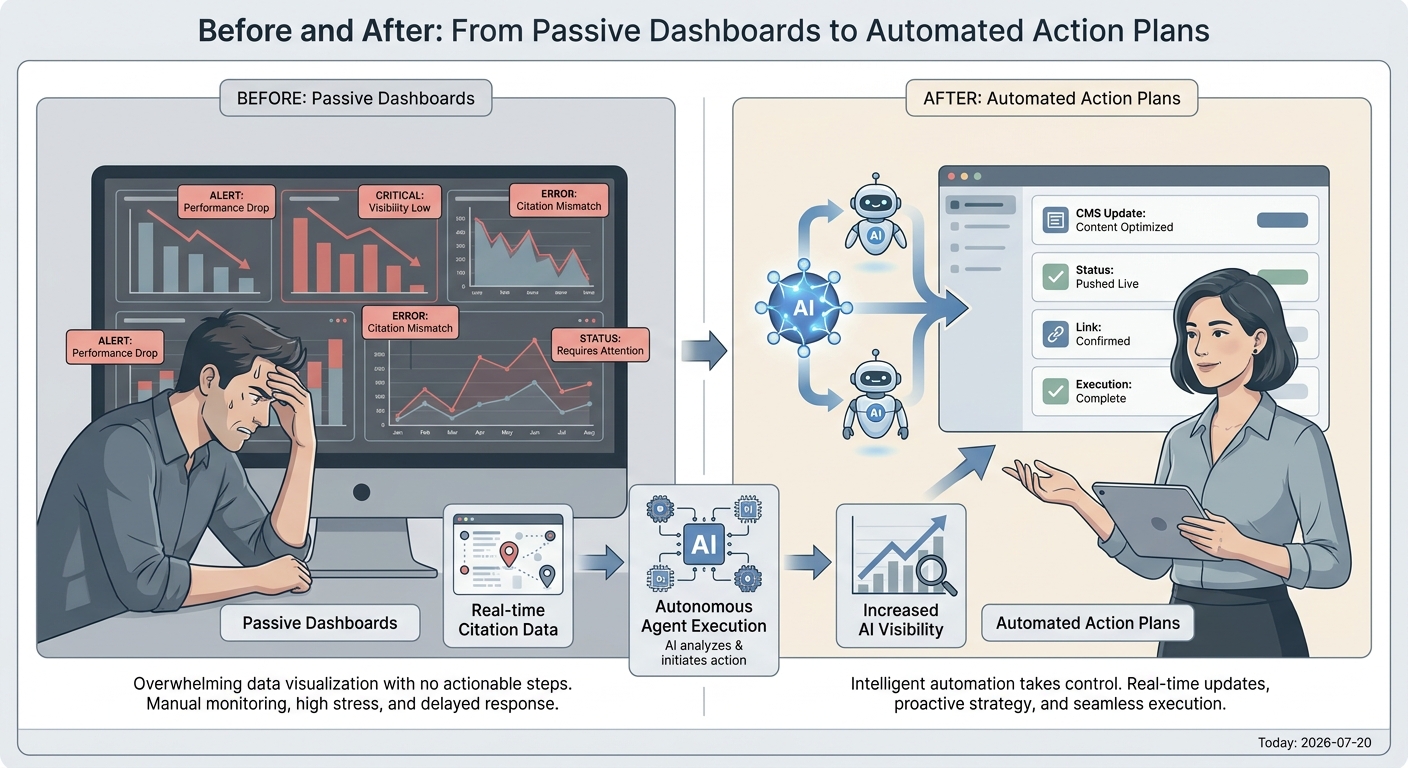
Most tools marketed as “AI SEO” platforms are little more than static dashboards. They show you historical keyword data and may even report on your visibility in Google’s AI Overviews, but they stop there. They tell you what happened, not what to do next. This passivity is a critical failure point.
True AI SEO platforms replace static monitoring with prioritized action plans executed by autonomous agents. This approach transforms SEO from a reactive, manual process into a proactive, automated growth engine.
| Feature | Data Handling | Execution | Business Outcome |
|---|---|---|---|
| Static Dashboards | Aggregates historical keyword data. | Requires manual interpretation and task creation. | Delayed implementation; stagnant visibility. |
| Prioritized Action Plans | Ingests real-time LLM citation data. | Autonomous agents push fixes directly to the CMS. | Faster time-to-value; increased AI visibility. |
Consider this workflow: an advanced platform detects a drop in your brand’s citations for a key feature within Perplexity’s answers. An AI agent is automatically triggered. It analyzes the top-cited competitors, identifies that your corresponding page is missing a crucial FAQ section, generates the necessary schema-enhanced content, and pushes the update directly to your CMS via an API call. This entire process is completed before a human analyst even opens a report.
This shift from manual analysis to automated execution drives massive efficiency gains. A Digitate and Sapio Research survey found that 60% of organizations report significant time savings from AI and automation
. The results are tangible and directly impact the bottom line. Another case study reported that applying schema markup, content restructuring and E-E-A-T signals increased appearances in AI Overviews from zero to 47 [4]
.
Challenge 3: Scaling Content Operations with Autonomous AI Agents
For a B2B SaaS enterprise, the real competitive advantage of AI in SEO isn’t using it as a simple writing assistant. It’s deploying a fleet of specialized AI agents—sometimes over 200—to automate the entire content and technical optimization pipeline. This requires deep expertise in orchestrating agentic frameworks and workflow automation platforms like n8n, a capability that distinguishes true AI SEO platforms from basic text generators [5]
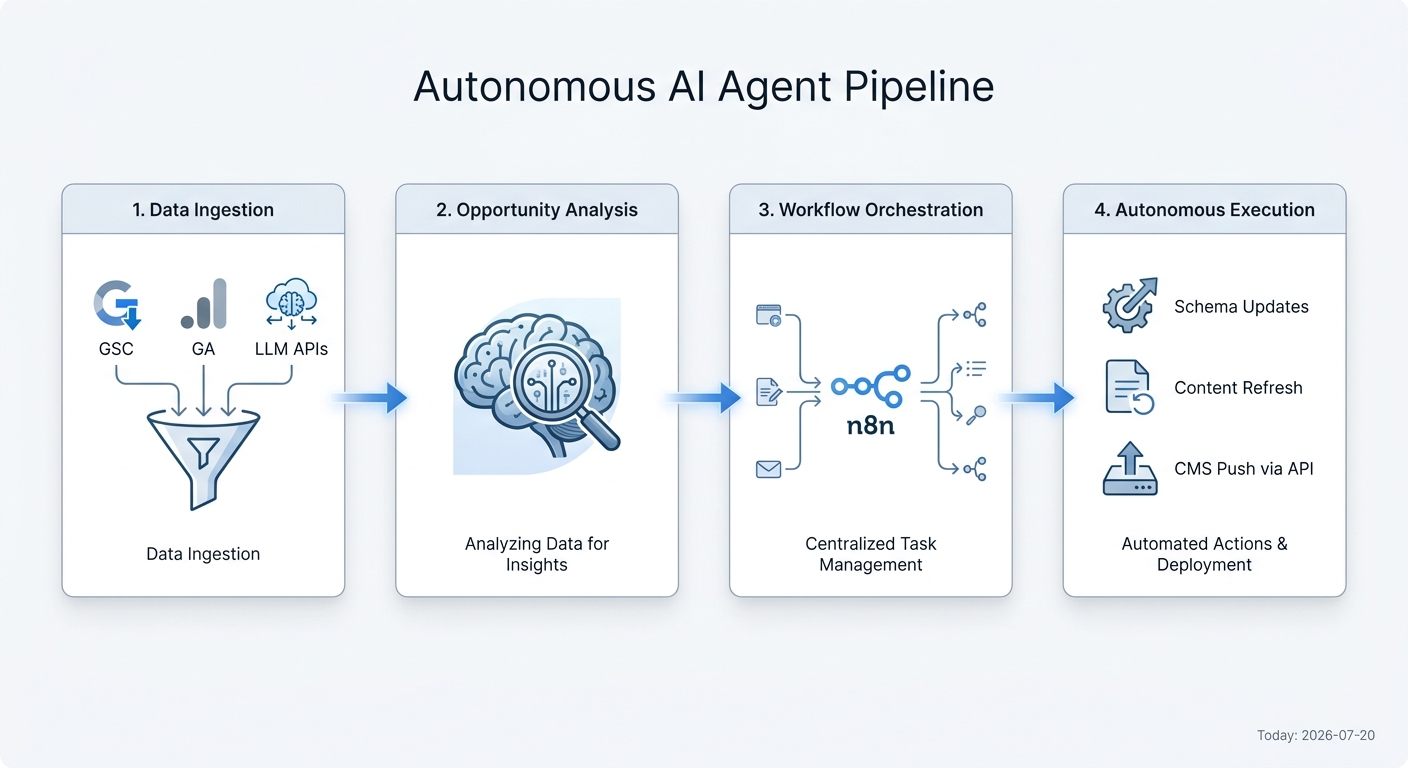
These autonomous agents operate across the full spectrum of SEO tasks:
- Data Ingestion & Opportunity Analysis: Agents connect directly to Google Search Console, analytics platforms, and LLM APIs. They continuously ingest real-time performance data, log query responses, and analyze competitor citation patterns to pinpoint optimization opportunities with the highest potential ROI.
- Workflow Orchestration & Content Generation: Using platforms like n8n or Make, you can design custom, automated workflows. An agent can be tasked to create programmatic SEO pages for long-tail service queries, conduct automated internal linking audits using semantic analysis to suggest and implement optimal link placements [9], or generate schema-enhanced content for new features.
- Autonomous Execution & Optimization: Agents are empowered to act on their findings. This includes pushing schema markup updates via CMS APIs, automatically refreshing underperforming content with new data, or drafting and configuring A/B tests of page titles and flagging broken links, with a human reviewing and approving the changes before they go live.
By integrating these workflows, AI SEO platforms automate website content and improve rankings systematically. This transforms SEO from a series of manual, disconnected tasks into a scalable, self-optimizing system that directly supports business growth.
Challenge 4: Winning Localized AI Answers in Competitive Markets
Generic AI advice for local SEO often stops at optimizing a Google Business Profile. For enterprises targeting specific U.S. markets or other key regions, this is dangerously insufficient. Dominating local AI search queries requires a sophisticated GEO strategy that understands how LLMs process localized entity data differently than traditional search algorithms.
While traditional local SEO emphasizes backlinks and keyword density, effective local GEO prioritizes structuring content in a clear, conversational, and interconnected way [6]. LLMs build understanding by connecting entities (people, places, organizations, events) and their factual relationships. To signal strong local relevance, a business must create a rich tapestry of content that explicitly details its local presence.
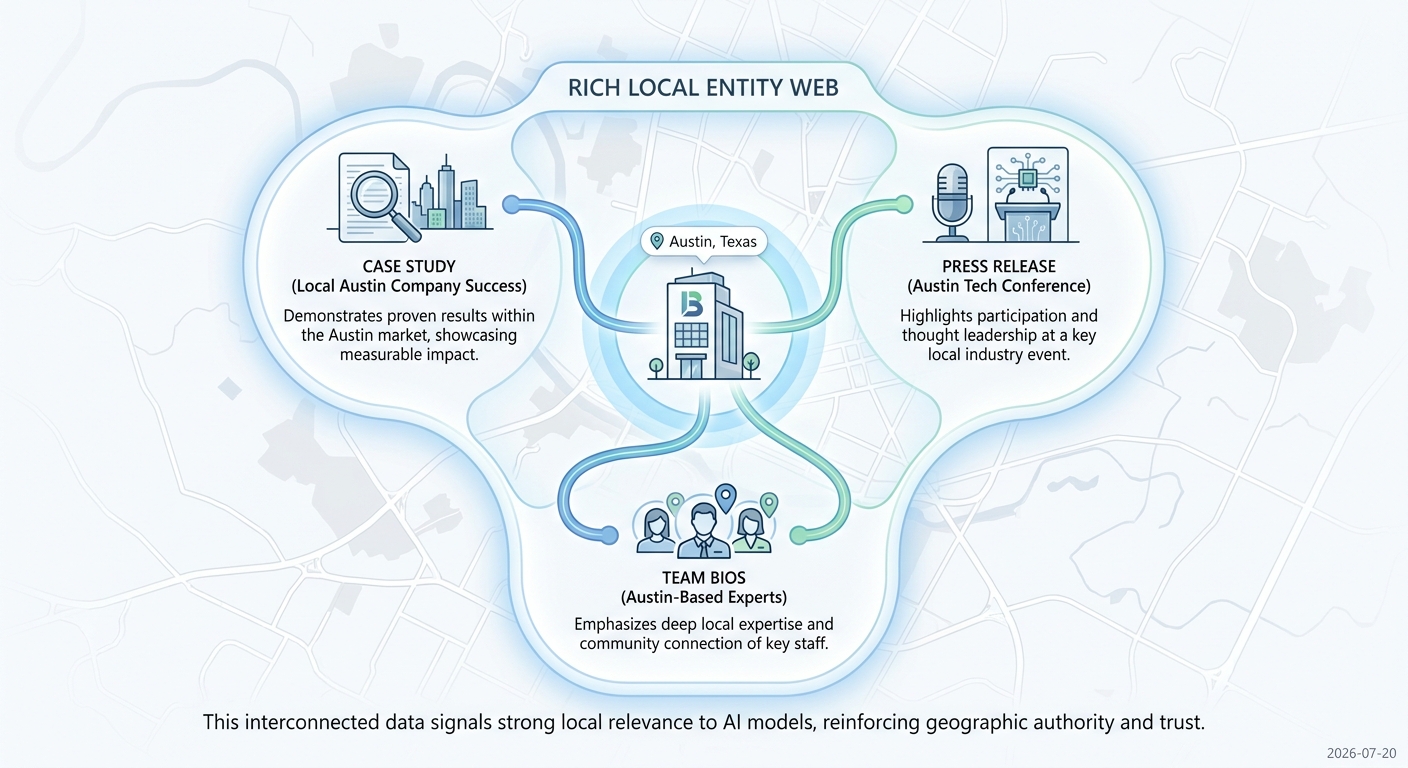
This goes far beyond simple directory listings. For example, a B2B SaaS company targeting customers in Austin, Texas, could implement the following GEO strategy:
- Create a detailed case study page about a partnership with a local Austin-based company.
- Use
OrganizationandEventschema to mark up a press release about sponsoring a local tech conference at the Austin Convention Center. - Publish biographies of its Austin-based sales engineers, highlighting their connection to the local community and linking to their local university alumni pages.
This web of rich, interconnected data is far more compelling to an LLM than a simple address and phone number. With roughly one in five Google searches related to location (Google, 2017), structuring data this way is critical for appearing in localized generative answers. As one community consensus on Twitter noted, “If your SEO platform isn’t giving you an automated action plan for GEO, you are just paying for a dashboard of declining traditional traffic.”
Balancing Automation with Human Expertise
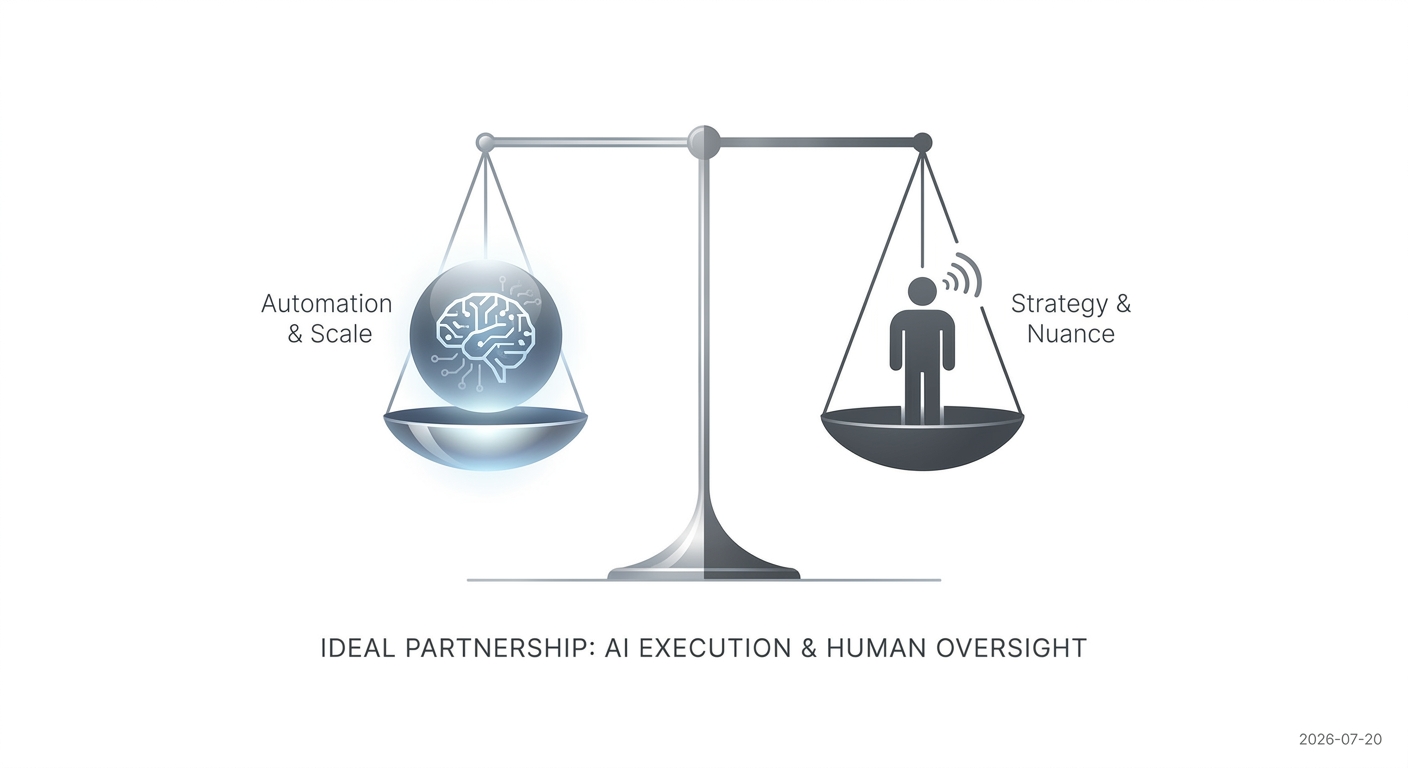
While AI SEO platforms are remarkably efficient, they are not a replacement for human strategic oversight. AI agents excel at data processing, pattern recognition, and repetitive execution, but human expertise remains indispensable for strategy, quality control, and brand alignment.
First, human nuance often wins. An industry analysis found that while 72% of SEOs say AI content can rank well, the coveted #1 position is still eight times more likely to be held by human-written content [2]
⚠️ Human Nuance Still Wins
While AI-generated content can rank, analysis shows the #1 position in search is still eight times more likely to be held by human-written content. This highlights the ongoing value of human creativity, empathy, and deep subject matter expertise for top performance.
This highlights the persistent value of human creativity, empathy, and deep subject matter expertise.
Second, human review is a critical safeguard, especially for Your Money or Your Life (YMYL) topics like finance and business strategy. To align with Google’s E-E-A-T (Experience, Expertise, Authoritativeness, Trustworthiness) guidelines, practitioners must use AI as a powerful “supporting tool to craft original, high-quality, and audience-focused content,” not as a hands-off replacement [7]. Over-reliance on automation without verification risks creating content that is technically optimized but lacks brand voice or, worse, propagates AI-generated inaccuracies.
Ultimately, a skilled human strategist provides the vision. They set the goals, define the brand’s unique value proposition, and make the critical judgment calls that automation cannot. The most successful approach combines the scalable execution of AI with the wisdom and oversight of experienced marketing professionals.
Frequently Asked Questions (FAQ)
How do AI SEO platforms improve website rankings?
AI SEO platforms improve rankings by automating content optimization, tracking generative engine citations, and executing prioritized technical fixes. Unlike traditional tools that only monitor keywords, these platforms use autonomous agents to structure entity data, ensuring your brand is consistently cited by LLMs like ChatGPT and Gemini. This leads to higher visibility in both AI-generated answers and traditional search results.
What is generative engine optimization (GEO)?
Generative Engine Optimization (GEO) is the practice of structuring website content to be cited within AI-generated answers. It moves beyond traditional SERP rankings to focus on optimizing for brand presence, entity clarity, and factual accuracy across multiple AI models. The goal is to become a trusted, citable source for the AI.
Can automated SEO handle technical website requirements?

Yes, modern automated SEO platforms can handle complex technical requirements through agentic workflows. By integrating with automation hubs like n8n, AI agents can autonomously crawl sites, identify and fix schema markup errors, optimize site speed parameters, run technical audits, and push fixes directly to CMS platforms like WordPress, Webflow, or Shopify via their APIs.
How can I track brand citations in ChatGPT and Gemini?
You can track brand citations in ChatGPT and Gemini using specialized AI SEO platforms designed for multi-model monitoring. These tools programmatically send thousands of prompts to over 17 global LLMs, analyzing how often your brand is recommended for key queries. They then provide automated action plans to improve that visibility.
Does Google penalize AI-generated content?
No, Google does not inherently penalize content because it was created with AI. Google’s official guidelines state that the appropriate use of AI or automation is not a violation . The ranking systems prioritize high-quality, helpful content that demonstrates expertise, experience, authoritativeness, and trustworthiness (E-E-A-T), regardless of how it was produced.
💡 Google’s Stance on AI Content
Google does not penalize content for being AI-generated. The official policy prioritizes high-quality, helpful content that demonstrates E-E-A-T (Experience, Expertise, Authoritativeness, Trustworthiness), regardless of the production method.
What is the difference between traditional SEO and answer engine optimization?
Traditional SEO focuses on optimizing for keywords and acquiring backlinks to rank on a search engine results page (SERP). Answer Engine Optimization (AEO), also known as GEO, focuses on structuring factual entity data and conversational content so that AI models directly cite your brand when generating comprehensive answers, making you part of the answer itself.
Traditional SEO vs. Answer Engine Optimization (AEO)
| Option | Pros | Cons |
|---|---|---|
| Traditional SEO | Focuses on ranking on a search results page (SERP). | Measures success with keyword positions and backlinks. |
| Answer Engine Optimization (AEO/GEO) | Focuses on being cited directly within an AI-generated answer. | Measures success with brand citations and entity-level visibility. |
Conclusion: From Passive Monitoring to Autonomous Growth
The transition from search engines to answer engines marks a permanent shift in how digital visibility is earned and measured. Relying on legacy keyword tracking and manual SEO processes is a strategy for managed decline. The future of organic growth belongs to those who adapt to the new generative landscape.
By deploying AI SEO platforms that provide prioritized action plans, autonomous agent execution, and multi-model citation tracking, businesses can secure their brand’s presence where users are now seeking information. These systems empower marketing teams to move from passive reporting to proactive, revenue-driving optimization. For marketing directors in competitive B2B markets who need to scale operations, future-proof their strategy, and lower their cost-to-serve, the time to embrace automation is now.
Begin automating your website content workflows and start dominating AI visibility across all major global models. Access a Free Trial of AI Rankia today.
References
[3] Generative Engine Optimization Statistics (2026): 60+ Data
[4] AI Overview Case Studies: Proven Strategies & Results for 2026
[5] Best AI SEO Agents in 2026 (Ranked by What They Actually Automate)
[6] Generative Engine Optimization (GEO): Win AI Search Visibility | O8
[7] AI for SEO: How to Use It Without Getting Penalized
[8] AI SEO Statistics for 2026: Search Trends, AI Visibility &