Key Takeaways
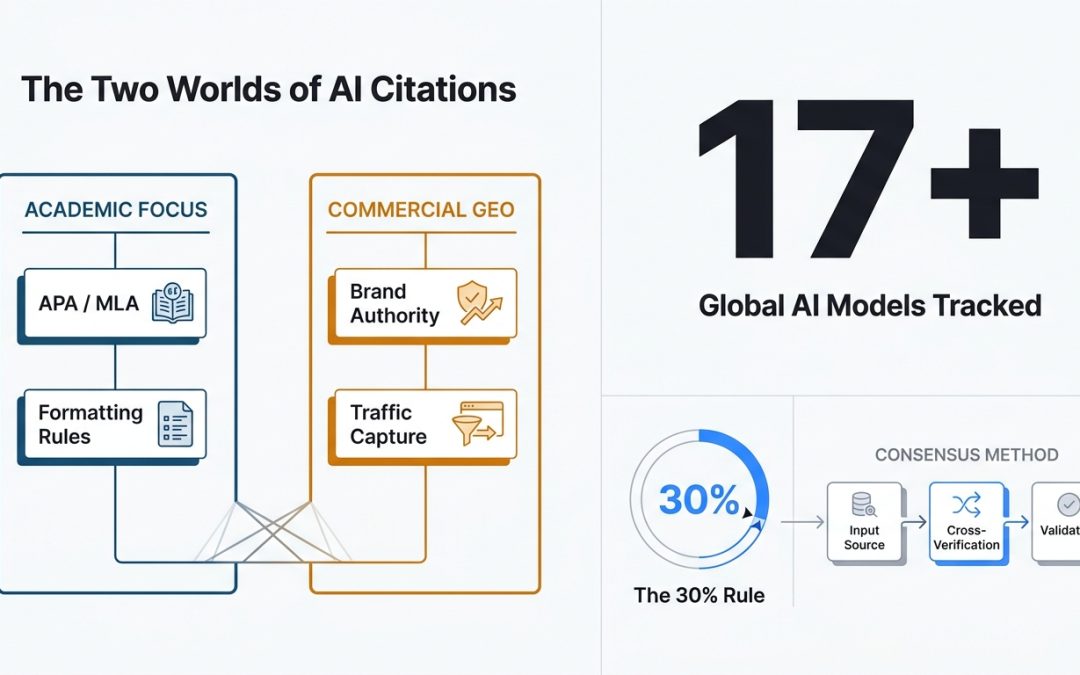
AI citations represent a fundamental shift in digital visibility. While academia focuses on formatting rules (APA/MLA) for using generative AI, B2B marketers must prioritize Generative Engine Optimization (GEO)—the strategic process of ensuring their brand becomes the cited source across 17+ global AI models to capture traffic and authority in a post-search landscape.
The Two Worlds of AI Citations
When we discuss AI citations, the conversation splits into two distinct realities. For students and academics, it means navigating a complex web of APA and MLA Style guidelines to properly attribute AI-generated text and uphold academic integrity. For B2B SaaS marketing directors and SEO specialists, however, it represents the new, high-stakes battleground for digital visibility and brand authority.
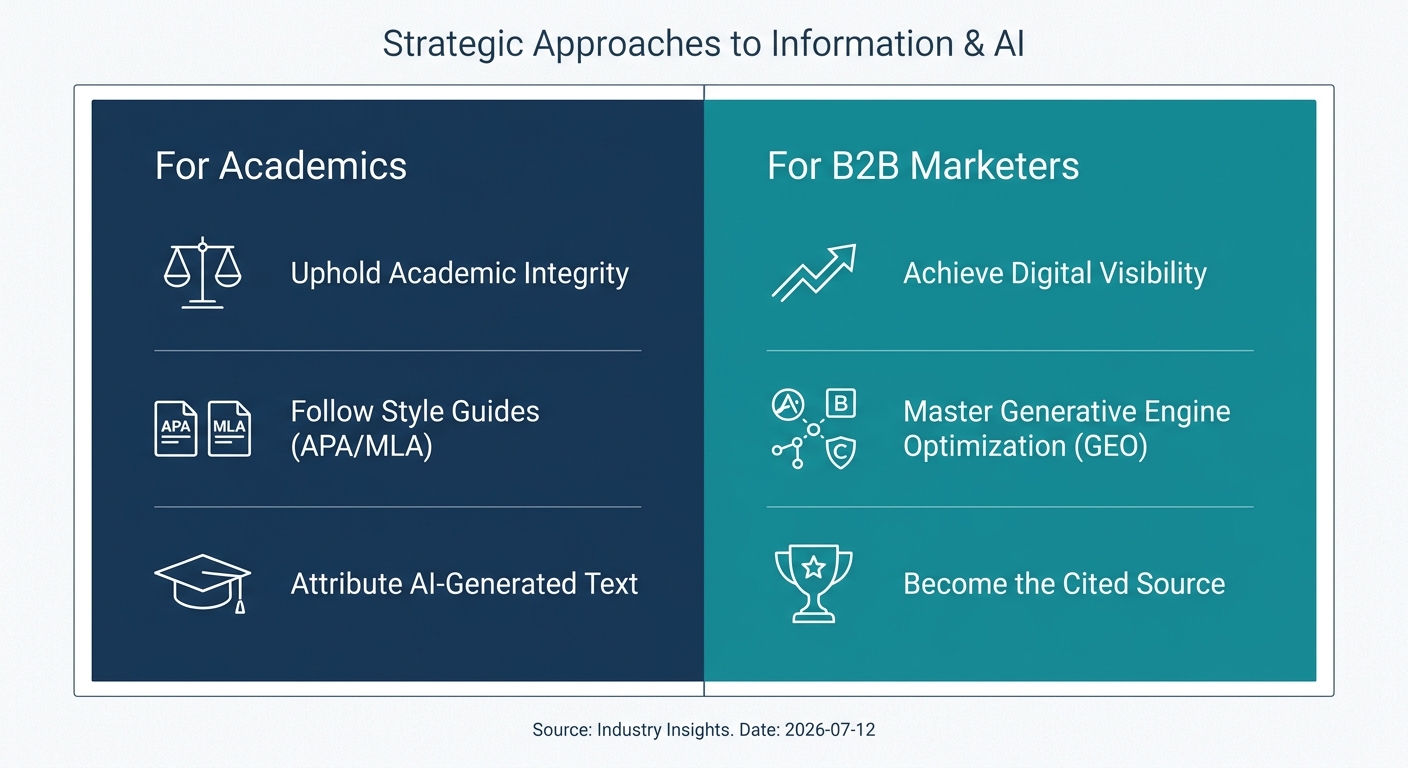
As traditional search traffic declines, being the cited source in AI-powered answer engines like ChatGPT, Perplexity, and Google’s AI Overviews is becoming critical for survival and growth. This guide bridges the gap between academic citation mechanics and commercial Generative Engine Optimization (GEO), providing a data-backed blueprint for tracking and optimizing your brand’s presence across the global AI landscape.
About the Author
Pedro Spota is the Director of Growth at ELOGIA (Viko Group) and Co-Founder of AI Rankia. He designs data-driven growth systems tied to revenue, orchestrating over 200 production AI agents focused on marketing, sales, and Generative Engine Optimization (GEO) to optimize conversion lift and secure brand visibility in AI search. Connect on LinkedIn.
Transparency Disclosure
This guide draws on publicly available academic style guidelines and published industry studies. AI Rankia provides commercial tracking software for AI search engines; however, the methodologies and verification frameworks discussed here are platform-agnostic and based on independent structural analysis of Large Language Models (LLMs).
What Are AI Citations? (Academic Rules vs. Commercial Value)
AI citations refer to two distinct concepts: the academic practice of attributing information generated by AI models, and the commercial reality of an AI engine attributing information to a brand’s website as a source. For B2B marketers, understanding and mastering the second definition is a strategic imperative.
In academia, the focus is on integrity and transparency. With the 2026 HEPI survey indicating that 95% of students use AI in at least one form
📊 AI’s Deep Integration in Academia
With the 2026 HEPI survey showing that 95% of students already use AI in at least one form in their studies, the need for clear citation guidelines has become urgent for academic institutions worldwide.
, institutions have scrambled to establish rigorous guidelines. This is part of a larger shift toward “AI-native academic integrity,” which moves beyond simply detecting plagiarism to understanding the entire AI-assisted creation process [8].
For example, style guides provide specific formats. APA Style recommends citing the AI’s developer (e.g., OpenAI), the model name, and the date the content was generated [4]. MLA guidelines state you should cite generative AI when you use its content, whether quoted or paraphrased [2]. Chicago style concurs, requiring a citation when you reproduce an AI’s words.
The core academic principle is to trace information back to its origin. According to the University of Connecticut’s AI guidelines (revised August 2026), AI-generated material must be attributed, and that attribution includes the AI itself [1]

.
For US B2B marketers, however, the goal is not learning how to cite AI, but how to be cited by AI. This commercial pivot is where Generative Engine Optimization (GEO) becomes the central strategy to reclaim traffic and establish authority in a post-search world.
Generative Engine Optimization: How to Get Cited by AI
Generative Engine Optimization (GEO) is the strategic process of making your brand’s content the authoritative, citable source for AI answer engines. While conversational AI often defaults to explaining academic citation formats, the commercial imperative is to be the answer. Drawing on experience orchestrating over 200 production AI agents, we see firsthand how LLMs extract, synthesize, and attribute information.
This shift from traditional SEO to GEO is a documented transformation in how users discover information. The data is stark: an Ahrefs study found that only 38% of URLs cited in Google AI Overviews rank in Google’s top 10 traditional search results. This means old SEO tactics focused on ranking for broad keywords are no longer sufficient.
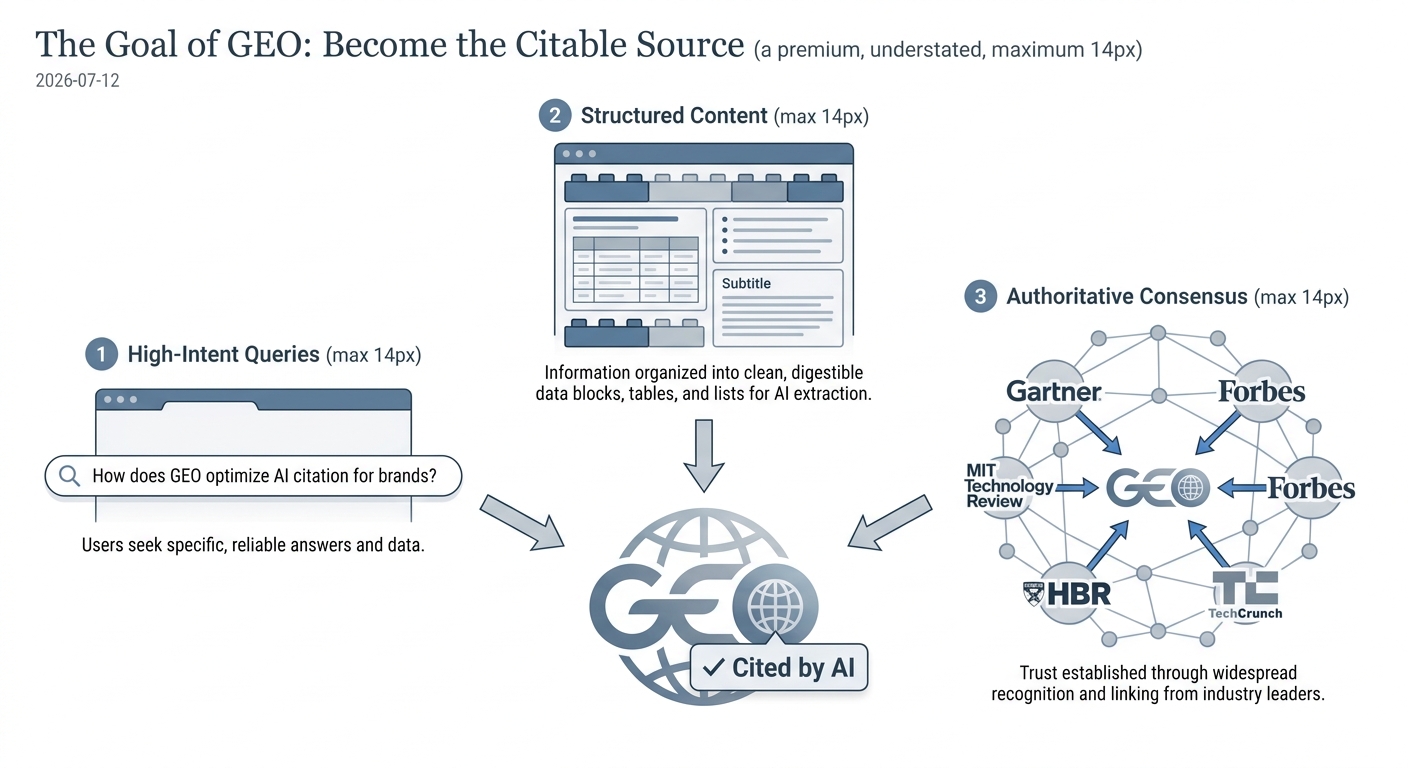
To adapt and earn AI citations, brands must implement three core GEO strategies:
Core Strategies for Generative Engine Optimization (GEO)
Target High-Intent Queries
Focus content on answering specific, long-tail questions your prospects ask, rather than ranking for broad keywords.
Structure Content for Extraction
Use clear headings, bullet points, and data tables to create ‘knowledge blocks’ that AI models can easily parse and cite.
Build Consensus Through Digital PR
Earn mentions in trusted industry reports and publications to build a web of authority that LLMs recognize as credible.
- Target High-Intent Informational Queries: LLMs are designed to answer questions, not rank keywords. Shift your content strategy from broad terms like “accounting software” to specific, long-tail questions your prospects ask. Focus on queries like, “What is the best accounting software for US-based freelance consultants?” or “Compare features of [Your Product] vs. [Competitor Product] for enterprise teams.” This aligns your content directly with the conversational nature of AI search.
- Structure Content for Extraction: Organize your content into “knowledge blocks”—dense, verifiable facts that models can easily parse and cite. Use clear headings (H2, H3), bullet points, and data tables. Instead of a narrative paragraph saying, “We offer many useful integrations,” create a structured, citable list: “Our platform integrates with [number] specific applications, including [App A], [App B], and [App C].” This atomic, data-rich approach makes your content a prime candidate for citation.
- Build Consensus Through Digital PR: AI prioritizes consensus across multiple authoritative sources. Earning a citation is less about the volume of backlinks and more about the authority of the sources that mention you. Focus on getting your brand’s data, executives, and product name featured in trusted industry reports (like Gartner or Forrester), guest articles on respected publications, and expert roundups. This builds a web of trust that LLMs recognize as authority.
The “30% Rule” and the Dangers of AI Citation Hallucinations
AI citation hallucinations are instances where a model fabricates a source or provides inaccurate attribution details. While platforms offer generic warnings, the statistical reality is alarming. Recent studies reveal that leading AI legal research tools produce incorrect or unfounded answers on 17% to more than 33% of benchmarking queries
⚠️ Extreme Risk of AI Citation Hallucination
Independent studies show that AI tools can give incorrect or unfounded answers on a significant share of queries. This means AI can invent sources, mismatch authors, or fabricate DOIs. Never trust an AI-provided source without manual verification.
. This isn’t a minor issue; it’s a fundamental flaw in how current models operate.
The nature of these errors is also evolving. An analysis comparing models found that while ChatGPT 3.5 frequently invented sources wholesale, the more advanced ChatGPT-4o introduced subtle, harder-to-spot errors like mismatched journal titles or incorrect author names [10]. This makes manual verification more critical than ever.
This risk is often discussed under the label of the “30% Rule.”
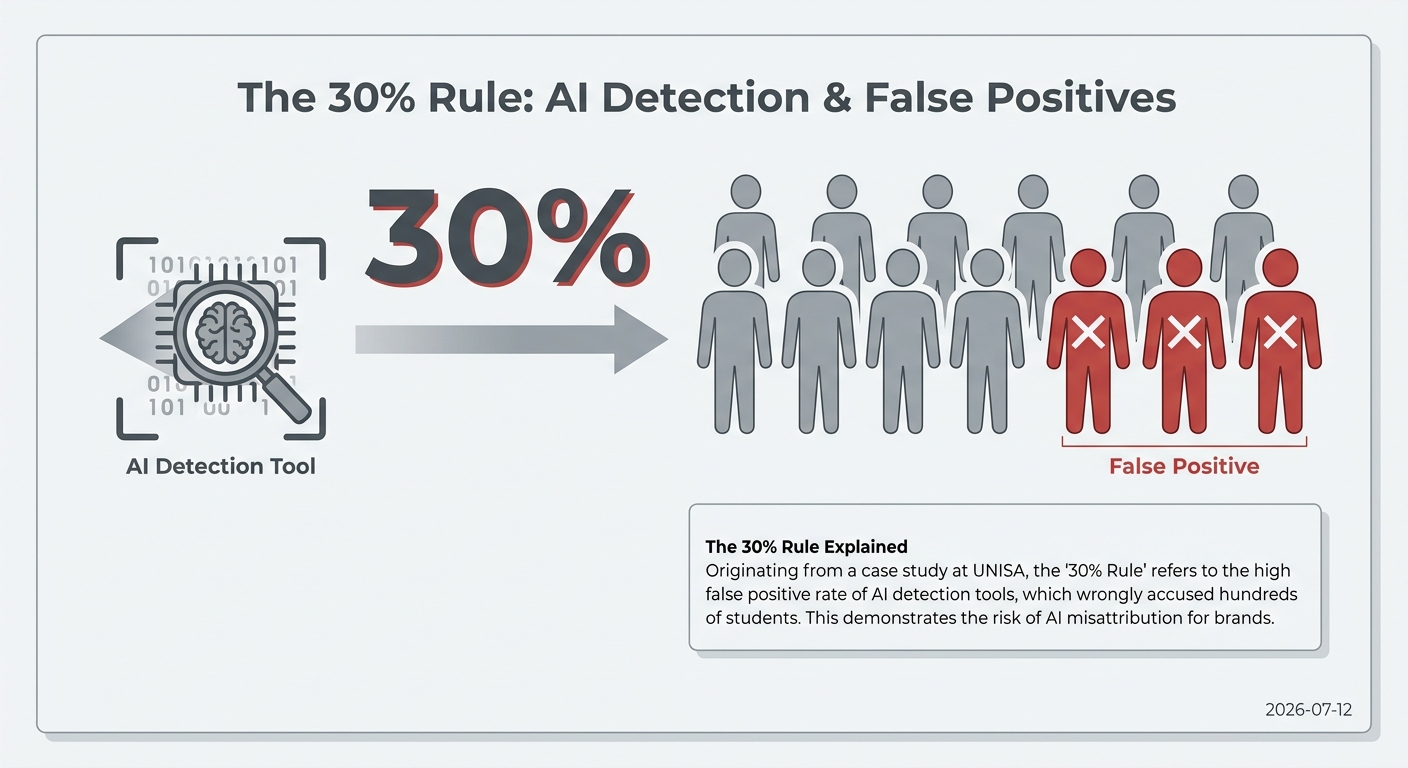
AI detection tools are known to produce false positives, which can lead to students being wrongly flagged. For marketers, the implication is twofold. First, it highlights the unreliability of automated AI content detectors. Second, it underscores a critical brand risk: if an AI can falsely accuse a student of plagiarism, it can just as easily misattribute a negative statement to your brand or cite your company in a false or damaging context. This makes proactive AI Reputation Management a defensive necessity.
The Consensus Method: A Framework for Verifying AI Sources
The Consensus Method is a structural framework for verifying AI-generated information that moves beyond simple fact-checking. Given that fabrication is an inherent property of how LLMs generate responses, merely refining prompts is insufficient. This method provides a more robust approach to achieving confidence in AI outputs.
🗣️ Query Multiple Models
Ask your key question to at least two independent AI models for factual research, and three or four for higher-risk tasks such as medical or legal research (e.g., Perplexity, Claude, Gemini) to gather a diverse set of responses and sources.
🔍 Find Overlapping Citations
Identify which sources are cited by multiple, different AIs. An overlapping consensus across models signals a strong, verifiable pattern in the training data.
✅ Manually Verify the Source
Click through to the primary document. Cross-reference the article title, author, and DOI on Google Scholar to confirm its existence and context.
The core principle is to seek corroboration across independent models. If you ask a question and Perplexity, Claude, and Gemini all provide AI citations pointing to the exact same source for a specific statistic, your confidence in that source’s validity increases significantly. This works because independent LLMs trained on different datasets are statistically unlikely to hallucinate the exact same incorrect source. Overlapping citations signal a strong, verifiable pattern in the underlying training data.
However, this digital consensus must be paired with rigorous manual verification, a practice echoed by academic communities. The consensus among practitioners is clear:
- Always follow the DOI (Digital Object Identifier) link if one is provided.
- Cross-reference the article title and author names on Google Scholar or other academic databases to confirm their existence and match.
- Never trust a source without clicking through to the primary document to confirm the information and its context.
Tracking Your Brand’s Citations Across 17+ Global Models
AI citation tracking is the process of monitoring when, where, and how your brand is being cited by AI answer engines worldwide. Most brands make the mistake of limiting their monitoring to US-centric models like ChatGPT, Gemini, and Claude. This creates a significant blind spot, especially for B2B SaaS companies with global ambitions.
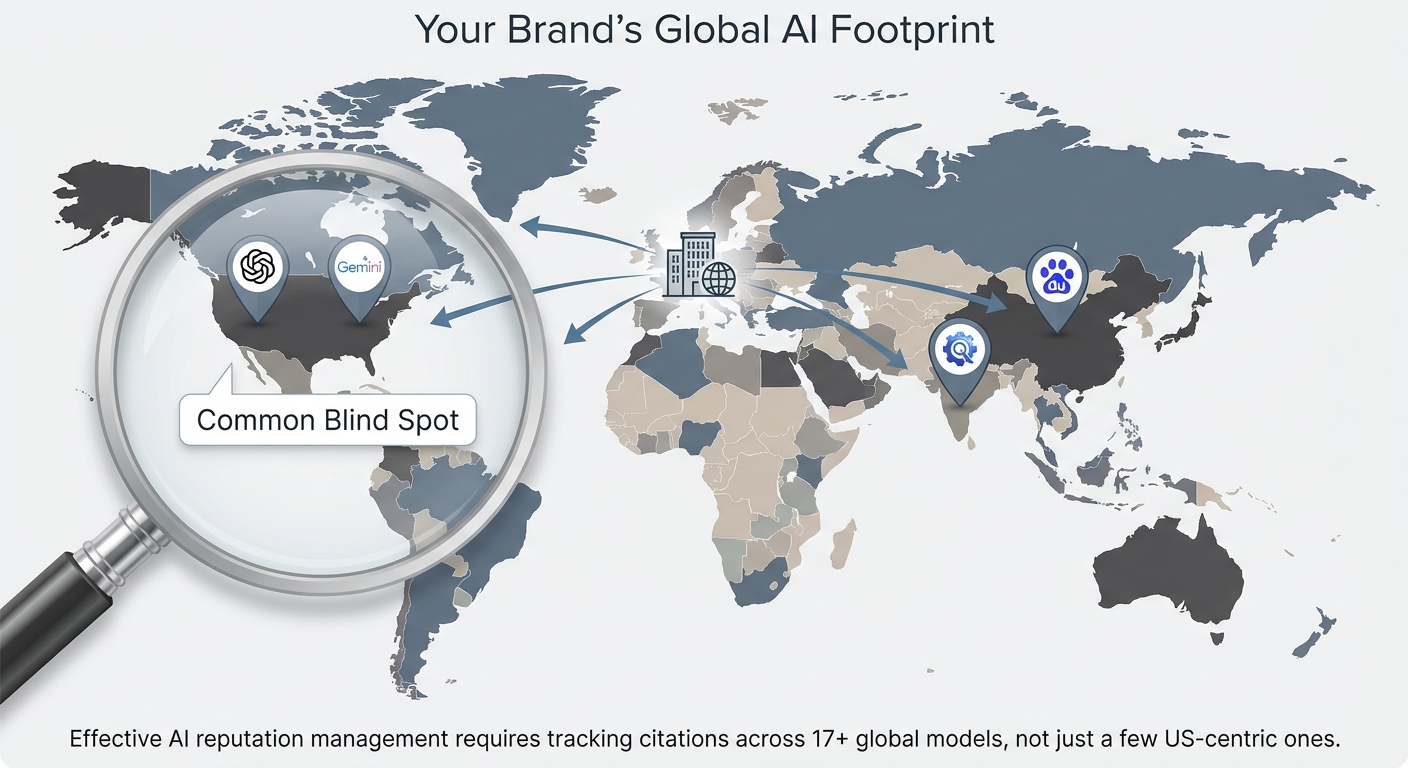
A manual tracking approach is unscalable, limited to a few models, and susceptible to personalization bias. In contrast, an automated, platform-based approach can cover 17+ models globally, including critical engines in Asian markets. While some AI citation generator tools are useful for academic reviews [9], they are not designed for comprehensive commercial brand tracking.
The business case for global tracking is both defensive and offensive. Defensively, it protects your brand narrative from misrepresentation. Offensively, it provides critical competitive intelligence. Tracking reveals which high-value queries your competitors are being cited for, uncovering your most urgent content gaps. It also provides real-time feedback on your messaging, showing how your brand is being interpreted and retold in key international markets. China’s AI user base, for instance, is one of the largest in the world, making models like Baidu’s ERNIE Bot and Alibaba’s Qwen (Tongyi Qianwen) critical for shaping procurement decisions and building credibility. A comprehensive platform allows marketing teams to systematically monitor this global footprint and defend their share of voice.
Frequently Asked Questions (FAQ)
Is it okay to use AI for citations?
Yes, but it depends on the context and requires disclosure. In academia, you must acknowledge AI use for drafting or outlining with a clear statement and always follow your instructor’s specific policy [6]. For commercial marketing, using AI to generate content ideas is acceptable, but all factual claims and sources must be manually verified before publication.
How do you do a citation for AI?
You format the citation based on the required style guide (e.g., APA, MLA). For APA Style, a citation of a specific chat now includes the author (OpenAI), the full date, the chat title, the label [Generative AI chat], ChatGPT, and the URL of the shared chat (see APA Style) [4]. For MLA Style, you would include a description of the prompt used, the AI tool’s name, its version, the developer, and the date the content was generated [2].
Which AI is best for citations?
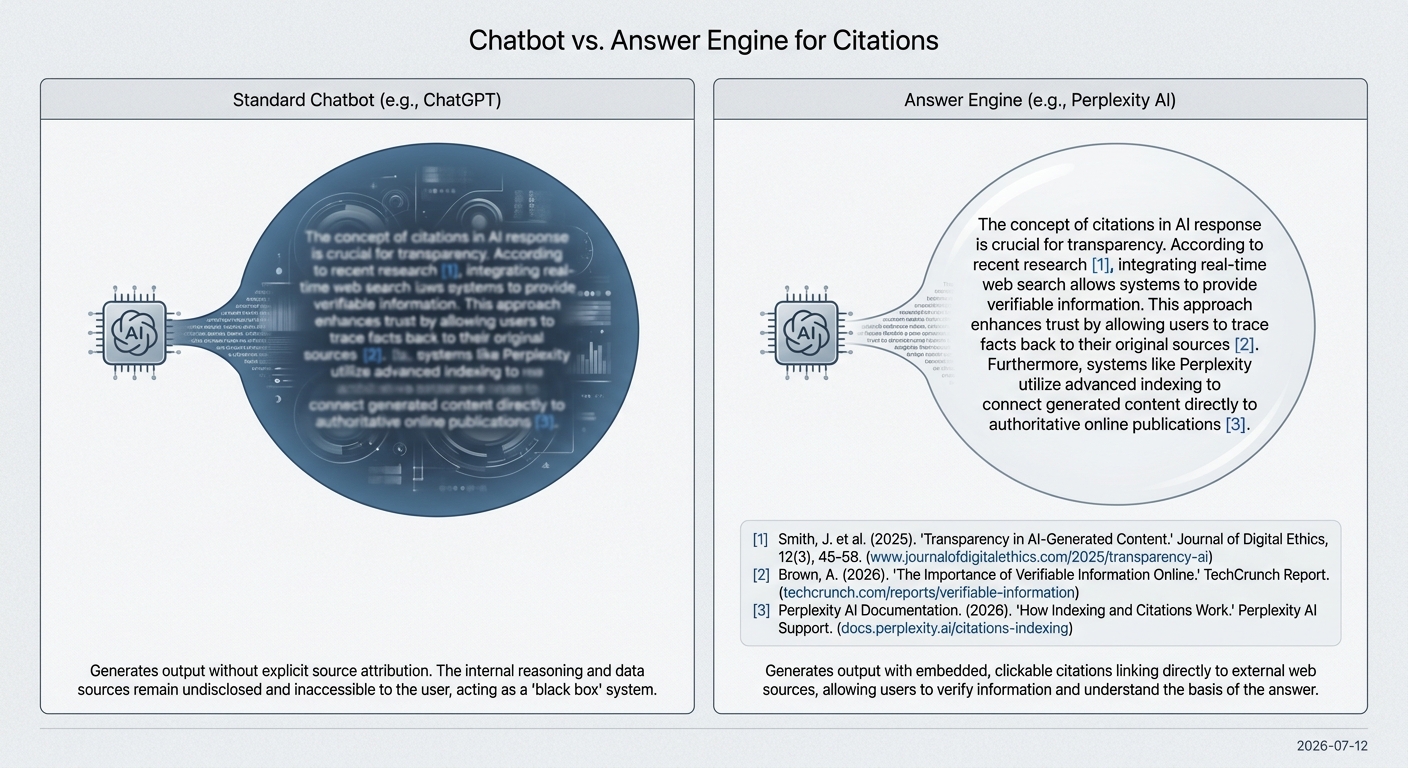
Perplexity AI is often considered a more reliable option for generating accurate citations. Unlike standard chatbots, Perplexity functions as an “answer engine” that actively crawls the web for its responses and often provides direct, footnoted links to its sources. This can reduce, but not eliminate, the risk of hallucination.
Is it okay to use ChatGPT for citations?
Using ChatGPT to find sources carries a significant risk of inaccuracy. In a Money.com test, ChatGPT Search answered only 65 of 100 financial questions correctly, while 29% of answers were misleading and 6% completely wrong. It is known to fabricate DOIs, mismatch authors with journals, and invent sources entirely. Every citation it provides must be manually verified from scratch.
Is it wrong to use ChatGPT for citations?
✅ Smart Use vs. Academic Misconduct
It is dishonest to use ChatGPT to invent sources. However, using it as a formatting assistant to organize your *manually verified* research into APA or Chicago style is an acceptable and efficient use of the tool, provided you disclose its use per institutional guidelines.
It is academically dishonest to use ChatGPT to invent sources or pass off unverified information as researched fact. However, using it as a formatting assistant—like an article citation generator—to organize your own manually verified research into APA or Chicago Style is generally acceptable, provided you disclose its use according to institutional guidelines.
What is the 30% rule in AI?
The “30% rule” is a label used in some discussions about AI detection tools and false positives; there is no verified, official 30% false positive rate attributed to a specific institution or tool. The broader lesson is that AI detectors can wrongly flag innocent students, so their results should never be the sole basis for a misconduct accusation.
Limitations, Alternatives & Professional Guidance
While this guide outlines the core mechanics of AI citations and GEO, the generative AI landscape is highly volatile. LLM training data, search algorithms, and model weights are updated continuously, meaning today’s best practices may be outdated tomorrow.
Relying on manual searches to track your brand’s AI citations is a possible alternative, but it is unscalable, prone to personalization bias, and fails to capture the global picture. For professional B2B marketing teams, an automated platform that tracks visibility across a diverse set of independent models is the most effective approach to measure and improve true Answer Engine share of voice. For academic work, always consult official style guides (APA, MLA, Chicago) for the most current formatting rules.
Conclusion: From Academic Rule to Commercial Imperative
The definition of AI citations has permanently expanded. It is no longer just about how a student formats a reference to ChatGPT in a research paper; it is about how B2B brands secure their visibility and authority in the next generation of search. The era of optimizing for ten blue links is over. Mastering Generative Engine Optimization is non-negotiable for survival and growth.
By shifting your content strategy to target high-intent queries, structuring data for extraction, and building consensus through digital PR, you can become the source AI models trust and cite. However, strategy without measurement is incomplete. Applying the Consensus Method for verification and actively tracking your brand across 17+ global models moves you from a defensive position to one of market dominance.
Stop guessing about your AI visibility. Take control of your brand’s narrative in the generative landscape by seeing exactly where you stand. Access a Free Trial with AI Rankia to start tracking your AI citations today.
References
[2] Citing artificial intelligence (AI) – Citing Sources – LibGuides at Duke University
[3] Home – Citing AI tools – LibGuides at MIT Libraries
[4] [PDF] Citation Guide for Use of AI in Research and Academic Writing
[8] AI-native academic integrity trends and impact | Turnitin
[9] The 10 Best AI Citation Generator Tools in 2025
[10] The Problems of Using AI for Academic Research | OpenScienceLab