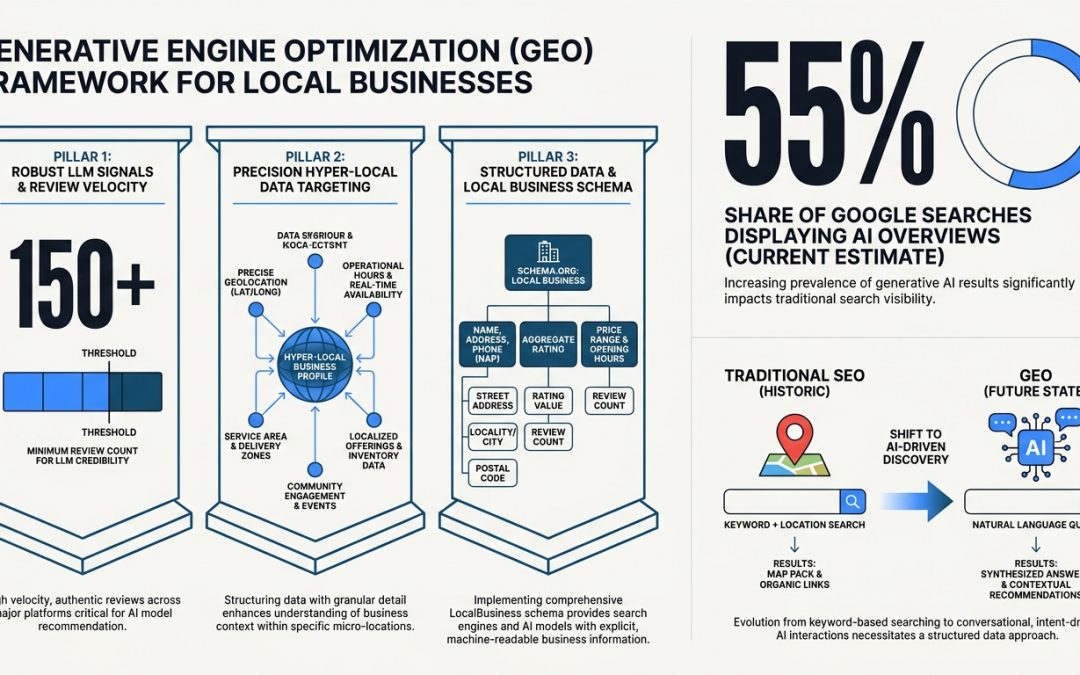
Master Generative Engine Optimization (GEO) for local businesses. Learn our 3-pillar framework to optimize for AI Overviews and dominate local search.
Key Takeaway
To succeed with google for local business today, Generative Engine Optimization (GEO) requires moving beyond traditional map packs. Getting direct citations in AI Overviews and LLMs like ChatGPT means building a strong volume of reviews, achieving hyper-local relevance through content and data, and implementing hierarchical LocalBusiness schema to secure your entity’s position in generative search.
Introduction
The way customers find local businesses has been fundamentally disrupted. For years, the primary goal was to rank in the Google Map Pack. Today, that is no longer sufficient. User behavior is rapidly shifting from simple “near me” searches to complex, conversational queries answered directly by AI. With AI Overviews now appearing in a growing share of Google searches [10]
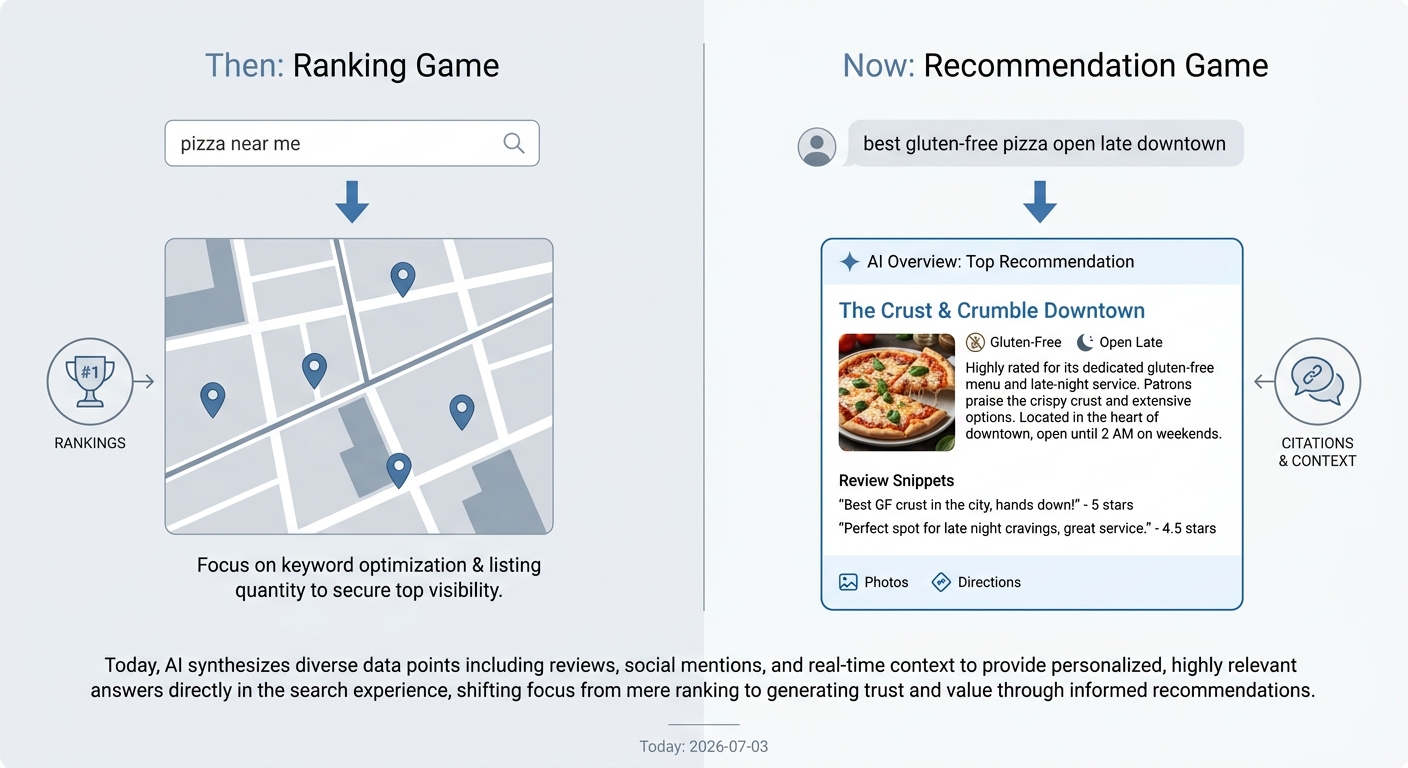
, your visibility—and ultimately, your foot traffic—depends entirely on a new strategy: Generative Engine Optimization (GEO).
Many local marketers feel lost, acknowledging that traditional SEO tactics are failing to secure placement in these new AI-driven answers. This guide cuts through the noise. We will move beyond generic advice and provide a clear, three-pillar framework for dominating local GEO in the United States market. You will learn the specific quantitative thresholds, technical schema, and contextual strategies required to make your business the definitive answer in the age of AI, ensuring you are not just found, but recommended.
Author Credentials & Transparency Disclosure
- Author: Airankia Team
- Bio: The Airankia team is a leading authority in AI SEO and Generative Engine Optimization, specializing in entity disambiguation and generative engine visibility for the US market. Our strategies are built on continuous data analysis and real-world application.
- Transparency Disclosure: This guide draws on the public sources listed in the References.
Expert Consensus: The Reality of Local GEO
The shift to AI has created significant uncertainty among seasoned professionals. The old playbook is obsolete, and the new rules are still being written. This confusion is evident in practitioner communities:
- “It’s no longer pizza near me. It’s more like, where can I get a gluten-free pizza that’s open late and delivers downtown?” — keyworddotcom on r/localseo (25 upvotes, Aug 2025) [10]
This last point is crucial. While AI uses Google’s data, it synthesizes it in a new way to answer complex, long-tail queries. Your job is no longer just to be listed, but to be the most logical, trustworthy, and contextually relevant answer for that synthesis.
💡 The New Search Paradigm
AI doesn’t just fetch information; it synthesizes it to answer complex, conversational questions. Your goal is to provide the clearest, most trustworthy signals so the AI chooses to synthesize your business into its answer.
The New Economics of Local Search: Why Clicks Don’t Matter
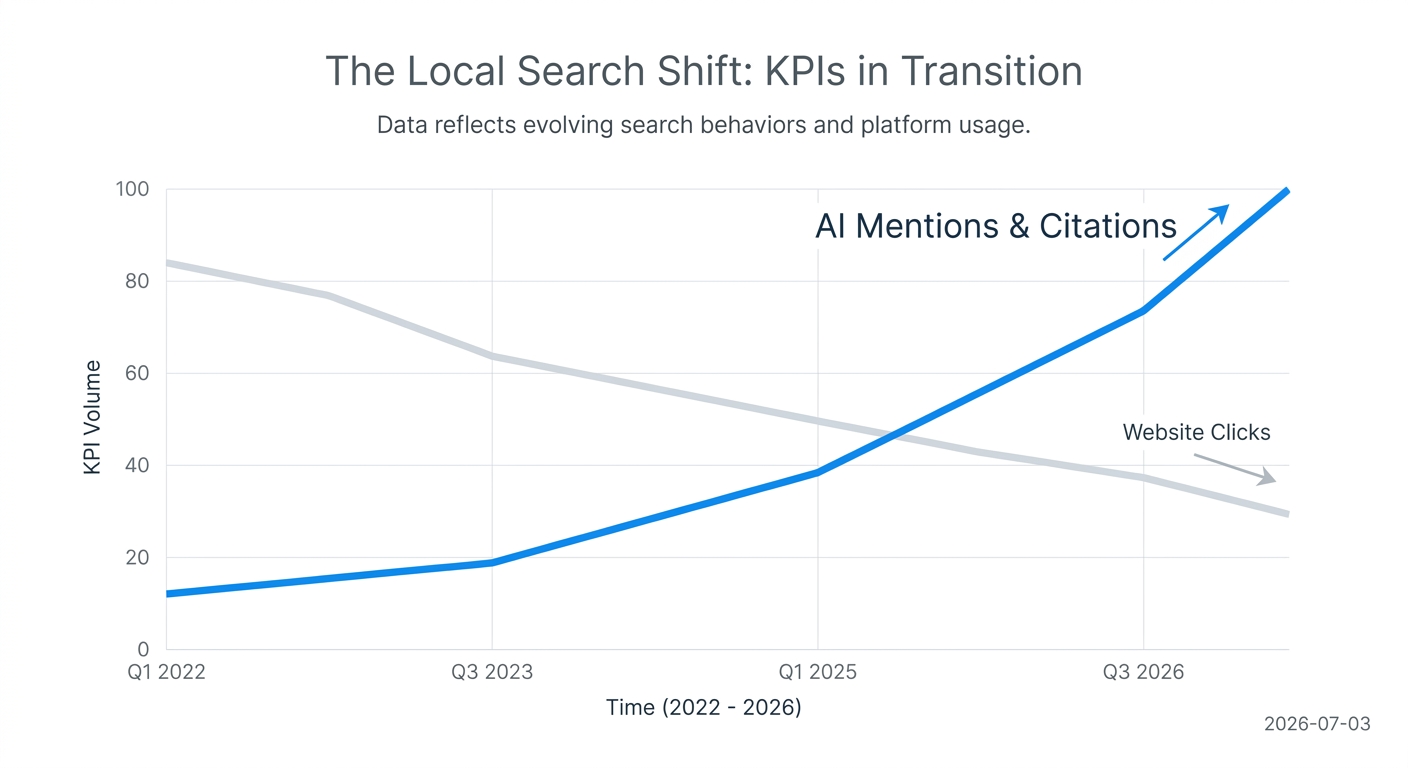
Before diving into strategy, we must accept a harsh new reality: the primary goal of local GEO is not to drive website traffic. It’s to win the “zero-click” interaction. Local discovery increasingly starts and ends within the AI answer, rendering traditional click-through rates an unreliable metric for physical storefronts [4].
The statistics are stark: an estimated 68% of US Google searches ended without a click in January–April 2026 (SparkToro), and Ahrefs estimates that AI Overviews reduce the CTR of the top-ranking page by 58% (December 2025 data) [10]
. Users get operating hours, service availability, and summarized reviews directly in the AI response. For google for local business optimizers, success is now measured by direct citations and accurate entity representation within the AI answer itself. Your new key performance indicator (KPI) is not a click, but a mention.
A 3-Pillar Framework for Local GEO Dominance
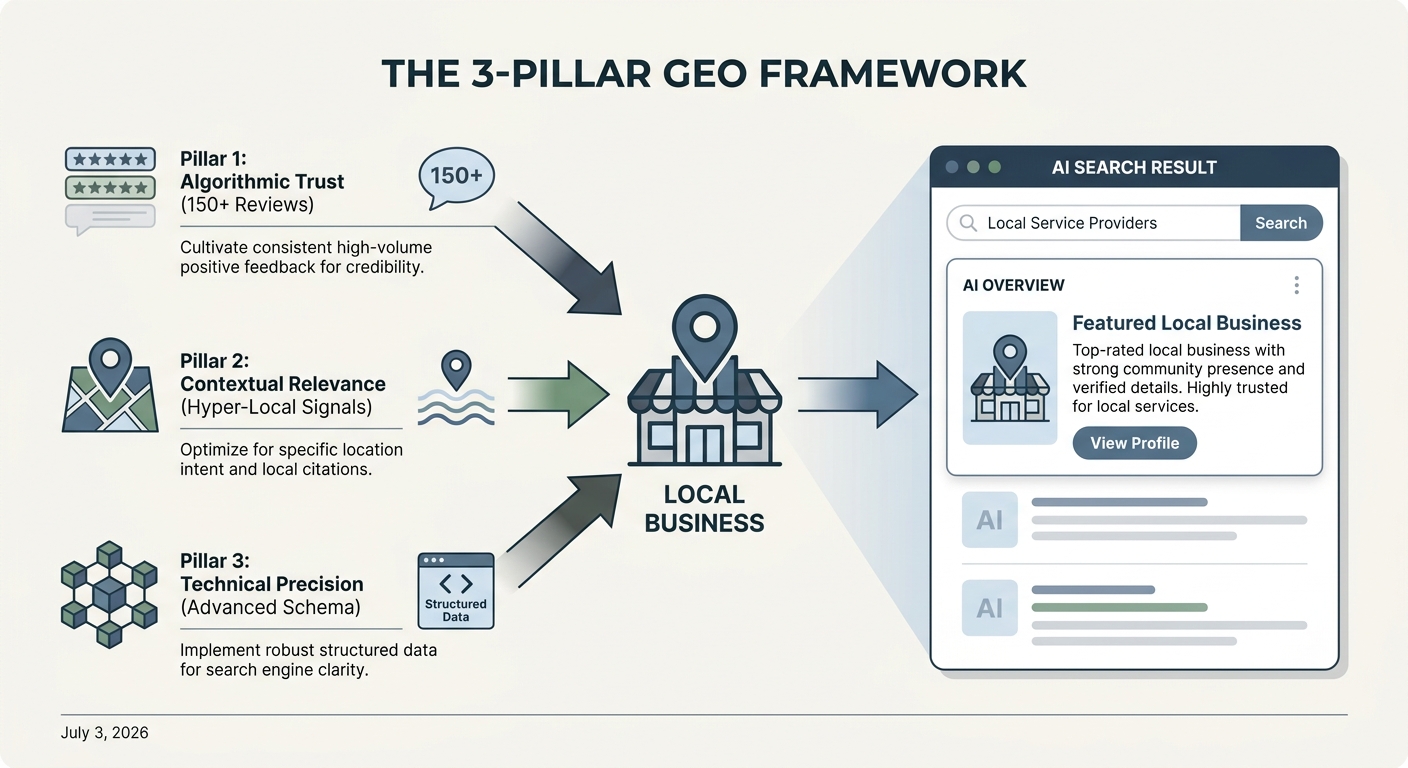
To consistently appear in AI-generated local recommendations, businesses need a structured approach. We’ve developed a three-pillar framework that moves beyond outdated SEO tactics and focuses on the signals generative engines prioritize for establishing trust, relevance, and technical clarity.

Pillar 1: Establish Algorithmic Trust with Quantitative Proof
Generic advice to “earn detailed reviews” is dangerously vague. It misses the specific quantitative and qualitative thresholds required for an LLM to confidently recommend a local business. This is why many businesses follow best practices but still fail to appear in AI Overviews.
Review volume matters for AI recommendations: a substantial number of reviews per location
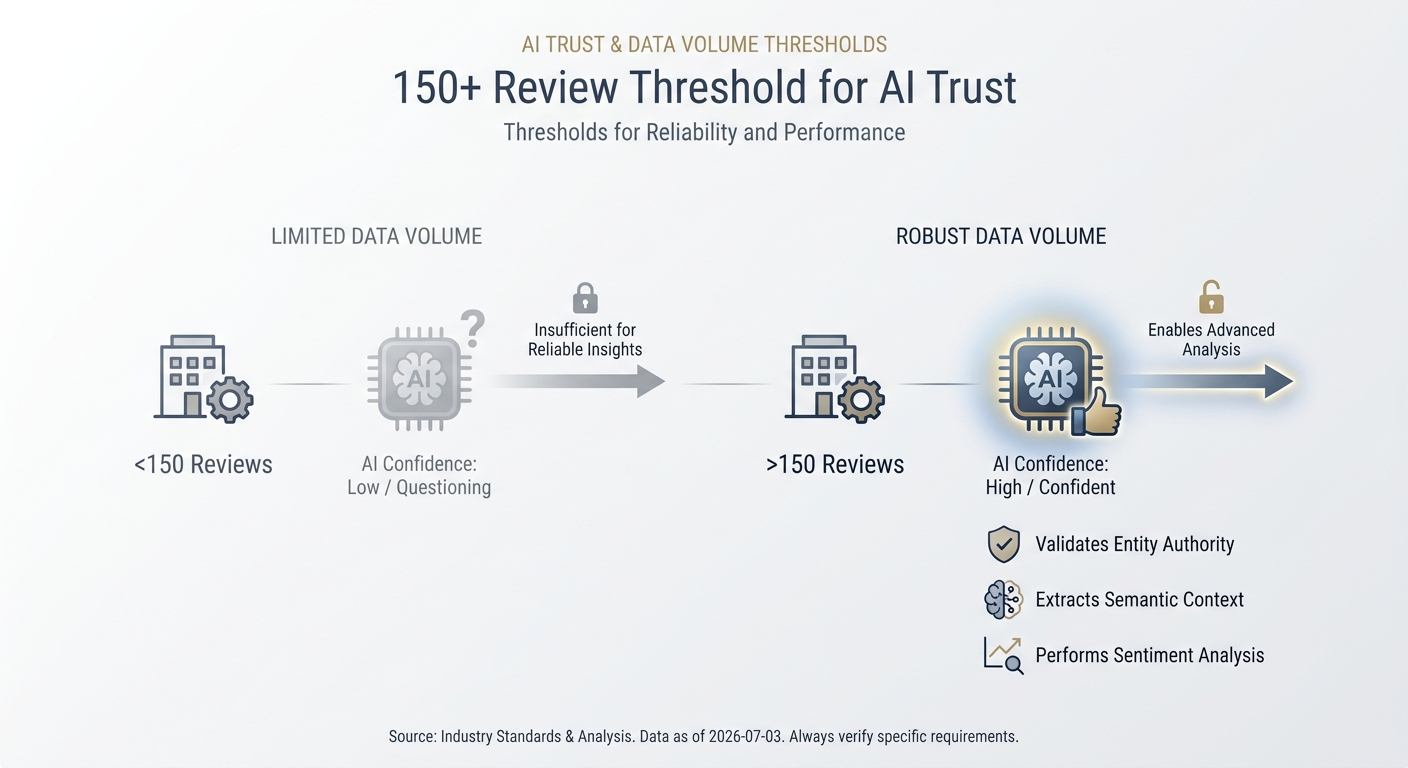
[3]. With a substantial volume of reviews, an AI can:
- Validate Entity Authority: A high review count acts as a powerful ‘AI Triangulation Signal,’ confirming the business is established, operational, and trusted by a significant volume of real customers.
- Extract Semantic Context: The AI doesn’t just count stars; it reads the text. It analyzes reviews to identify recurring mentions of specific services, products, and attributes (e.g., “great patio,” “quick service,” “gluten-free options,” “perfect for a date night”). This is how it answers nuanced, conversational queries.
- Perform Sentiment Analysis: A large volume of reviews allows the model to reliably gauge overall customer satisfaction and identify what the business is best known for, moving beyond simple categorization.
Actionable Strategy: Implement a systematic review generation process. Use post-service emails or texts to prompt customers for feedback. Crucially, guide them to be specific. Instead of asking for a “review,” ask “What did you enjoy most about your visit?” or “Which service did you receive today?” This encourages the context-rich feedback that fuels AI recommendations. Building a strong volume of reviews with this level of semantic detail is a useful first step toward showing your entity is worth citing.
✅ Actionable Strategy: Elicit Context-Rich Reviews
Don’t just ask for a review. Prompt customers with specific questions like ‘What did you enjoy most about your visit?’ or ‘Which dish would you recommend?’ to generate the detailed, semantic feedback that AI models value.
Pillar 2: Achieve Contextual Relevance Through Hyper-Localization
Once trust is established, the next pillar is relevance. Standard local SEO rightly emphasizes “NAP consistency,” but it overlooks a critical dynamic in AI search: hyper-specific queries often favor single-location businesses over large multi-location brands.
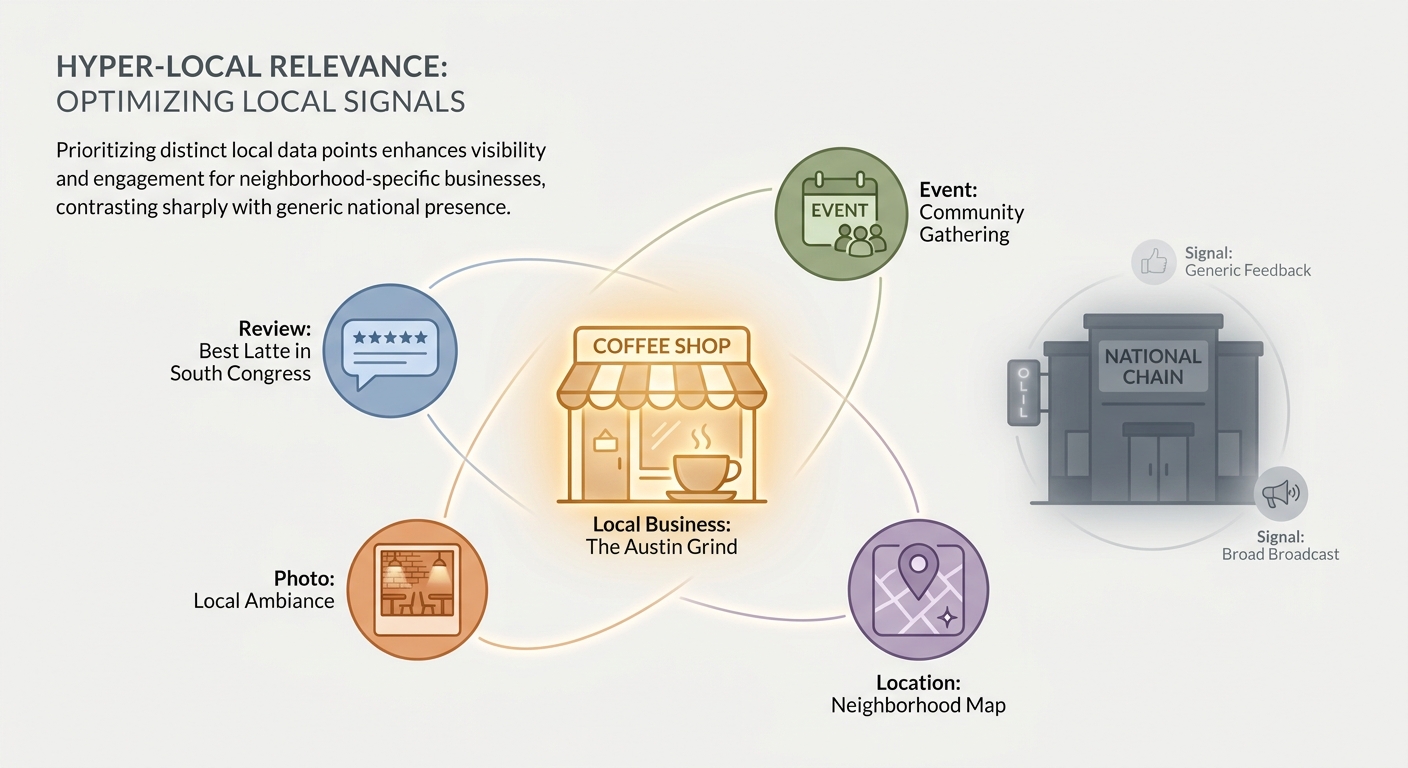
As community members note, queries are evolving from “pizza near me” to “Where can I get a gluten-free pizza that’s open late and delivers downtown?” [10]. In these scenarios, a single-location business with deep, highly localized review data and content builds stronger AI Triangulation Signals. A 97 Switch case study for The Albert, a single-location restaurant, proved this by combining a strong local SEO foundation with enhanced GBP data and review management to compete effectively in AI-assisted search [8]
.
This pillar involves two key actions:
- Lean into Single-Location Depth: National chains often have generic, shallow content for each location. A single Austin-based coffee shop can outperform a global chain by cultivating hyper-focused signals. This includes reviews mentioning specific neighborhoods (“best latte in South Congress”), user-uploaded photos of the local ambiance, and website content detailing partnerships with local suppliers or participation in community events. This creates a rich, locally-rooted identity that AI can easily grasp.
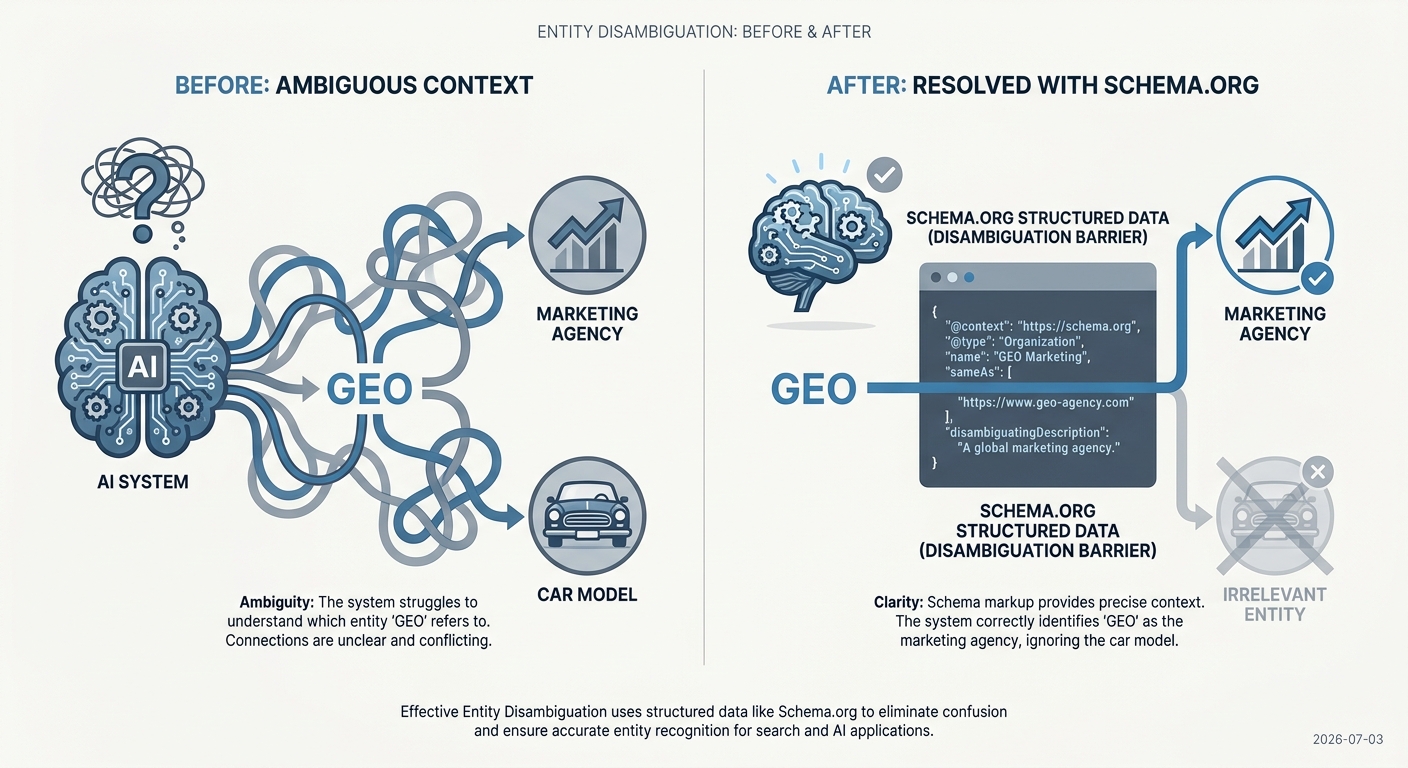
- Ensure Entity Disambiguation: You must explicitly tell AI who you are—and who you are not. Failing to separate your brand from homonyms (words with the same spelling but different meanings) can kill visibility. For example, a marketing agency named “GEO” must prevent AI from confusing it with the legacy “Geo” car brand, which dominates search volume for related terms.
| Search Query | Search Volume (Per Month) | Entity Type |
|---|---|---|
| geo tracker for sale | Variable | Automotive (Legacy) |
| geo metro for sale | Variable | Automotive (Legacy) |
| geo tracker for sale near me | Variable | Automotive / Proximity |
| 1995 geo tracker for sale | Variable | Automotive / Temporal |
Understanding how LLMs process search is essential. You must use advanced technical schema (Pillar 3) and on-page content to separate your brand from the automotive noun in the Knowledge Graph. Research confirms that “schema markup increases brand citations in generative AI results” because it improves the AI’s understanding of entity connections [6]
💡 Schema is a Direct Instruction
Structured data is not just a hint; it’s a direct, machine-readable instruction. Using properties like `disambiguatingDescription` explicitly tells AI models what your business is (and what it is not), preventing costly confusion and improving citation accuracy.
.
Pillar 3: Ensure Technical Precision with Advanced Schema
The final pillar is communicating your trust and relevance to machines with technical precision. Hierarchical LocalBusiness and Organization schema acts as a direct translation layer for AI, clarifying who you are, what you do, and where you operate.

Google’s guidance says structured data is not required to appear in its generative search features, but generative responses do draw on business details. As they state, “Generative AI responses can include product listings, product information, and local business details” [1]. LocalBusiness schema can help clarify your business details for AI-generated local recommendations [7]. By nesting LocalBusiness markup within Organization schema, you provide a clear, machine-readable map of your brand’s identity and offerings.
Beyond the basics, focus on properties that directly answer conversational queries:
Key Schema Properties for Conversational Search
servesCuisine / hasOfferCatalog
Explicitly lists your food types or product/service offerings.
priceRange
Helps AI qualify your business for budget-specific queries like ‘affordable dinner’.
disambiguatingDescription
Crucial for clarifying your entity against others with the same name.
geo
Provides precise coordinates for ‘near me’ and location-based queries.
-
servesCuisineorhasOfferCatalog: Explicitly lists what you sell. -
priceRange: Helps AI qualify your business for budget-specific queries. -
disambiguatingDescription: A crucial property for clarifying your entity against homonyms (e.g., “A digital marketing agency, not related to the automobile brand”). -
geo: Provides precise coordinates for “near me” and location-based synthesis.
Illustrative example (fictional business, not taken from Schema.org’s documentation):
{
  "@context": "https://schema.org",
  "@type": "Restaurant",
  "name": "The Downtown Bistro",
  "disambiguatingDescription": "A modern American restaurant in Austin, TX, specializing in farm-to-table cuisine. Not affiliated with any automotive brand.",
  "address": {
    "@type": "PostalAddress",
    "streetAddress": "123 Main St",
    "addressLocality": "Austin",
    "addressRegion": "TX",
    "postalCode": "78701",
    "addressCountry": "US"
  },
  "geo": {
    "@type": "GeoCoordinates",
    "latitude": "30.267153",
    "longitude": "-97.7430608"
  },
  "servesCuisine": "Modern American",
  "priceRange": "$$$"
}
Finally, ensure your site is verified in Google Search Console. This is a foundational step that allows Google to communicate with you about technical issues and provides access to performance data, which is essential for diagnosing problems with how your site is crawled and indexed [1].
Frequently Asked Questions About Local GEO
What is GEO in local marketing?
Generative Engine Optimization (GEO) is the practice of optimizing your digital presence to be cited directly by AI features like Google’s AI Overviews. This involves structuring your business data (Pillar 3), enhancing entity authority through quantitative proof like reviews (Pillar 1), and managing your online reputation so that AI models confidently recommend your physical location to users.
How does Generative Engine Optimization differ from local SEO?
Local SEO vs. Local GEO
| Option | Pros | Cons |
|---|---|---|
| Traditional Local SEO | Focuses on ranking in established formats like the Google Map Pack. | Less effective for direct citation in new AI Overviews and conversational answers. |
| Generative Engine Optimization (GEO) | Aims for direct recommendation within AI answers, capturing ‘zero-click’ traffic. | Requires more technical precision (schema) and a higher volume of qualitative data (reviews). |
While traditional local SEO focuses on ranking in the Google Map Pack through proximity and citations, GEO focuses on direct LLM citation and entity disambiguation. Learning about Generative Engine Optimization GEO shows that success requires feeding structured, conversational context to AI models (Pillar 2 & 3), not just building standard directory links.
How can my local business appear in ChatGPT recommendations?
To appear in ChatGPT recommendations, a business benefits from a high volume of context-rich reviews (Pillar 1) and consistent entity signals. AI models cross-reference multiple high-authority platforms, so maintaining a high volume of context-rich reviews and consistent entity data across the web is essential for visibility.
What schema markup is required for AI local search?
Hierarchical LocalBusiness and Organization schema can help clearly define your entity to generative engines (Pillar 3), although structured data is not required to appear in Google’s generative search features. Nesting specific details like services (hasOfferCatalog), geographic coordinates (geo), and a disambiguatingDescription within this structured data helps AI confidently surface your business for hyper-specific local queries.
Limitations, Alternatives & Professional Guidance
AI search algorithms are volatile, and results can fluctuate without warning. The “black box” nature of LLMs means direct cause-and-effect for ranking changes can be difficult to prove definitively. The strategies outlined here represent the most effective, data-backed methods currently available. Businesses struggling with complex issues like entity confusion—especially those overlapping with legacy terms like “used geo tracker for sale”—should consult a specialized AI SEO agency. Professional guidance can provide advanced disambiguation strategies that go beyond the scope of this guide.
⚠️ A Note on Volatility
Generative AI is a rapidly evolving technology. The algorithms are a ‘black box,’ and visibility can change unexpectedly. The strategies in this guide represent the most stable, data-backed methods for building long-term authority.
Conclusion
Mastering google for local business in the AI era requires a strategic pivot from chasing clicks to earning citations. The path to dominating generative search is not about finding a single secret trick; it’s about building a resilient foundation based on our three-pillar framework: establishing algorithmic trust through a high volume of reviews, achieving contextual relevance with hyper-local depth, and ensuring technical precision with advanced schema.
By implementing this strategy, you stop competing for a spot on a list and start becoming the definitive answer. This is how you secure your position not just in today’s search results, but as the primary recommendation in tomorrow’s generative engines.
Audit Your AI Visibility in the US Market Today with Airankia to see where you stand and begin building your GEO dominance.
References
[1] Google's Guide to Optimizing for Generative AI Features on
[2] Google AI Search for Local Businesses: Reviews, GBP, Schema | Cheers
[3] Local SEO Ranking Factors 2026 [Full Algorithm]
[4] How AI is reshaping local search and what enterprises must do now
[5] 7 Google Business Profile Optimization Tips to Drive Visibility
[6] Schema Markup for AI Search: Complete Guide – SEOptimer
[7] Structured Data AI Search: Schema Markup Guide (2026) – Stackmatix
[8] AEO & GEO Case Studies: Real Answer Engine Optimization Results, ROI & Proven Strategies (2026)
[9] Google AI Overviews for Local Businesses: How to Appear in 2026
[10] AI Overview Statistics: The Latest Data, Trends & What They Mean