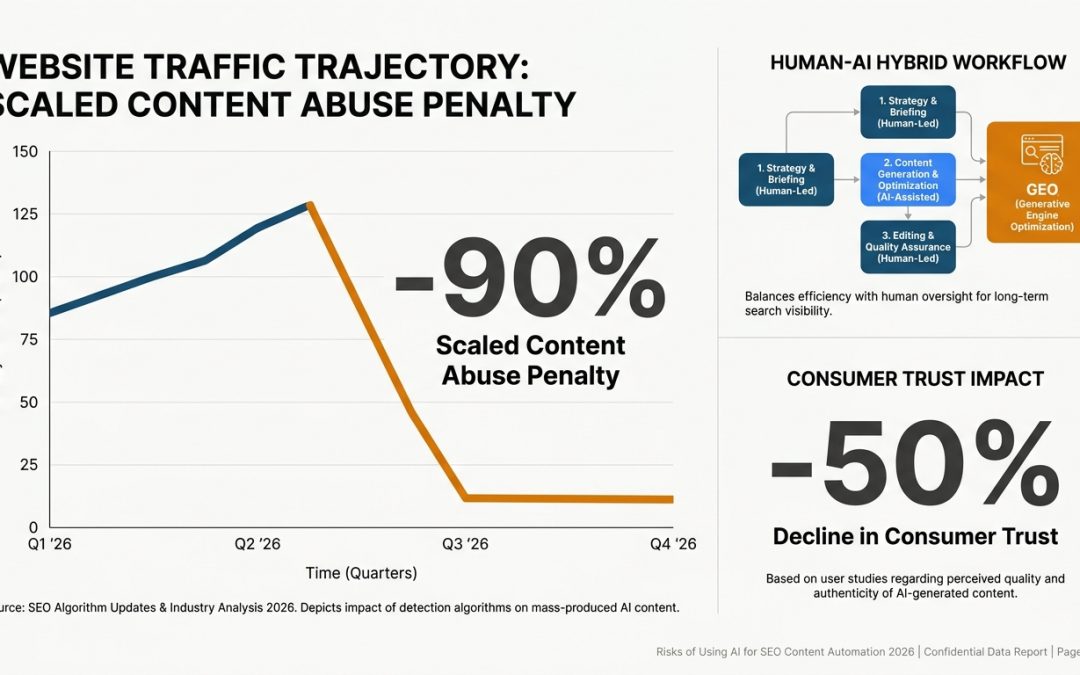
In 2026, the greatest risk of using AI for SEO content automation isn’t the tool—it’s Google’s spam enforcement. Google penalizes “scaled content abuse,” a practice that, according to Google’s spam policies, can leave a site ranking lower or dropping out of results altogether. For US businesses deploying unedited AI content, the consequences are stark: a loss of consumer trust (Raptive research found trust falls by nearly 50% when content is perceived as AI-generated) and a direct hit to the bottom line. To safely scale, marketing directors must evolve, implementing a Human-AI Hybrid Workflow that injects brand voice, cultural nuance, and verifiable expertise. This is the critical transition from traditional SEO to Generative Engine Optimization (GEO).
⚠️ The Core Risk in 2026
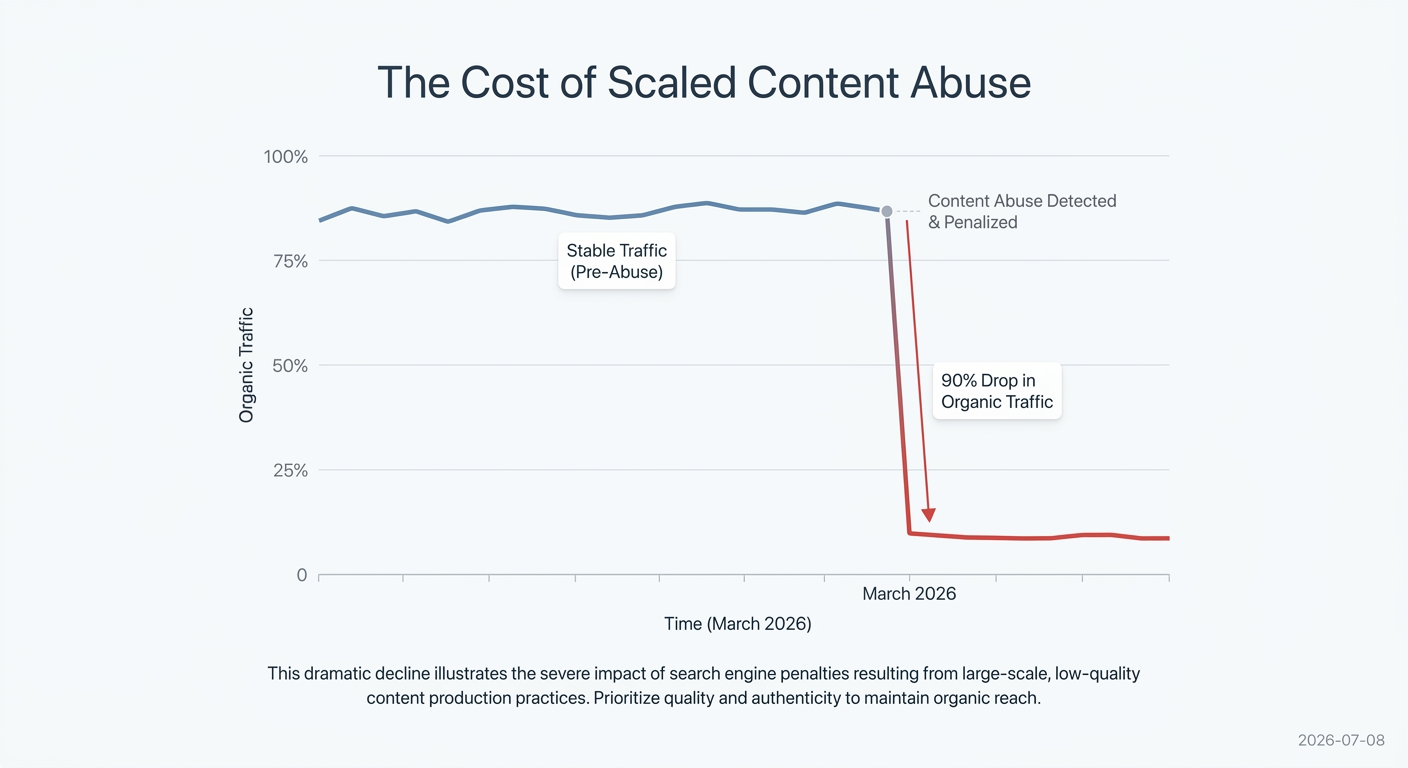
Google doesn’t penalize AI—it penalizes ‘scaled content abuse.’ Deploying unedited, low-value AI content at scale can lead to severe traffic penalties and erode consumer trust.
The Google March 2026 Core Update sent shockwaves through US B2B SaaS companies, leaving many with devastated organic traffic. According to Google’s Search Status Dashboard, the update began rolling out on March 27, 2026 and finished on April 8, 2026
. This sudden shift sparked immediate anxiety regarding the risks of using AI for SEO content automation in 2026. Does Google actually penalize AI?
The short answer is no; Google penalizes scaled content abuse—the mass production of low-quality pages—not the technology itself [10]. As noted by industry analysts, Google’s core updates have long targeted manipulative spam, a trend that culminated in its March 2024 update which aimed to reduce low-quality, unoriginal content by 40% and, according to Google, reported a 45% reduction in low-quality, unoriginal content by April 2024, a result it attributed to the March 2024 update combined with earlier efforts [5]. The 2026 update simply reinforced this with more sophisticated tools.
At AI Rankia, we monitor 17+ AI engines, and we believe automation can support growth when governed correctly. This guide provides a concrete, US-focused hybrid workflow to help you avoid algorithmic penalties and optimize your digital presence for 17+ AI search engines.
Author: Pedro Spota
Title: Director of Growth | Co-Founder of AI Rankia
Pedro Spota designs and implements data-driven growth systems tied to revenue and cost reduction. With over six years of experience, he leads AI-driven marketing, sales, and SEO workflows, leveraging advanced frameworks like n8n to optimize conversion lift and lower cost-to-serve. LinkedIn
Disclosure: This guide is developed by AI Rankia’s intelligence team based on the public sources cited in the references and in the text, including US consumer research from Raptive and traffic analyses by Lily Ray
.
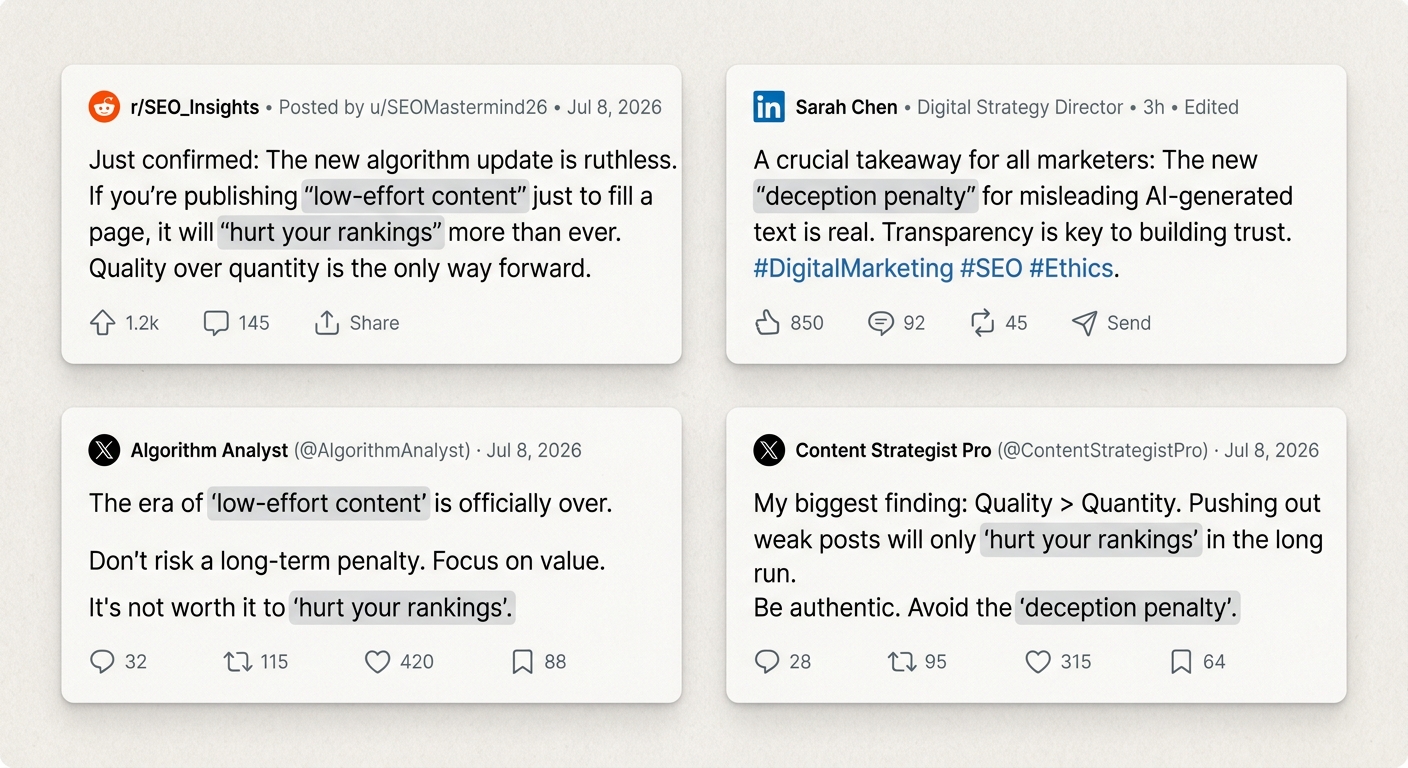
Reddit (/r/DigitalMarketing): “AI content is killing SEO when it’s mass-produced. They flag low-effort content that lacks information gain.”
LinkedIn (Nitin Kamani): “AI can accelerate SEO growth — but only when used strategically. Used incorrectly, it can hurt your rankings, brand authority, and long-term visibility.”
Twitter/X (Glenn Gabe): “Site hit with a manual penalty for using AI to fake human writers… That’s a deception penalty, not an AI penalty.”
The Reality of Scaled Content Abuse in the US Market
The core risk of AI content automation is being flagged for “scaled content abuse,” a violation that Google now enforces with precision. Google’s quality systems and SpamBrain are designed to identify content produced at scale without meaningful human editorial oversight [3]
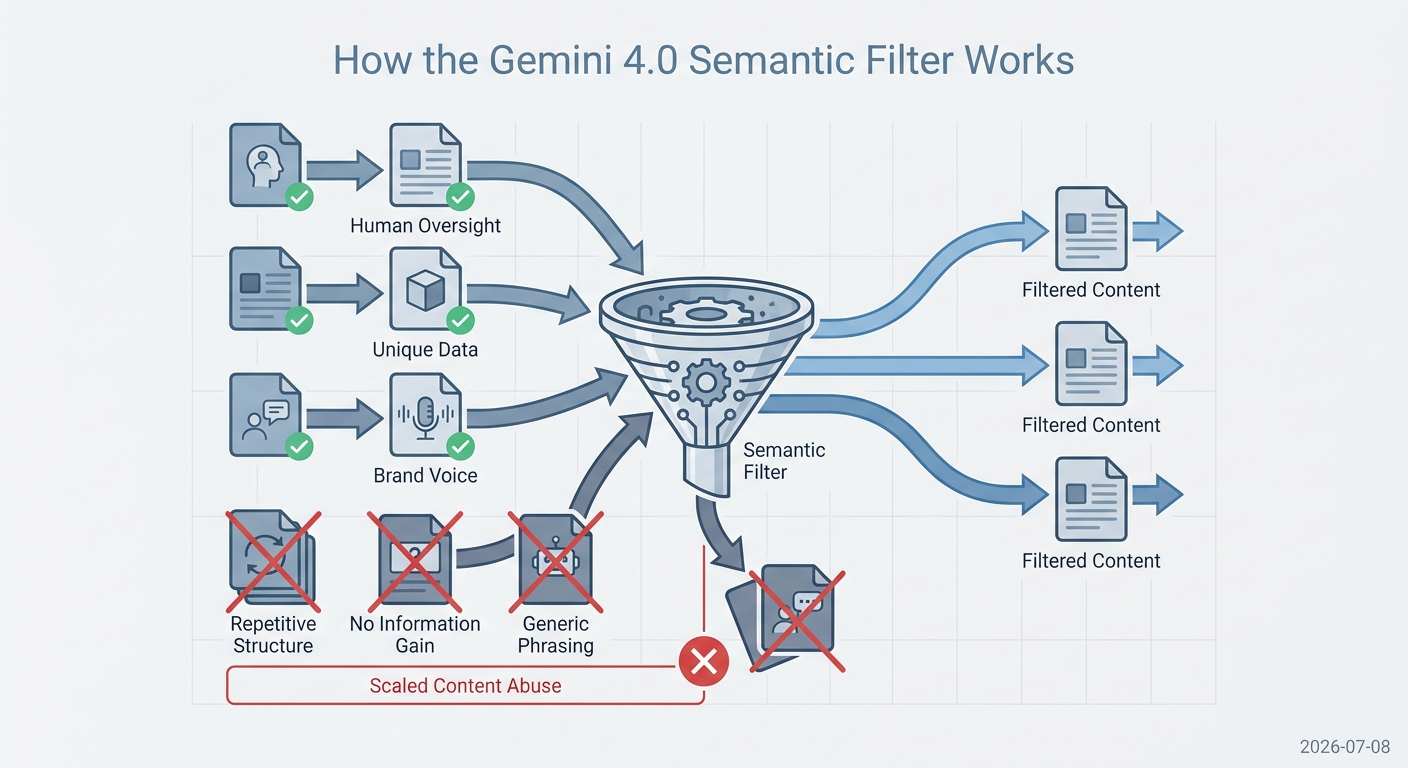
. This isn’t about detecting AI; it’s about detecting a lack of value.
When businesses deploy unedited AI text, they expose themselves to severe ranking consequences. An analysis by Lily Ray of more than 220 sites found that 54% lost at least 30% of their peak organic traffic, 39% lost at least 50% and 22% lost at least 75%. This enforcement extends beyond traditional search results, as Google’s spam policies now officially cover generative AI responses in Search, including AI Overviews and AI Mode [1].
Understanding the risks requires looking beyond search rankings. A study commissioned by Raptive surveyed 3,000 US adults and found a severe erosion of brand credibility when users detect low-quality, automated content. This data reveals a direct link between poor automation and bottom-line business metrics.
| Metric | Impact of Unedited AI Content |
|---|---|
| Consumer Trust | Nearly 50% decrease (when content is perceived as AI-generated) |
| Purchase Consideration | 14% decrease |
| Premium Pricing Acceptance | 14% decrease |
These figures show that the risks of poor automation extend directly to revenue. To audit your site for vulnerability, review your publishing velocity and editorial workflows. If you publish hundreds of pages monthly without a documented human review process, you may attract scrutiny from Google’s spam systems. The system identifies structural footprints common in AI output, such as the overuse of transitional phrases (“In conclusion,” “Furthermore”) and repetitive sentence structures. Managing these footprints is a core component of effective AI Reputation Management
✅ Conduct a Vulnerability Audit
Review your content workflow. If you publish hundreds of pages monthly without a documented human review process, your site may be at high risk of being flagged for scaled content abuse. Check for overuse of common AI transitional phrases and repetitive sentence structures.
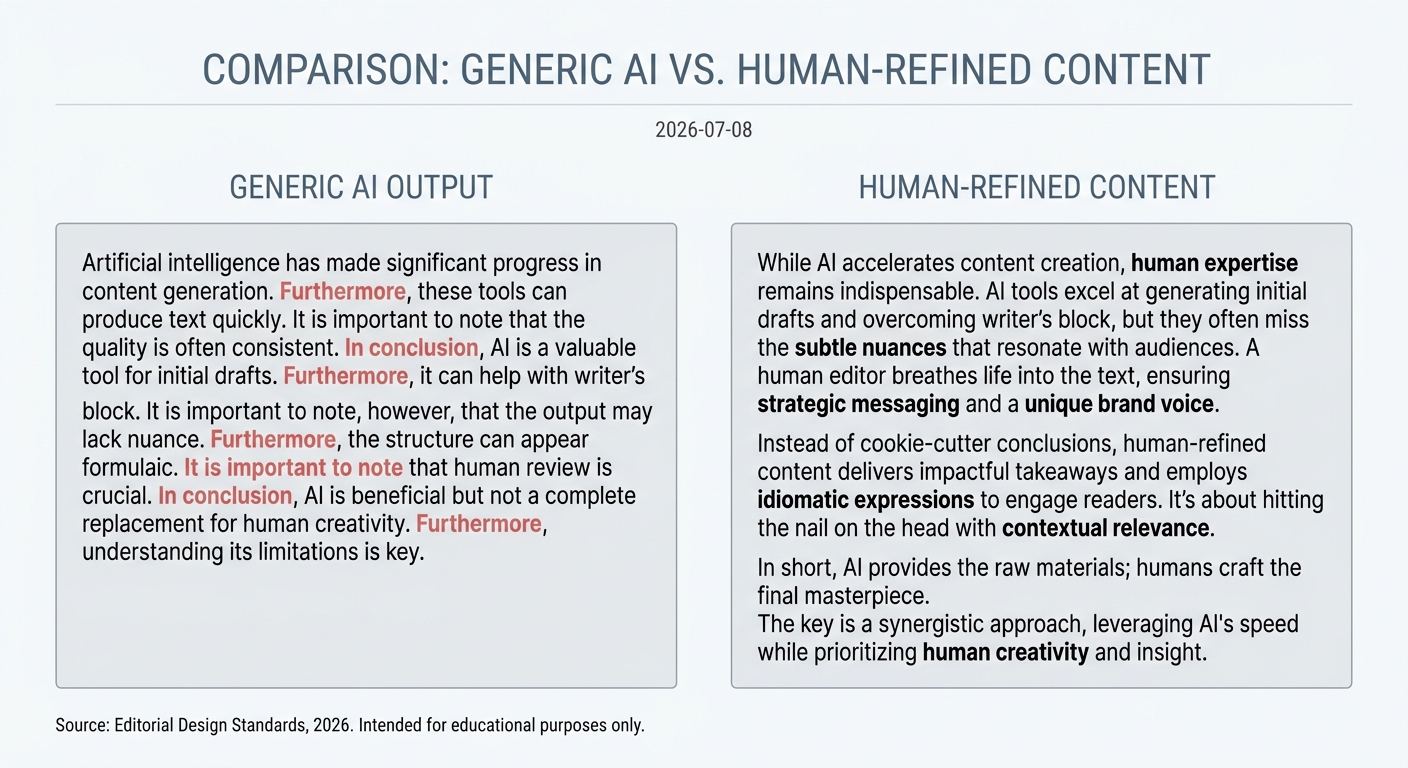
.
Human-AI Hybrid Workflow to Prevent Brand Voice Dilution
The most common advice for mitigating AI content risk is to “edit it so it sounds like your brand,” but this lacks a concrete, scalable workflow. A robust defense requires a structured Human-AI Hybrid Workflow. This process uses AI for initial drafting and research but relies on human experts for critical augmentation and refinement, a methodology proven to be effective [9].
Our advantage lies in orchestrating this process with a structured AI content enhancement workflow [6]
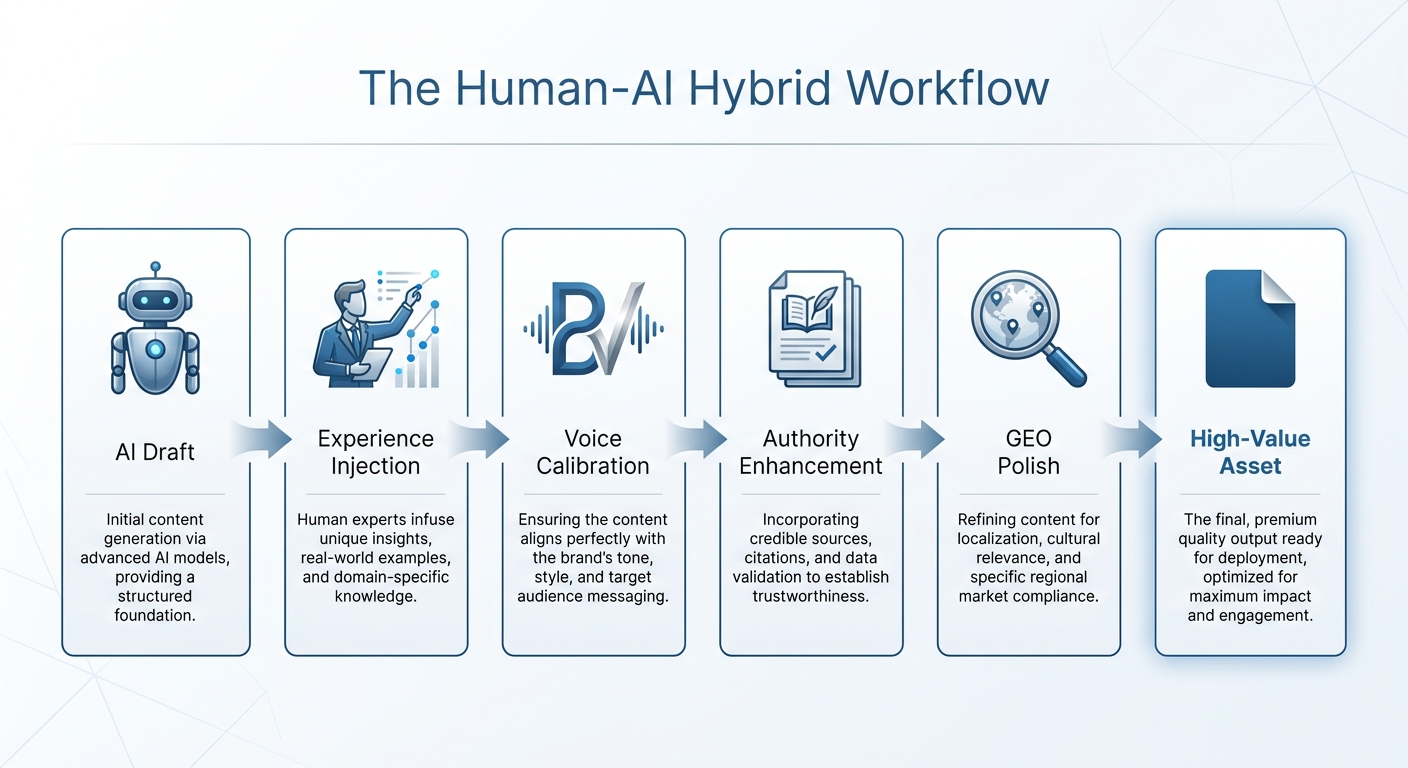
. This workflow moves content from a generic draft to a valuable, brand-aligned asset.
- Experience Injection: The human editor adds real case studies, specific data points, and firsthand observations that an AI cannot generate. This step directly addresses the “information gain” requirement of search engines.
- Voice Calibration: The editor aligns the AI’s output with brand voice guidelines. This involves removing generic, overly formal phrases and injecting personality.
- Authority Enhancement: The editor adds quotes from internal subject matter experts, cites authoritative third-party sources, and integrates unique company data to build credibility.
To overcome the predictable “AI tone,” editors must perform deliberate linguistic differentiation. Large Language Models (LLMs) default to a sanitized, predictable format. Human editors must inject literary devices to break these patterns and signal authentic expertise.
Linguistic Differentiation Tactics to Break the ‘AI Tone’
Cultural Grounding
Weave in idioms, metaphors, and references relevant to your target market (e.g., the US market) to build rapport and cultural fluency.
Rhythmic Variation
Mix short, punchy statements with longer, more complex sentences. Use literary devices like parallelism to create engaging momentum.
Structural Disruption
Alter standard syntax and paragraphing. Avoid the monotonous block-text format common in AI output to improve readability and signal authenticity.
Linguistic Differentiation Matrix:
| Tactic | Implementation Strategy |
|---|---|
| Cultural Grounding | Weave in idioms and references relevant to the US market to build rapport and demonstrate cultural fluency. |
| Rhythmic Variation | Vary sentence structure, mixing short, punchy statements with longer, complex sentences that use parallelism to create engaging momentum. |
| Structural Disruption | Alter standard syntax and paragraphing to avoid the monotonous block-text format common in AI output. |
This level of linguistic sophistication does more than engage human readers; it provides unique syntactical and semantic signals that help generative models differentiate your content from the sea of generic AI text, marking it as a higher-quality source for synthesis. This hybrid model ensures that content contributes to conversion lift and lower cost-to-serve without sacrificing quality. This approach is foundational for the new era of Generative Engine Optimization (GEO).

Legal Risks, AI Bias, and YMYL Vulnerabilities
The risks of unmonitored AI extend beyond algorithmic penalties into significant legal and reputational liabilities, especially for businesses operating in the US and international markets. Understanding these vulnerabilities is critical when evaluating the risks of using AI for SEO content automation in 2026.
The legal landscape is evolving rapidly. The EU AI Act, passed in 2024, is the first comprehensive AI regulation and categorizes AI models by risk level. It requires transparent labeling, data disclosure, and potential watermarking for generative AI used in content creation [4]
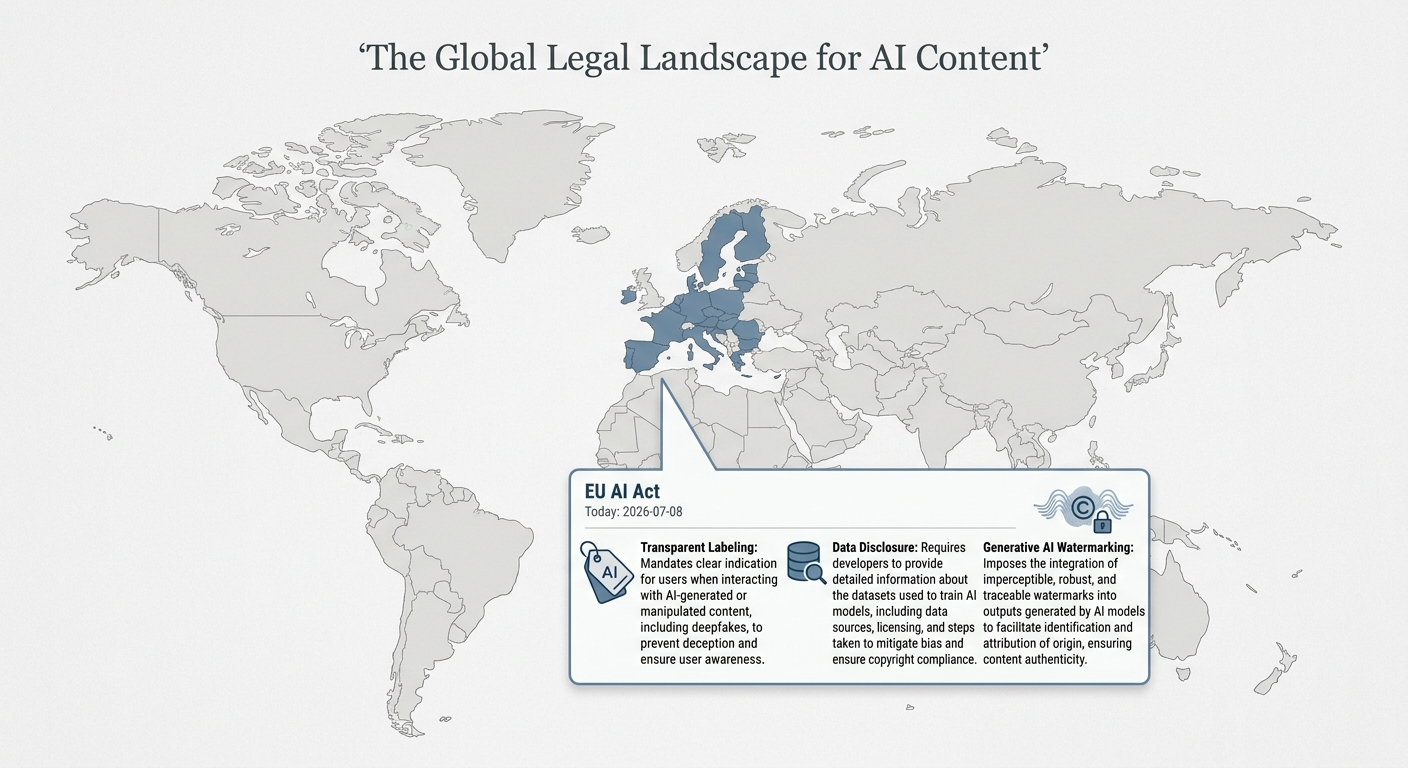
. US businesses with a global footprint must comply with these frameworks or face substantial fines and legal challenges. As industry expert Glenn Gabe noted, penalties are already being issued for “using AI to fake human writers,” which is classified as a deception penalty, not an AI penalty.
Beyond legal compliance, inherent AI bias poses a severe threat to brand reputation. LLMs trained on flawed or incomplete datasets can generate culturally insensitive, factually incorrect, or skewed perspectives. For a B2B SaaS company, this could manifest as biased marketing personas, exclusionary language in product descriptions, or flawed technical advice, contributing to the 14% decrease in purchase consideration seen in consumer trust studies.
These risks are magnified in YMYL (Your Money or Your Life) and technical B2B sectors. An AI generating API documentation could produce faulty code snippets. An AI writing a guide on security compliance could misinterpret regulations, exposing clients to risk. An AI explaining financial modeling features could “hallucinate” functions that don’t exist. Every piece of automated content, especially in technical fields, must be rigorously fact-checked by a subject matter expert to meet the high standards of modern search engines and protect your brand, a process central to Understanding LLM Integration in Modern Search Engines: A Beginner’s Guide
⚠️ Critical Risk for YMYL & Technical Content
In ‘Your Money or Your Life’ (YMYL) sectors like finance, health, and legal, AI errors are not just embarrassing—they’re a liability. All technical claims, code, and advice generated by AI must be rigorously fact-checked by a qualified subject matter expert.
.
Frequently Asked Questions
Does Google penalize AI-generated content in 2026?
Google does not penalize the use of AI tools directly, but it heavily penalizes “scaled content abuse.” If you publish mass-produced, unedited AI content that lacks unique information gain, it may be flagged as spam. According to Google’s 2026 guidelines, content quality and user value matter more than the creation method [2].
What is scaled content abuse according to Google’s March 2026 update?
Scaled content abuse is the automated generation of large volumes of low-quality pages designed to manipulate search rankings. The March 2026 update specifically targeted sites publishing AI content without meaningful human editorial oversight, focusing on the manipulative intent rather than the tools used [10].
How can US agencies safely automate SEO content?
US agencies can safely automate SEO by implementing a Human-AI Hybrid Workflow. This involves using AI for drafting and structuring, followed by human editors who inject unique case studies, brand voice, and verifiable expertise to ensure the content provides genuine value [9].
What are the legal risks of using AI for content creation?
The primary legal risks include copyright infringement, data disclosure violations, and non-compliance with global frameworks like the EU AI Act. US companies operating internationally must ensure transparent labeling of AI-generated assets to avoid legal repercussions and deception penalties [4].
How does AI content affect brand trust and user engagement?
Content perceived as AI-generated can drastically reduce brand trust, with Raptive research indicating trust falls by nearly 50% among US consumers. When users detect generic AI patterns, purchase consideration and willingness to pay premium prices may also decline by 14%, directly impacting revenue.
Can Google detect AI content automatically?
Yes, Google uses quality systems and SpamBrain to detect the footprints of low-quality automation. While it doesn’t use a simple “AI checker,” it identifies predictable linguistic patterns, lack of depth, and other signals of mass-produced, unedited content [3].
What is the difference between GEO and traditional SEO?
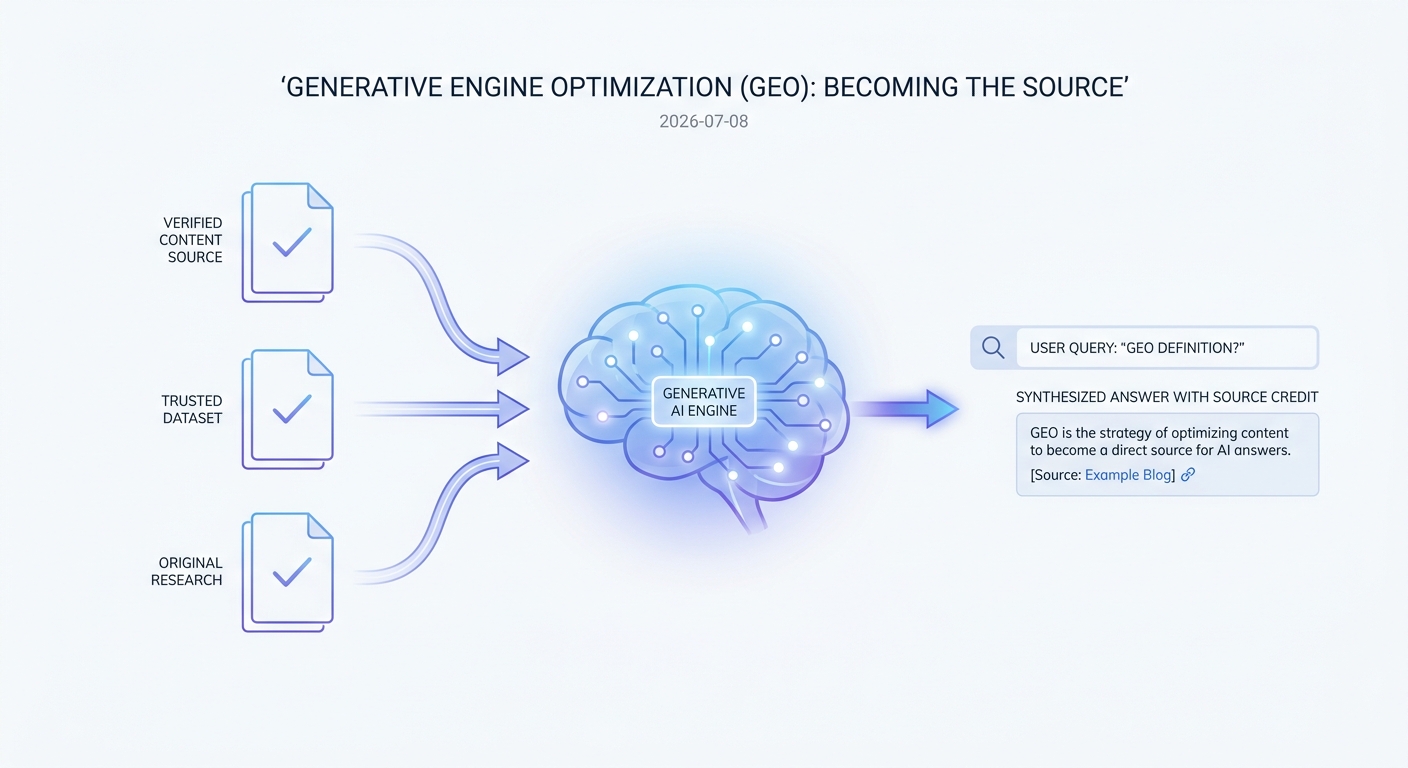
Traditional SEO focuses on ranking keywords on a search results page. Generative Engine Optimization (GEO) focuses on structuring content to be cited and synthesized by AI models like Google’s AI Overviews. GEO prioritizes verifiable facts, clear sourcing, and data-rich content that an AI can trust and use to answer a user’s query [7].
How do you maintain brand voice when using AI content tools?
You maintain brand voice through a strict Voice Calibration process within a hybrid workflow. This involves human editors injecting local idioms, distinctive syntax, brand-specific terminology, and personal anecdotes to break the predictable “AI tone” and align the output with your brand guidelines [6].
From Content Factory to Insights Engine: Building Your GEO Center of Excellence
While AI content tools like Jasper or ChatGPT are excellent for ideation and drafting, they are not replacements for human expertise. Relying solely on these tools for end-to-end production is the direct path to scaled content abuse penalties. The alternative is not to abandon AI but to build a governed, hybrid orchestration system—an AI content “Center of Excellence.” This structure transforms your marketing team from a reactive content factory into a strategic insights engine.
This model establishes a clear, three-tiered workflow with defined roles:

- AI Prompt Engineer / Wrangler: This specialist does more than just type queries. They are responsible for creating sophisticated, multi-step prompts, testing various AI models to find the best source for raw material, and structuring the initial drafts to align with the strategic goals of the content piece. They are the architects of the AI’s first pass.
- Subject Matter Expert (SME): This is your internal expert—an engineer, a product manager, or a senior strategist. Their role is to fact-check every technical claim, add proprietary data and unique analysis that only your company possesses, and inject firsthand experiences. They are the guardians of accuracy and the source of true E-E-A-T (Experience, Expertise, Authoritativeness, Trust).
- Brand Voice & GEO Editor: This final gatekeeper does more than a simple copyedit. They perform the final polish, ensuring the content is engaging and perfectly aligned with the brand’s persona. Crucially, they also optimize the content for Generative Engine Optimization (GEO) by ensuring factual statements are clear, data is well-cited, and the structure is easily parsable for AI models to use in synthesized answers [8].
💡 The SME: Your Most Valuable Asset
The Subject Matter Expert (SME) is the most critical role in defending against penalties. Their job is to inject proprietary data, firsthand experience, and verifiable facts—the very elements that AI cannot generate and that signal true E-E-A-T (Experience, Expertise, Authoritativeness, Trust).
This structured workflow is the foundation of GEO. Instead of just trying to rank on a SERP, GEO aims to make your content so reliable and authoritative that it becomes a primary source for AI models themselves. This approach builds a durable competitive moat around your brand’s authority, a level of quality that ad-hoc automation simply cannot achieve.
Conclusion
The risks of using AI for SEO content automation in 2026 are substantial, but they are entirely manageable with the right strategy. Google does not act as an “AI detector”; it acts as a “value detector.” It actively penalizes scaled content abuse, which can lead to devastating organic traffic drops and erode consumer trust for brands that rely on unedited, mass-produced text.
The solution is not to abandon automation but to master it. The future belongs to marketing directors who embrace the Human-AI Hybrid Workflow and shift their focus to Generative Engine Optimization (GEO). By using AI as a powerful assistant and layering in genuine human expertise, unique data, and brand personality, you can protect your brand while scaling content efficiently. This is the difference between surviving the AI transition and leading it. To see how this works in practice, review our Casos de Estudio: Éxitos y Fracasos de Motores Generativos en Acción.
Don’t leave your organic visibility and brand reputation to chance. Access a Free Trial or book an AI Rankia Demo today to receive automated action plans that protect and enhance your brand’s presence across all major AI search engines.
References
[1] Google spam policies now officially cover AI Overviews and AI Mode in Search
[2] Google AI Content Guidelines: Complete 2026 Guide
[3] Google March 2026 Core Update: What Changed & What To Do
[4] AI and the Law: Legal Risks in Content Creation | Markup AI
[5] Google Algorithm Updates & Changes: A Complete History
[6] AI Content Strategy: Balancing Automation with Authenticity
[7] Generative Engine Optimization (GEO): The New Frontier of Web Visibility in the Age of AI
[8] GEO Guide 2026: Generative Engine Optimization Explained
[9] When AI Blogging Becomes Spam: Avoiding Google Penalties