💡 Key Takeaways
A topical map is a structured knowledge graph that replaces outdated keyword lists, optimizing content for citations across 17+ global AI models. To succeed, brands must build complete semantic coverage of their topics, moving beyond traditional SEO tactics.
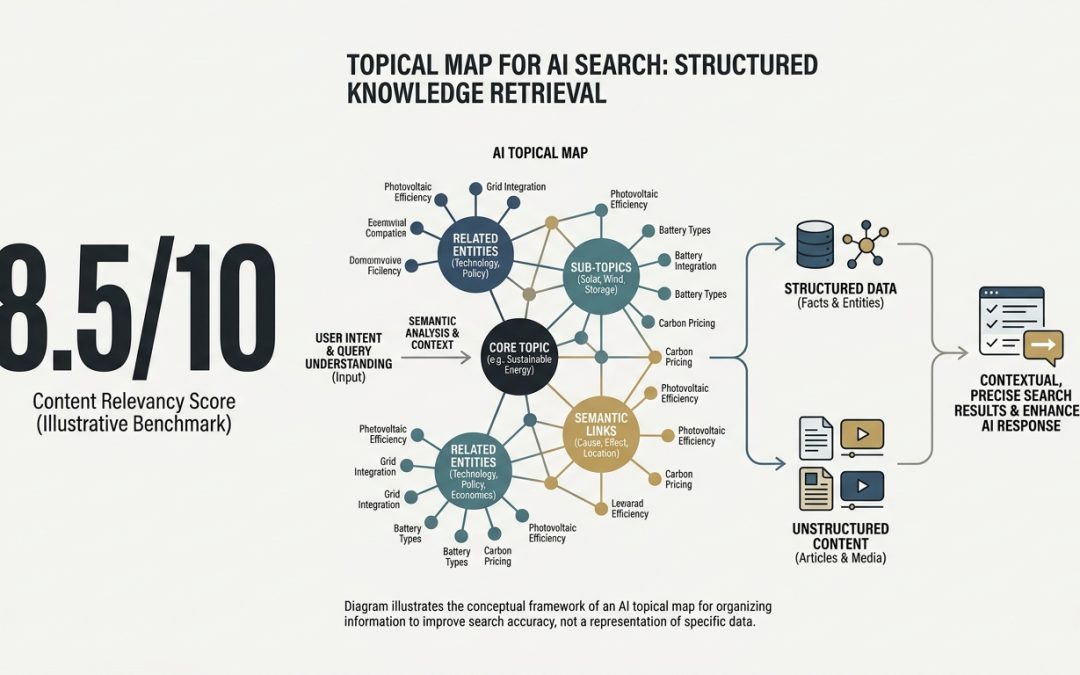
A topical map for AI is a structured semantic architecture that connects core digital entities, attributes, and multi-modal assets into a knowledge graph that Large Language Models (LLMs) can easily crawl and cite. Unlike traditional SEO keyword lists, an AI topical map optimizes for generative engines across 17+ global models, helping your B2B SaaS brand cover its topics completely so it can earn citations in AI answers.
The New Reality: From Search Engine Rankings to AI Citations
Traditional search traffic is in rapid decline for US B2B SaaS companies, and legacy SEO tactics are failing to capture the new wave of user discovery. As users migrate toward generative engines like Perplexity and Google AI Overviews, relying on outdated keyword lists is no longer a viable strategy. These AI systems don’t just “rank” pages; they synthesize information by understanding the relationships between concepts. Without a robust knowledge graph mapping your expertise, your brand becomes invisible.
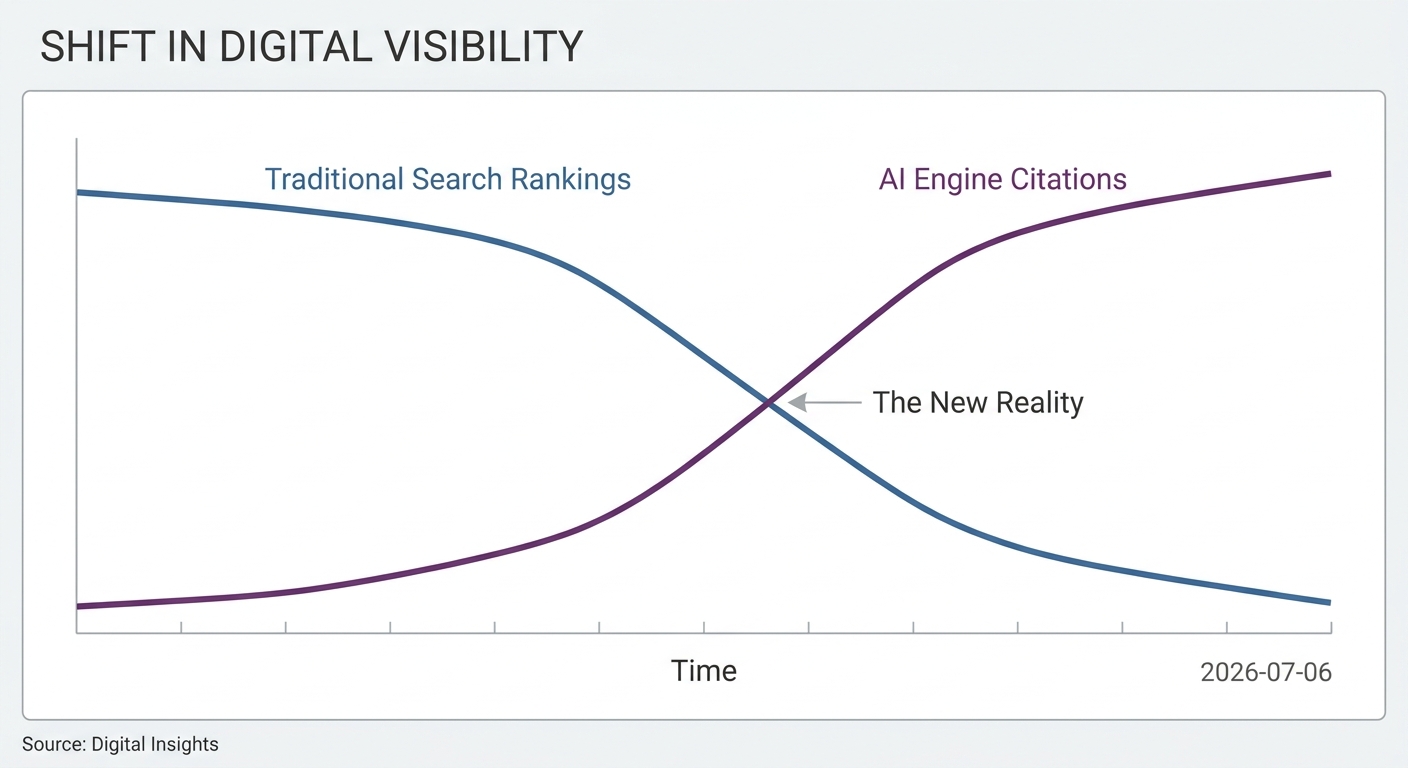
This guide moves beyond generic advice to provide a quantitative, automated, and global framework for Generative Engine Optimization (GEO). We will dissect the four critical AI gaps that cause most brands to fail in this new landscape and provide a clear methodology for building a topical map ai architecture that secures brand visibility across 17+ global models, including Baidu and Qwen. By structuring data specifically for LLMs, you can future-proof your digital presence and turn the threat of AI search into a powerful competitive advantage.
Author Credentials
Pedro Spota
Director of Growth at ELOGIA (Viko Group) and Co-Founder of AI Rankia. Pedro designs data-driven growth systems and orchestrates 200+ AI agents via n8n to optimize conversion lift and automate SEO workflows.
LinkedIn: https://www.linkedin.com/in/pedrospota
Transparency Disclosure: This guide is authored by the Co-Founder of AI Rankia. While it features objective data, third-party research, and industry consensus on Generative Engine Optimization (GEO), it includes references to AI Rankia’s automated action plans and tracking capabilities across 17+ AI models.
What is a Topical Map for AI? (And Why It Replaces Keyword Lists)
The transition from keyword lists to a semantic entity architecture marks a fundamental shift in digital strategy, moving from targeting text strings to modeling knowledge. For years, traditional topical mapping seo relied on search volume and flat keyword lists. This approach fails to provide the relational context that generative engines require to establish expertise and trust.
A topical map for AI, or a semantic architecture, defines how concepts relate to one another within a broader knowledge graph, forming a defensible digital asset for your company. This isn’t just a technical SEO update; it’s a strategic imperative. Brands that fail to build a robust semantic architecture are not just losing rankings; they are becoming invisible to an entire generation of AI-native users. As one industry report notes, well-structured and complete content is crucial for appearing in AI answers and summaries [1].
Consider the navigational metaphor of digital wayfinding. Just as consumers rely on maps for directions
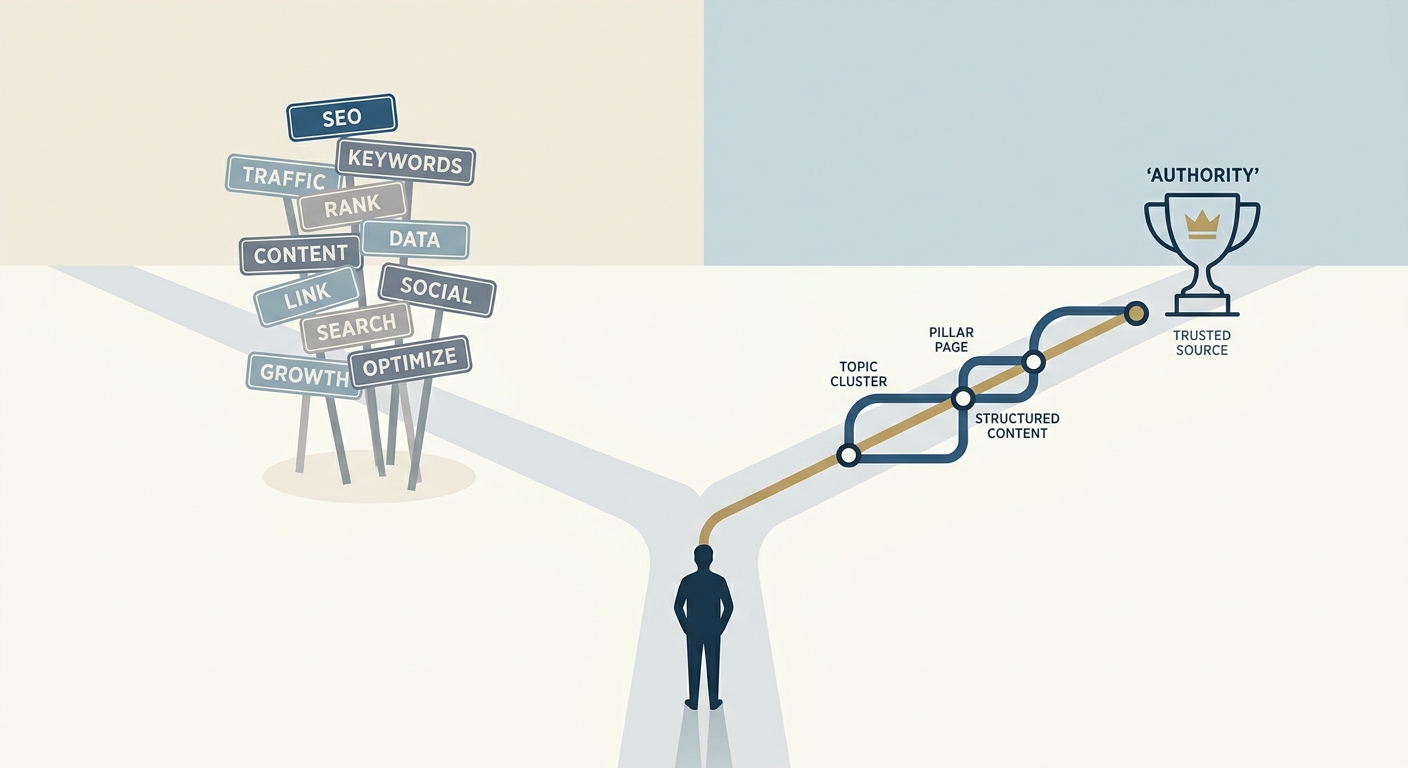
to understand physical spatial relationships, LLMs utilize semantic architectures to navigate digital entities. A well-defined seo topical map feeds clear, structured entity relationships directly to AI models.
For a B2B SaaS company offering “project management software,” a keyword list might include disconnected terms like “Gantt chart tool” and “team collaboration app.” A semantic architecture would instead define “Project Management Software” as the core entity, with “Gantt Chart” and “Team Collaboration” as features (attributes) and “Agile Methodology” as a related concept. To achieve this, practitioners must map the semantic cluster by asking: “What related entities, attributes, and concepts naturally surround this core entity in the Knowledge Graph?” [5]. Establishing these connections requires precise internal architecture, as generic internal linking wastes semantic signals. “Every internal link should use anchor text that names the entity or attribute” [6]
✅ Anchor Text Best Practice
Every internal link should use anchor text that precisely names the entity or attribute on the target page. Avoid generic phrases like ‘click here’ or ‘learn more’ to send clear semantic signals to LLMs.
.
The 4 Critical Gaps: Why Most Brands Fail at AI Search
Achieving visibility in AI search requires more than just creating content; it demands a strategic approach that addresses the specific requirements of LLMs. Most brands fail because they have significant gaps in their strategy. Here are the four most critical areas to address.
The 4 Critical Gaps in AI Search Strategy
Semantic Incompleteness
Failing to cover your core topics with complete entity, attribute and question coverage.
Global Myopia
Ignoring the fragmented global AI landscape beyond Google and ChatGPT, like Baidu’s ERNIE and Alibaba’s Qwen.
Passive Monitoring
Relying on manual tracking instead of automated workflows to patch content when AI citations are lost.
Text-Only Focus
Underutilizing multi-modal content (images, video, schema) which significantly boosts citation likelihood.
AI Gap 1: Missing Semantic Completeness
To secure citations from LLMs, your content should cover its topic completely, including the relevant sub-entities, attributes and questions. Generative engines don’t evaluate subjective quality; they measure semantic density and entity coverage.
Achieving strong semantic completeness requires a methodical approach that goes beyond surface-level definitions to cover the necessary sub-entities, attributes, and expert-level insights. This depth is crucial, as LLMs do not need expert sources for 101-level content [4].
AI Gap 2: Ignoring the Global AI Landscape (Beyond Google & ChatGPT)
Optimizing for a global footprint requires a topical authority map
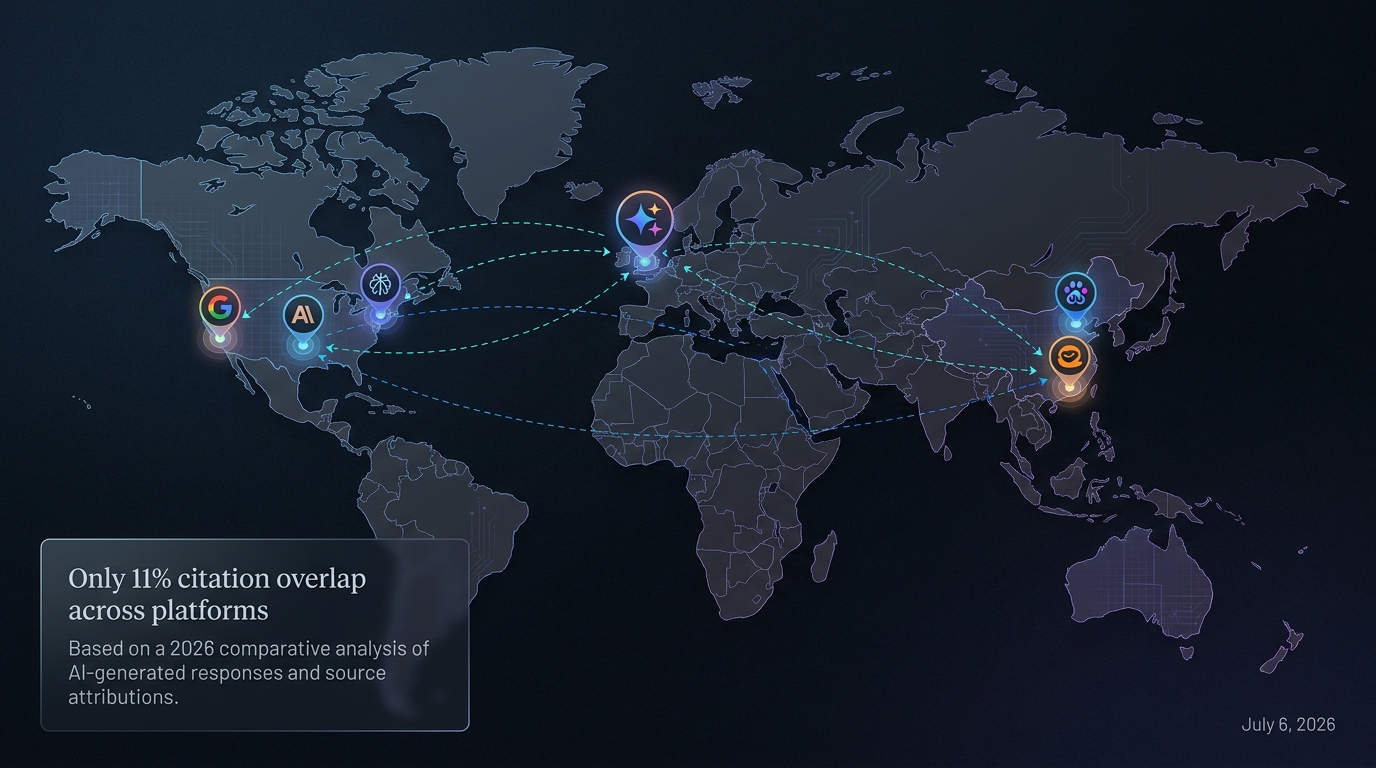
that extends beyond Google and ChatGPT. This narrow focus is increasingly risky for B2B SaaS companies targeting international markets. True global reach means optimizing across 17 models—including Baidu’s ERNIE Bot, Alibaba’s Qwen, Claude, and Gemini.
This global approach is critical due to the extreme fragmentation of AI citations. According to The GEO White Paper, the overlap of cited domains between ChatGPT and Perplexity can be as low as 11% [7]. This volatility proves that a single-platform strategy is highly vulnerable. Different LLMs also possess unique architectural and data biases. An entity map for “data privacy software” built for Gemini must account for GDPR, while one for Baidu’s ERNIE Bot must prioritize China’s PIPL. US enterprises must structure their entity relationships to be legible to these diverse algorithms to manage brand reputation across AI models on a global scale.
AI Gap 3: Relying on Passive Monitoring Instead of Automated Workflows
The generative search landscape demands a shift from passive monitoring to agentic workflows that automatically deploy content patches when AI citations drop. Manual keyword tracking in spreadsheets is obsolete. The necessity for automation is clear: an August 2025 Ahrefs study found that only 12% of URLs cited by ChatGPT, Gemini and Copilot appear in Google’s top 10 results [10]
⚠️ The Visibility Blind Spot
Only 12% of URLs cited by ChatGPT, Gemini and Copilot rank in Google’s top 10 results (Ahrefs, August 2025). Teams that only monitor blue-link rankings can miss a large share of the sources that AI answers actually cite.
. If your team only monitors traditional blue links, you are missing a large share of where AI engines source their answers.
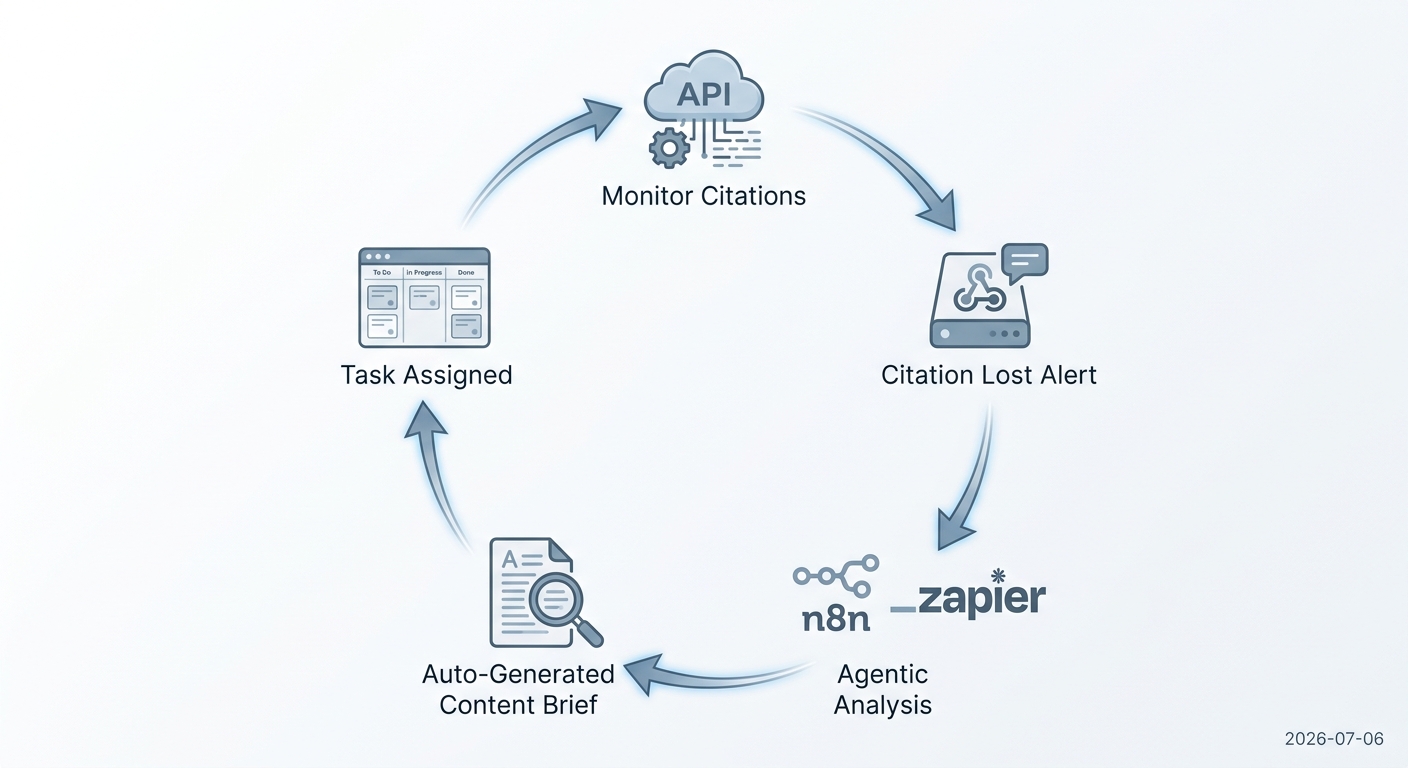
An effective automated workflow involves continuous API monitoring of citation status, triggered alerts via webhooks when a citation is lost, and an agentic analysis (via n8n or Zapier) that identifies the semantic gap. This triggers the automatic generation of a content update brief, assigned directly into a project management tool. This automated approach is a core component of Generative Engine Optimization fundamentals, improving efficiency by reducing the manual overhead required to maintain semantic authority.
AI Gap 4: Underutilizing Multi-Modal Content in Your Knowledge Graph
A successful AI search strategy must integrate images, video, and structured data (schema) into its architecture. Focusing purely on text-based content is a critical error. Generative engines increasingly synthesize text with visual and structured elements to provide comprehensive answers.
Industry data strongly supports this multi-modal approach. Research from Wellows states that multi-modal content drives 156% higher selection (r=0.92) in AI Overviews. When an LLM can associate a high-quality chart, infographic, or video with a text entity, the likelihood of citation increases significantly. Furthermore, data from Virayo indicates that comparative listicles (“Best X for Y”) account for 32.5% of AI citations. Embedding these elements into your seo topical map
is essential for understanding LLM integration and maximizing visibility.
How to Build a Foundational Topical Map: A 5-Step Framework
Moving from theory to practice, here is a step-by-step framework for building a foundational topical map that satisfies the demands of AI search.
#### Step 1: Define Your Core Entity & Audience Intent
Start by identifying a single, high-value concept you want to own. This is your core entity. For a B2B SaaS, this could be “Cloud Data Warehouse” or “Salesforce Integration Platform.” Then, map the primary intent of your target audience. Are they looking for comparisons, implementation guides, pricing, or problem-solving? This defines the “job to be done” for your content.
#### Step 2: Map the Semantic Cluster
With your core entity defined, brainstorm and research all related concepts. Group them into three categories:
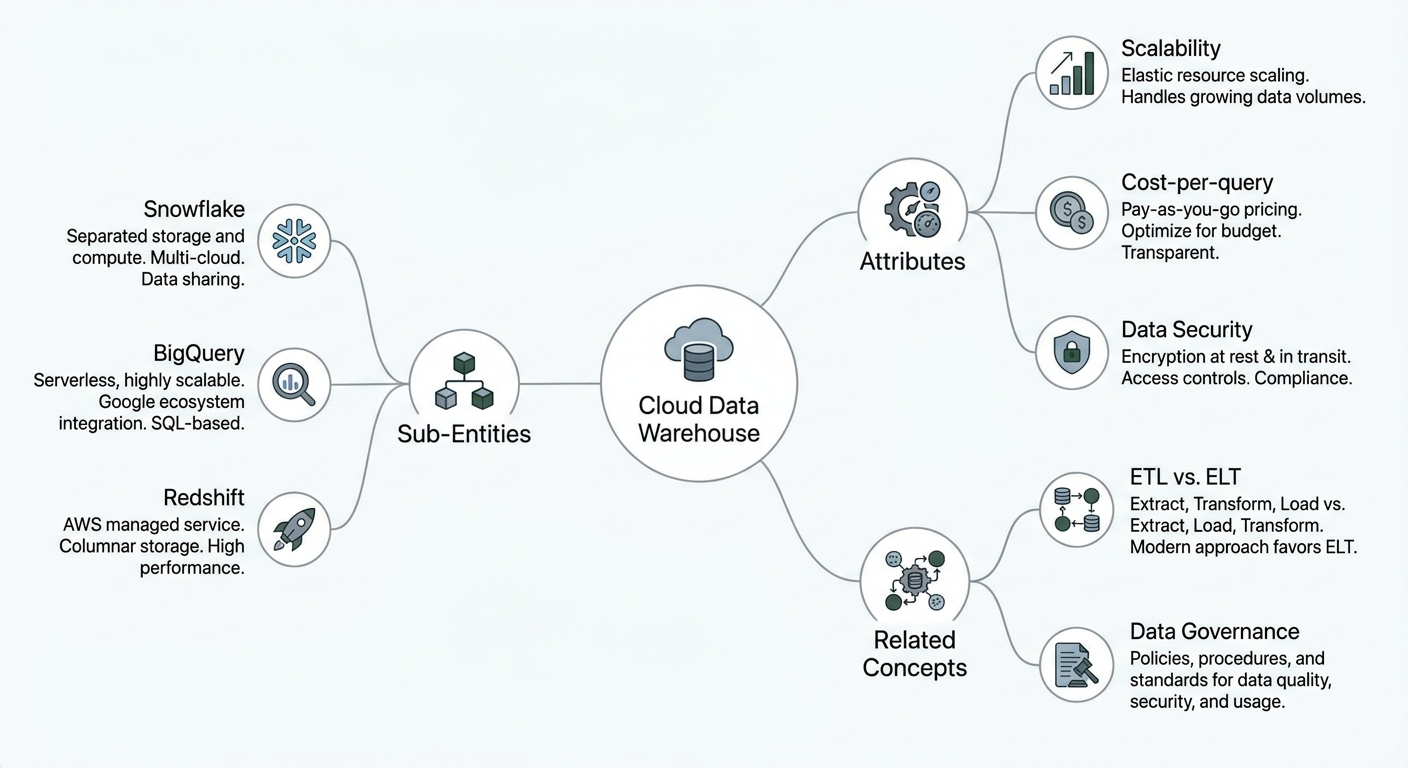
- Sub-Entities: The components or types of your core entity (e.g., for “Cloud Data Warehouse,” sub-entities are “Snowflake,” “BigQuery,” “Redshift”).
- Attributes: The features, properties, or characteristics (e.g., “scalability,” “cost-per-query,” “data security,” “real-time analytics”).
- Related Concepts & Questions: Broader topics and user questions that provide context (e.g., “ETL vs. ELT,” “What is data governance?,” “How to reduce data latency?”).
#### Step 3: Conduct a Content Gap Analysis & Score for Completeness
Audit your existing content against the semantic cluster map you just created. For each piece of content, score its semantic completeness on a 1-10 scale. Does your pillar page on “Cloud Data Warehouses” adequately explain and link to pages about “scalability” and “data governance”? Do you answer the key questions your audience is asking? This process will reveal your content gaps and help you prioritize new content creation or updates.
#### Step 4: Integrate Multi-Modal Assets and Structured Data
For each entity in your map, plan for non-text assets.
- Visuals: Does this concept need a comparison table, a workflow diagram, or a video tutorial?
- File Naming & Alt Text: Use descriptive, entity-rich file names (
cloud-data-warehouse-architecture.png) and alt text (“Diagram showing the architecture of a cloud data warehouse with data sources, ETL process, and BI tools”). - Schema Markup: Use
Article,FAQPage,HowTo, andImageObjectschema to explicitly tell AI models what your content is about and how its elements are related.
#### Step 5: Establish a Precise Internal Linking Architecture
Your internal links are the synapses of your brand’s knowledge graph. They signal relationships and pass authority between pages.
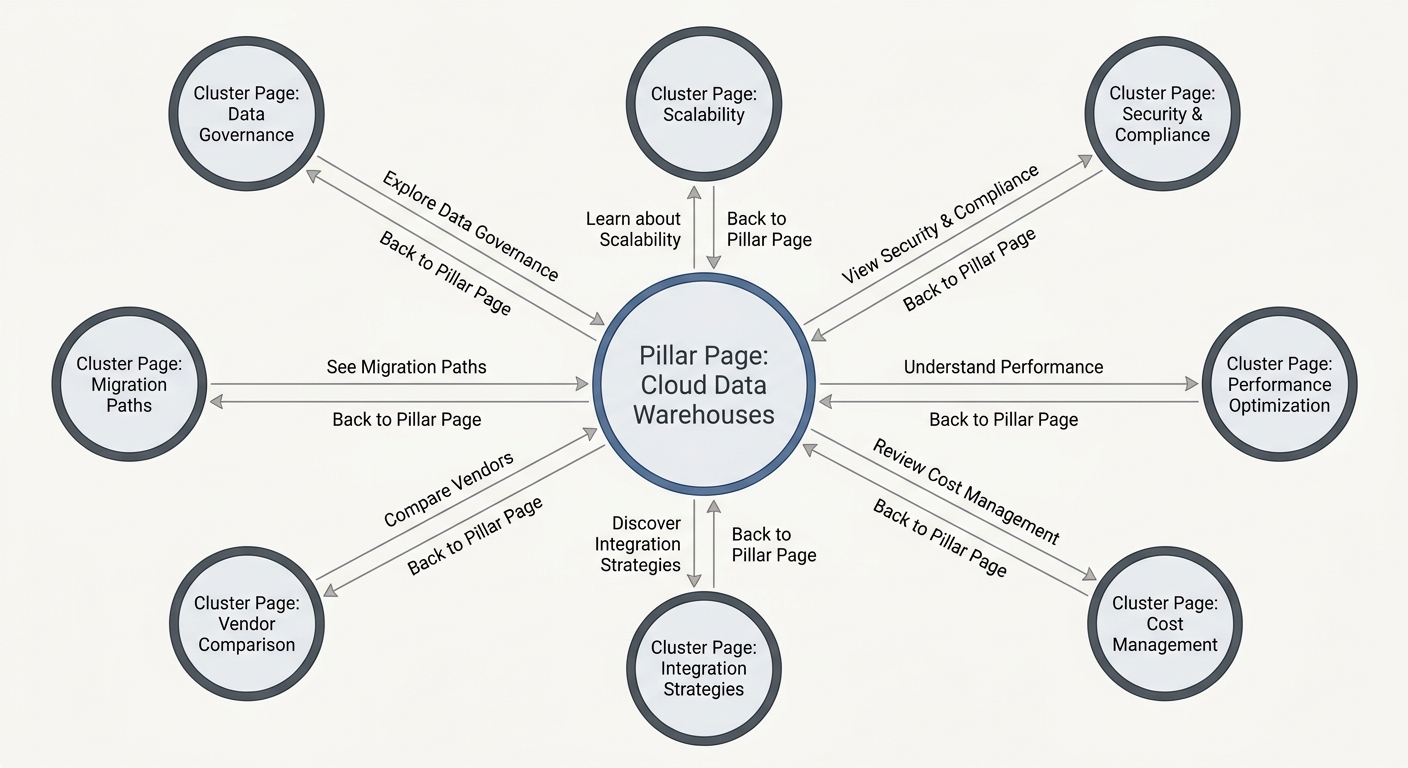
- Use Entity-Based Anchor Text: Link from a mention of “data governance” directly to your page on that topic using that exact anchor text. Avoid generic anchors like “click here.”
- Link from Authoritative Pages: Link from your main pillar page down to supporting cluster pages, and have those cluster pages link back up. This hub-and-spoke model reinforces the topical hierarchy for LLMs.
Strategic Implementation: Manual Spreadsheets vs. Automated GEO Systems
Choosing how to build and maintain your topical map ai architecture is a critical decision. The choice boils down to a manual, spreadsheet-based approach versus an automated, platform-driven one.
The Manual Approach (Spreadsheets & Human Audits)
Building a topical map manually in spreadsheets is slow, difficult to scale, and highly prone to human error. Because a 2025 Profound study measured cited sources rotating roughly 40–60% from one month to the next, a manual monthly audit can quickly become outdated, leaving your brand vulnerable and resulting in missed opportunities.
The Automated Approach (GEO Platforms & Agentic Workflows)
The superior alternative is a specialized GEO platform that continuously monitors and updates your semantic clusters. While tools can assist with initial mapping, a complete solution requires continuous, multi-model monitoring connected to agentic workflows. By using platforms like n8n to connect monitoring data with content deployment systems, teams can automate the entire process from gap detection to content patching.
| Factor | Manual Approach | Automated GEO System |
|---|---|---|
| Speed | Weeks or months to react | Real-time (minutes to hours) |
| Accuracy | Low; prone to human error | High; data-driven analysis |
| Scalability | Poor; resource-intensive | Excellent; scales far better than manual work |
| Visibility | Misses AI citations from pages outside the top 10 [10] | Full visibility across 17+ global models |
| Cost | Low initial tool cost, high long-term labor cost | Higher tool cost, low long-term labor cost |
For US Marketing Directors and SEO practitioners, the path forward is clear. A baseline audit of your current semantic completeness is the critical first step. But to win, you must invest in systems that match the speed and scale of AI itself.
Conclusion: From Topical Map to Dominant AI Presence
Surviving the decline of traditional search requires B2B SaaS companies to move decisively from outdated keyword lists to a robust semantic entity architecture. Building a comprehensive topical map ai is no longer optional; it is a structural necessity for generative engine discoverability. By closing the four critical AI gaps—achieving semantic completeness, integrating multi-modal content, expanding to global models, and automating workflows—your brand can secure a dominant advantage.
Stop passively monitoring traditional rankings while your AI visibility evaporates. The time for manual spreadsheets and slow, reactive content updates is over. Marketing teams must adopt automated, agentic workflows to patch content gaps in real-time and defend their authority. To transition from passive observation to proactive optimization, you need a system built for the new reality of search.
Discover how AI Rankia monitors your brand across 17+ AI engines at airankia.com.
Frequently Asked Questions (FAQ)
What is a topical map for AI search?
A topical map for AI search is a structured semantic architecture that connects core digital entities and their attributes to facilitate easy crawling by Large Language Models. It organizes content into a clear knowledge graph, ensuring that generative engines understand the depth, context, and relational hierarchy of your brand’s expertise, moving beyond simple keyword lists.
How does a topical map differ from traditional keyword research?
A topical map focuses on defining entity relationships and semantic context, whereas traditional keyword research relies primarily on search volume and isolated phrases. While keyword lists target specific user queries for standard search engines, semantic maps build a comprehensive web of knowledge designed to satisfy the contextual requirements of AI models.
What is the difference between GEO and traditional SEO?
GEO (Generative Engine Optimization) targets generative engine citations across multiple AI models, while traditional SEO focuses on ranking within the conventional 10-blue-links.
💡 GEO vs. SEO
Generative Engine Optimization (GEO) focuses on securing citations in AI answers across multiple models like ChatGPT and Perplexity. Traditional SEO focuses on achieving high rankings in the 10-blue-links of search engines like Google. GEO requires a deeper focus on semantic completeness and entity relationships.
GEO requires optimizing for semantic completeness, entity relationships, and multi-modal integration to secure visibility in AI Overviews, ChatGPT, and other conversational interfaces.
How do you structure a topical map for LLMs like ChatGPT and Perplexity?
Structuring a map for LLMs requires achieving high semantic completeness, integrating multi-modal assets, and avoiding basic 101-level content. You must build deep, expert-level content clusters that thoroughly explore sub-entities and attributes, utilizing descriptive anchor text and schema markup to explicitly define relationships for the AI.
Which AI models rely on semantic entity relationships?
All major AI models rely on semantic entity relationships, including Google AI Overviews, ChatGPT, Claude, Perplexity, Baidu’s ERNIE Bot, and Alibaba’s Qwen. Because these models synthesize information rather than just indexing links, they depend heavily on structured knowledge graphs to accurately retrieve, summarize, and cite authoritative sources globally.
References
[1] Topical Authority: Build Trust & Dominate Search Rankings
[2] How to rank in Google’s AI Overviews: A step-by-step guide
[3] Why topical authority isn’t enough for AI search
[4] How to Build Topical Authority for AI Search: A Comprehensive Guide
[5] Semantic SEO in 2026: NLP, Entities, and Knowledge Graphs – CONTADU Content Intelligence
[6] Semantic SEO: How Entity Architecture Drives Search Rankings & AI Citations
[7] The GEO White Paper: Optimizing Brand Discoverability in Models like ChatGPT, Perplexity, and…
[8] 15 Best GEO Tools For 2026: Generative Engine Optimization
[9] AI Ranking Factors: How AI Search Engines Select & Rank Sources 2026
[10] Ahrefs: AI Search Overlap – only 12% of AI-cited URLs rank in Google’s top 10