What is GEO?Generative Engine Optimization (GEO) is the technical process of structuring product data, reviews, and brand information to be accurately understood and cited by AI search models like ChatGPT, Perplexity, and Google AI Overviews.
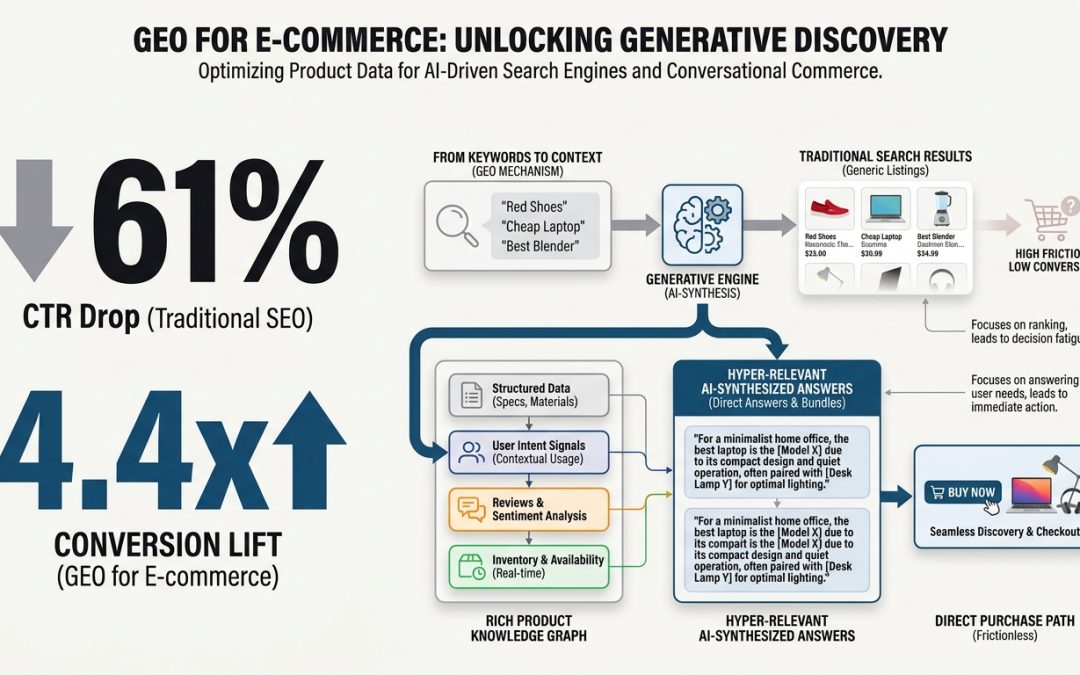
Why it Matters Now: The presence of Google AI Overviews can cause organic click-through rates to fall sharply, although Seer Interactive’s data shows the size of the impact has fluctuated since late 2025. However, the traffic that does arrive from AI tools converts at a 4.4x higher rate, making GEO essential for capturing high-intent buyers.
The Core Shift: GEO moves beyond traditional SEO’s focus on keywords and backlinks. It prioritizes entity authority, structured data (Schema), and “extraction confidence”—the ability of an AI to parse and trust your content.
💡 What is Generative Engine Optimization (GEO)?
GEO is the technical process of structuring your product data, reviews, and brand information so it can be accurately understood, trusted, and cited by AI search models like ChatGPT, Perplexity, and Google AI Overviews. It prioritizes entity authority and data structure over keywords.
Strategic Imperatives: Success requires tracking brand visibility across 17+ global AI models, automating content and schema updates with tools like n8n, and resolving entity ambiguity to ensure AI understands your brand’s specific context.
Introduction
The rapid deployment of generative AI has fractured the search visibility landscape, creating an existential threat and a powerful opportunity for e-commerce brands. Recent data reveals a stark new reality: organic click-through rates can drop sharply when Google’s AI Overviews are present. Yet, visitors who arrive from these AI-powered answers demonstrate a remarkable 4.4x higher conversion rate, alongside 59% longer visits (Adobe, July 2026) and 32% lower bounce rates in retail (Adobe, March 2026).
↓
Organic CTR Drop
Potential decrease in click-through rates when Google AI Overviews are present.
4.4x
Higher Conversion Rate
Visitors arriving from AI-powered answers convert at a significantly higher rate.
+59%
Longer Session Duration
Increased engagement from high-intent traffic originating from AI recommendations.
This high-stakes environment is intensified by rapid AI adoption in the B2B sector, where Gartner predicted that 80% of sales interactions between suppliers and buyers would occur in digital channels by 2025 [5]. For Marketing Directors and SEO Specialists at B2B SaaS and e-commerce companies, this shift is unsettling; the playbook that guaranteed traffic for a decade is now obsolete. The solution lies in a strategic pivot from passive keyword monitoring to an active, automated approach to Generative Engine Optimization (GEO). This involves leveraging automation workflows to continuously structure and optimize product data for a diverse ecosystem of AI models, ensuring your brand is not just found, but authoritatively recommended.
Author Credentials
Pedro Spota
Director of Growth at ELOGIA (Viko Group) & Co-Founder of AI Rankia
Pedro orchestrates a team of 200+ AI agents focused on marketing, sales, and SEO, leveraging advanced frameworks like n8n to optimize conversion lift and lower cost-to-serve.
This content is authored by Pedro Spota, Co-Founder of AI Rankia, an enterprise platform specializing in multi-model AI tracking and automated GEO action plans. The data, workflows, and case studies presented reflect AI Rankia’s proprietary methodologies and verified third-party research from academic and industry sources.
The Shift from SEO to Generative Engine Optimization (GEO)
The transition from traditional e-commerce SEO to Generative Engine Optimization (GEO) requires a fundamental change in how digital assets are structured and measured. While Google’s official documentation confirms that optimizing for generative AI is still part of SEO [3], the underlying mechanics are radically different. GEO prioritizes ‘semantic fitness’ and ‘extraction confidence’ over simple keyword repetition, forcing a re-evaluation of long-standing SEO practices [7][8]. As industry analysts and practitioners note, traditional rankings no longer guarantee visibility in AI answers; the new focus is on structured clarity and authority.
This shift is most evident at the product level. In a GEO framework, the Product Detail Page (PDP) is no longer just a landing page for humans; it becomes the primary source of truth for AI. Generative engines don’t skim for keywords; they retrieve granular specifications, buying logic, and attribute-to-benefit mappings directly from the PDP’s code and content. This requires a deeper, more structured approach.
Key Differences: SEO vs. GEO
🎯
Focus: Keywords vs. Intent
SEO targets keywords. GEO targets answering user intent directly for AI synthesis.
🔗
Authority: Links vs. Entities
SEO relies on link equity. GEO builds authority through structured data and verified entity information.
💬
Goal: Navigation vs. Answers
SEO aims to get a click. GEO aims to provide data for a direct answer within the AI interface.
📊
Metrics: Rankings vs. Citations
SEO measures success by rank position. GEO measures success by citation frequency and accuracy in AI answers.
Key differences include:
Keyword Density vs. Intent Matching: Traditional SEO often involved repeating target terms. GEO demands clear, precise answers formatted for easy synthesis by AI models, which analyze language using sophisticated transformer architectures [6].
Link Equity vs. Entity Authority: While backlinks still signal authority, AI engines increasingly rely on structured data (Schema.org) and entity disambiguation to verify a brand’s credibility and expertise.
Navigation vs. Direct Answers: Generative models aim to provide complete answers directly within the AI interface. This makes it crucial to structure PDPs and category pages for confident data extraction, not just for human navigation [9].
Success Metrics: SEO success is measured by rankings and organic traffic volume. GEO success is measured by citation frequency in AI answers, the accuracy of those citations, and the conversion quality of the resulting traffic.
To capture this high-intent audience, brands must adopt multi-model tracking to monitor how different Large Language Models (LLMs) interpret and present their products.
Challenge 1: The Multi-Model Visibility Gap
A common and costly mistake in early GEO strategies is focusing only on Google AI Overviews and ChatGPT. This narrow approach creates a significant visibility gap, as brands now compete for attention inside answers generated by a growing list of models including Gemini, Claude, and Perplexity. B2B buyers increasingly use multiple sources to research a purchase, many of which are AI-powered.
What’s missing from generic advice is the need for e-commerce tracking across a global ecosystem of 17+ AI models. This includes critical Chinese engines like Baidu (ERNIE Bot) and Alibaba (Qwen), which are essential for brands with international supply chains or those targeting the global B2B SaaS market. Relying on just one or two models provides a fragmented and dangerously incomplete view of your brand’s digital presence, risking inconsistent messaging and missed opportunities.
⚠️ The Danger of a Narrow Focus
Relying on tracking just one or two AI models gives a dangerously incomplete view of your brand’s digital presence. Different models prioritize different data, risking inconsistent messaging and missed opportunities in key markets, especially for global B2B brands.
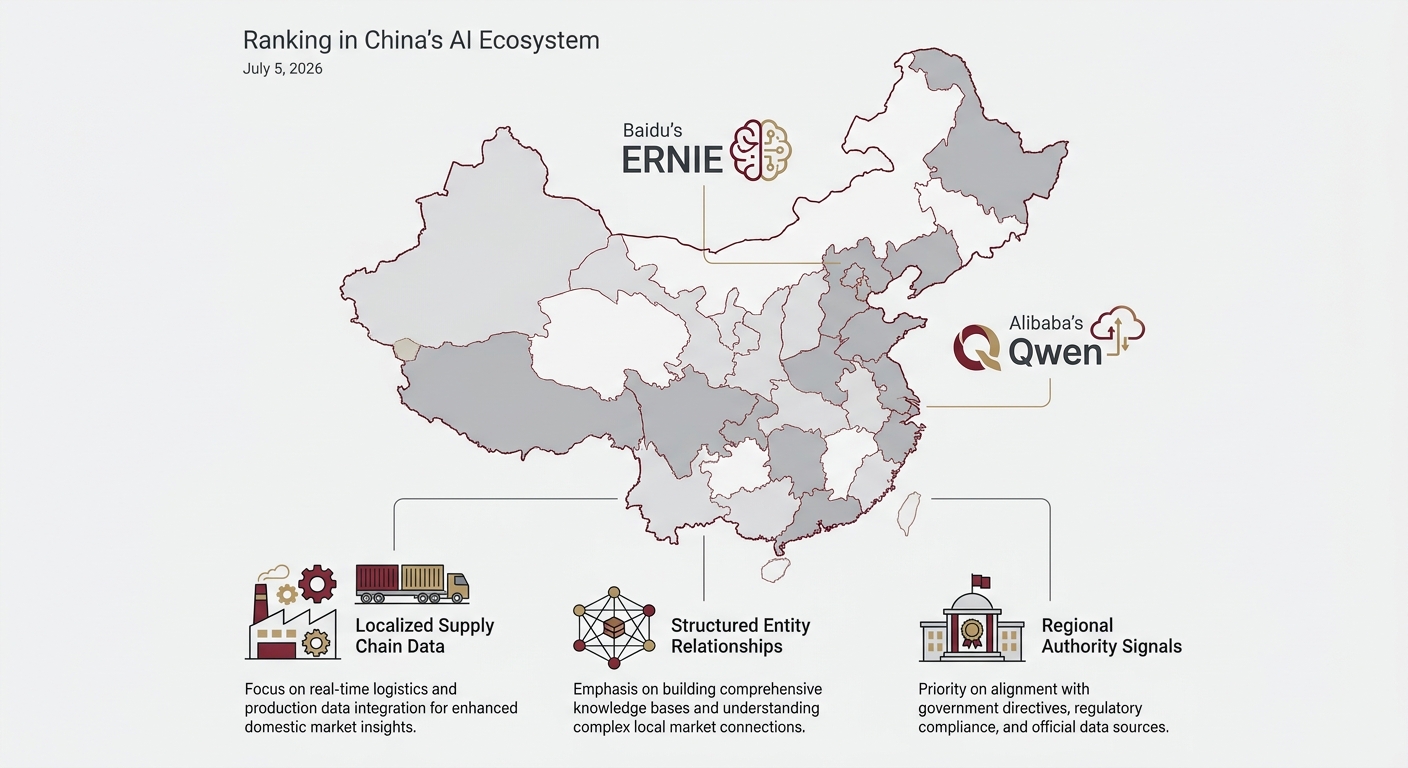
According to airankia.com, AI Rankia monitors 17+ AI engines. Continuous brand citation monitoring allows marketing teams to effectively manage brand reputation in AI across diverse geographic and linguistic contexts. Different LLMs prioritize different data; for instance, Baidu’s models may favor localized supply chain data, while Perplexity emphasizes real-time web extraction and authoritative sources.
To measure performance across this complex landscape, frameworks like the E-GEO benchmark offer a structured testbed for e-commerce GEO [2]. By actively monitoring these engines, brands can pinpoint where their extraction confidence drops and deploy targeted schema updates to regain visibility in specific AI ecosystems before significant traffic loss occurs.
Challenge 2: The Automation Deficit in Action Plans
Generic GEO advice often stops at recommending manual monitoring of brand mentions in AI outputs, typically through static dashboards. This reactive approach is unscalable for enterprise e-commerce and fails to capitalize on the efficiency gains AI promises. According to McKinsey’s 2025 State of AI report, some respondents report cost reductions from AI in functions such as software engineering, manufacturing, and IT.
The critical gap is the transition from passive visibility monitoring to prioritized, automated action plans that reduce cost-to-serve. Manual tracking leads to slow responses, whereas automated systems can trigger and deploy structural corrections in near real-time. This is the core difference between active GEO and passive observation when comparing enterprise AI tracking platforms.
A robust automated workflow follows three key steps:
1
🔔 Data Ingestion & Alerting
An n8n webhook triggers the moment a platform detects a drop in extraction confidence for a product across any monitored LLM.
2
✍️ Automated Content Chunking
Specialized AI agents rewrite product descriptions into legible ‘AI chunks’—bulleted specs and concise summaries that generative engines can easily parse.
3
🚀 Automated Schema Deployment
The system pushes updated JSON-LD schema (Product, Review, etc.) directly to the CMS to build trust and provide explicit signals to AI models.
Data Ingestion & Alerting: An n8n webhook triggers the moment a platform detects a drop in extraction confidence for a product or brand across any monitored LLM. This real-time alert ensures optimization efforts are immediate and precise.
Automated Content Chunking: Specialized AI agents rewrite product descriptions into legible “AI chunks.” This process, informed by how LLMs interpret content [6], breaks down dense paragraphs into bulleted specifications, attribute-benefit pairs, and concise summaries that generative engines can easily parse and cite.
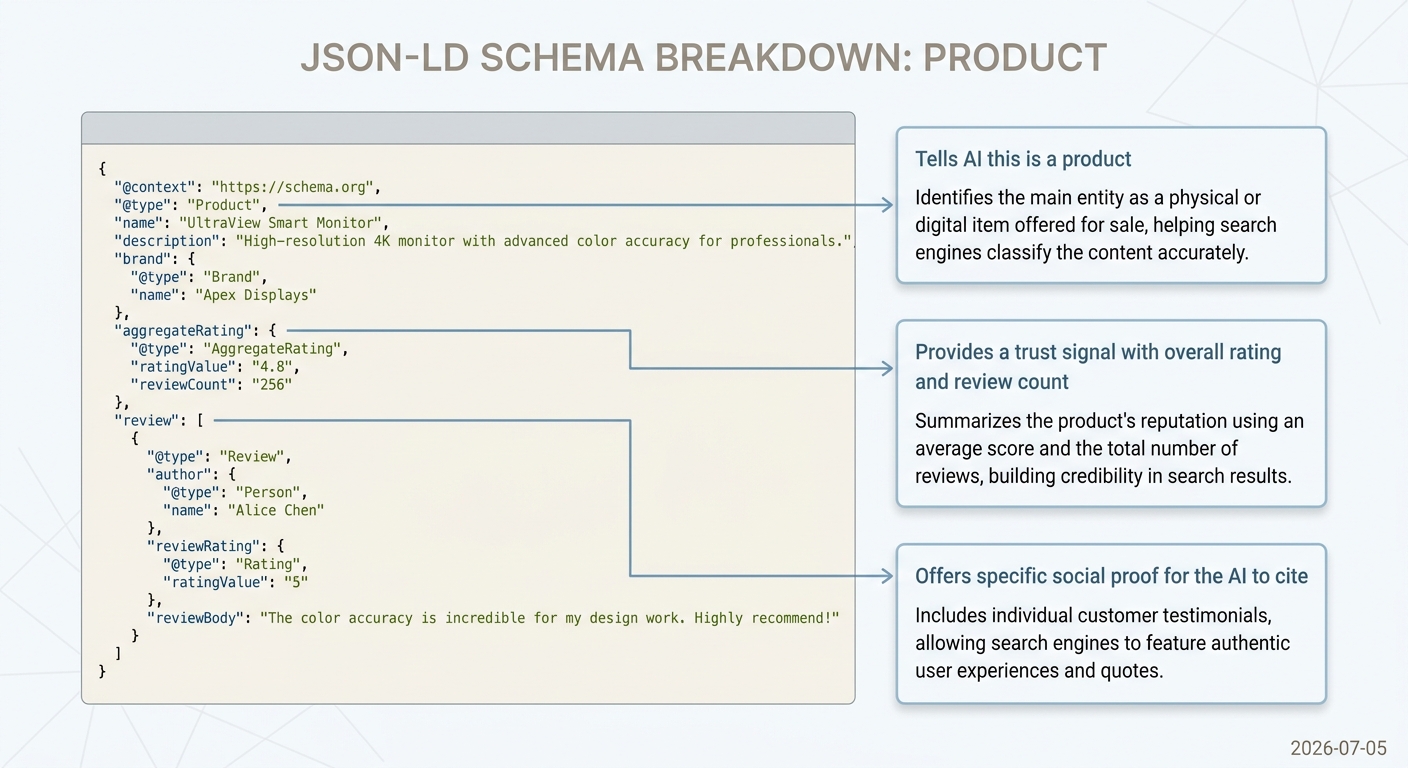
Automated Schema Deployment: The final step is pushing updated JSON-LD schema directly to the CMS. This focuses on injecting rich Product, Review, and Comparison schema into the page architecture. By providing explicit signals about product quality (aggregateRating) and social proof (review), this schema helps AI models build trust in their answers.
{
"@context": "https://schema.org/",
"@type": "Product",
"name": "Enterprise B2B Software",
"aggregateRating": {
"@type": "AggregateRating",
"ratingValue": "4.4",
"reviewCount": "89"
},
"review": {
"@type": "Review",
"author": {"@type": "Person", "name": "Jane Doe"},
"reviewRating": {
"@type": "Rating",
"ratingValue": "5"
},
"reviewBody": "This software transformed our workflow."
}
}A visual breakdown of a Product schema code snippet, explaining what each part like aggregateRating and review does for an AI engine.
The importance of this automated schema deployment was highlighted in a recent e-commerce case study. A specialty retail brand with strong SEO rankings was consistently excluded from AI shopping comparisons due to weak product schema, missing review schema, and a lack of structured comparison content. This aligns with academic research calling for an integrated framework for SEO, GEO, and AEO, where structured data is foundational for AI retrieval [1]
📊 Case Study: The Power of Schema
A specialty retail brand was consistently excluded from AI shopping comparisons. After automating schema enrichment for products and reviews, the brand reportedly improved its presence in AI-generated product roundups.
.
Challenge 3: US Entity Disambiguation (Software vs. Automotive)
When optimizing for a specific region, generic AI guidance often overlooks critical search intent conflicts. A prime example in the US market is the ambiguity between “GEO” (Generative Engine Optimization) and legacy automotive searches for the Chevrolet/Geo Tracker, a popular 90s SUV.
What’s missing from standard advice is the need for advanced negative matching and entity separation. Without these, an LLM might confuse a B2B marketing director’s query for “GEO software” with a car enthusiast looking to buy a used vehicle. Search volume data confirms this risk: queries like “geo tracker for sale” (3,600 monthly searches) and “geo tracker for sale near me” (480 monthly searches) can easily contaminate B2B software intent if entities are not strictly defined.
Mastery of semantic HTML and structured data is required to force LLMs to distinguish between these entities. Understanding LLM integration
Entity Disambiguation: GEO Software vs. Geo Tracker
Option
Pros
Cons
Generative Engine Optimization
Context: B2B SaaS, Digital Marketing. Intent: Optimize websites for AI. Schema: `SoftwareApplication`, `Service`.
Can be confused with unrelated entities if not properly defined.
High search volume can contaminate B2B software intent for ambiguous queries.
means recognizing that they rely on contextual vectors; ambiguity leads to incorrect results. We create clear separation using schema.
Entity Attribute
“Generative Engine Optimization”
“Geo Tracker”
Industry Context
B2B SaaS, Digital Marketing
Automotive, Used Vehicles
Primary Intent
Optimize e-commerce site for AI
Vehicle purchase, parts, repair
Associated Schema
SoftwareApplication, Service
Car, Product, Vehicle
To resolve this, technical SEOs must deploy SameAs schema and Wikidata entity linking. By linking your brand’s “GEO” service to its specific Wikidata identifier (e.g., Q134083964 for “generative engine optimization”) and associating it with concepts like “Software as a Service” (Q1254596), you provide an unambiguous, machine-readable signal. This builds a knowledge graph for your brand that clarifies the software context for LLMs, ensuring your content surfaces for the correct high-intent queries.
Choosing Your GEO Strategy: Manual Spot-Checking vs. Scalable Systems
While manual tracking of AI citations via individual prompts is a free alternative, it is unscalable and unreliable for enterprise e-commerce. This approach provides only sporadic snapshots and cannot realistically monitor many AI models at once for a complete global picture. It creates data silos and significant delays between problem detection and resolution, leading to lost revenue and opportunity cost.
For small businesses, this manual process might be a starting point. However, for established e-commerce and B2B SaaS brands needing to operate at scale, professional platforms are required. These systems track models simultaneously, automate schema updates, and prevent the revenue loss associated with delayed response times and incomplete data. The choice is between manual spot-checking and a scalable, automated system built for enterprise growth.
Choosing Your GEO Strategy
For enterprise e-commerce, manual GEO spot-checking is unreliable. A scalable, automated platform is required for comprehensive monitoring and real-time optimization.
FAQ Section
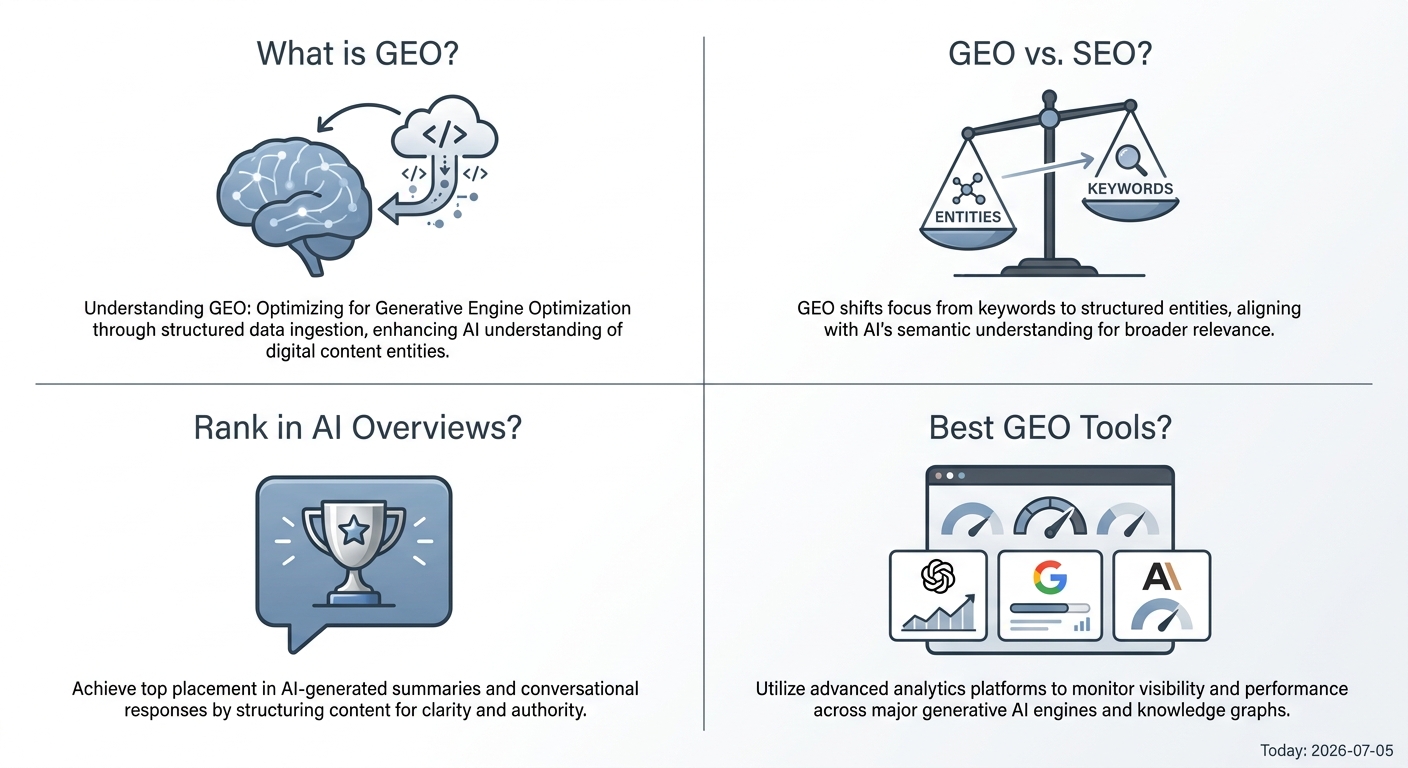
An icon-based visual summarizing the key questions in the GEO FAQ section, such as what it is, how it differs from SEO, and what tools to use.
What is Generative Engine Optimization (GEO) for e-commerce?
Generative Engine Optimization (GEO) is the process of structuring product and brand content so AI models can accurately retrieve, understand, and cite it. This involves optimizing product pages (PDPs) with clear, chunked data and implementing comprehensive schema markup that Large Language Models (LLMs) prefer.
How does GEO differ from traditional e-commerce SEO in the US?
GEO prioritizes AI extraction confidence and entity authority, while traditional SEO focuses on keyword rankings and backlinks. In the US, a key GEO task is entity disambiguation—separating a “GEO” software brand from unrelated local searches (e.g., for a “Geo” car)—to ensure AI models understand the correct context.
How can US e-commerce brands rank in Google AI Overviews?
Brands appear in Google AI Overviews by providing answer-first content, robust review schema, and high-quality structured data. Google’s generative AI relies on easily parsable, contextually relevant data. E-commerce sites must ensure product specifications, comparisons, and customer reviews are structured for confident AI extraction.
What are the best GEO tools for tracking visibility across multiple AI models?
The best GEO tools offer automated action plans, not just passive monitoring dashboards. Leading platforms track brand citations across 17+ global AI models (including ChatGPT, Perplexity, Gemini, and Baidu) and integrate with automation tools like n8n to deploy real-time content and schema updates.
How do Chinese AI engines like Baidu and Qwen rank global e-commerce products? Infographic showing that Chinese AI engines like Baidu’s ERNIE prioritize localized supply chain data and regional authority signals for ranking.
Chinese AI engines like Baidu’s ERNIE and Alibaba’s Qwen prioritize localized supply chain data, structured entity relationships, and regional authority signals. For US brands operating globally, ranking in these models requires specific multilingual schema and a tracking system that can monitor cross-border AI citation velocity.
Conclusion
The era of relying solely on traditional keyword rankings and organic search traffic is over. With AI Overviews and conversational search becoming primary discovery channels, the old SEO playbook is no longer sufficient. US e-commerce and B2B SaaS brands must adopt Generative Engine Optimization to survive and thrive in this new landscape.
Success hinges on moving beyond passive monitoring to actively address three critical challenges: the multi-model visibility gap, the lack of automation in response, and the risk of entity ambiguity. By implementing a strategy that tracks visibility across 17+ global models, uses n8n workflows for automated action plans, and clarifies brand identity through structured data, marketing leaders can secure their position in the AI-generated answers that drive high-value conversions.
To stop losing high-intent traffic and start dominating AI citations, your organization needs a system built for this new reality. Access a free trial of AI Rankia’s enterprise tracking platform to see how automated GEO can protect and grow your revenue.