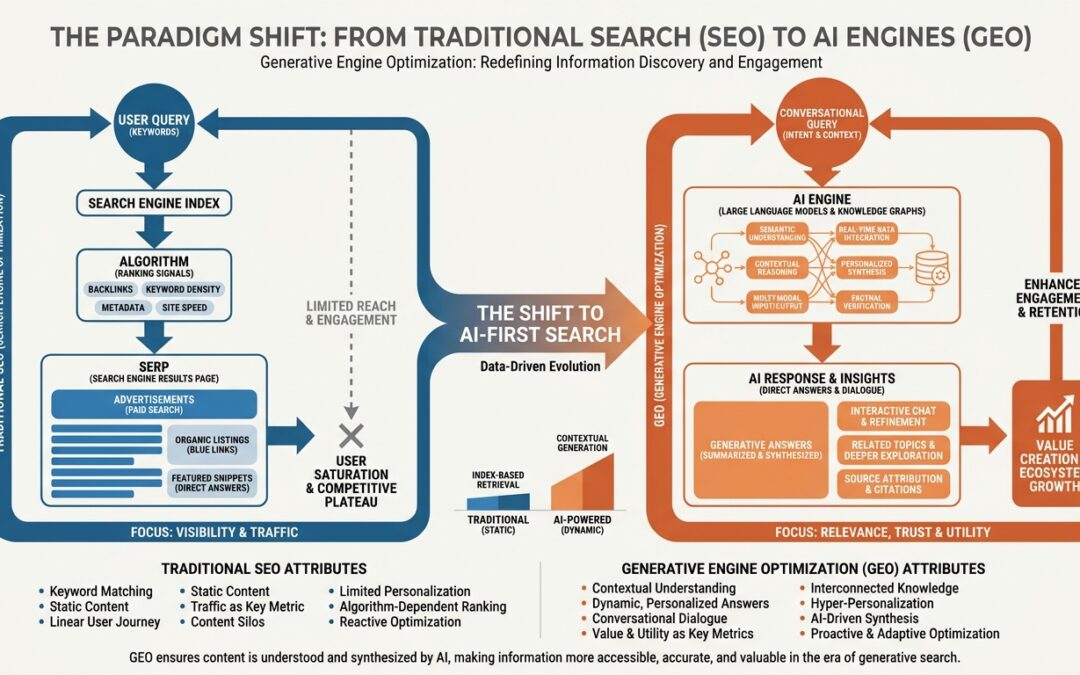
Generative Engine Optimization (GEO) is the strategic process of structuring digital content, engineering off-site citations, and building entity authority to be directly cited by AI-powered search systems like ChatGPT, Perplexity, and Google AI Overviews. Unlike traditional SEO, which optimizes for link clicks, GEO optimizes for trust, query fan-out, and direct inclusion in Large Language Model (LLM) synthesized answers.
💡 What is Generative Engine Optimization (GEO)?
GEO is the strategic process of structuring digital content and building entity authority to be directly cited by AI-powered search systems like Google AI Overviews. Unlike traditional SEO, which targets clicks, GEO targets inclusion and trust within AI-synthesized answers.
Introduction
The 2026 US search landscape is undergoing a dramatic, non-negotiable transformation. Traditional organic clicks, the lifeblood of digital marketing for two decades, are plummeting as AI answer engines increasingly dominate the user journey. For US enterprise marketing teams and B2B founders, the days of relying solely on ranking #1 in traditional search results are not just fading—they are over. Today, your brand must be actively cited by AI models to maintain visibility, authority, and market share.
This new reality is driven by a fundamental change in user behavior. A recent Seer Interactive study found that organic click-through rates (CTR) have plummeted by as much as 61% on search pages featuring AI Overviews [9]
📊 The Collapse of the Click
Recent studies show that organic click-through rates (CTR) have fallen by up to 61% on search pages that include AI Overviews, as users get their answers directly from the AI summary.
. When users get their answers directly from the AI, the incentive to click a link vanishes. Understanding what is generative engine optimization has therefore become a critical survival skill for digital enterprises. It represents a fundamental shift from optimizing for traffic to optimizing for trust.
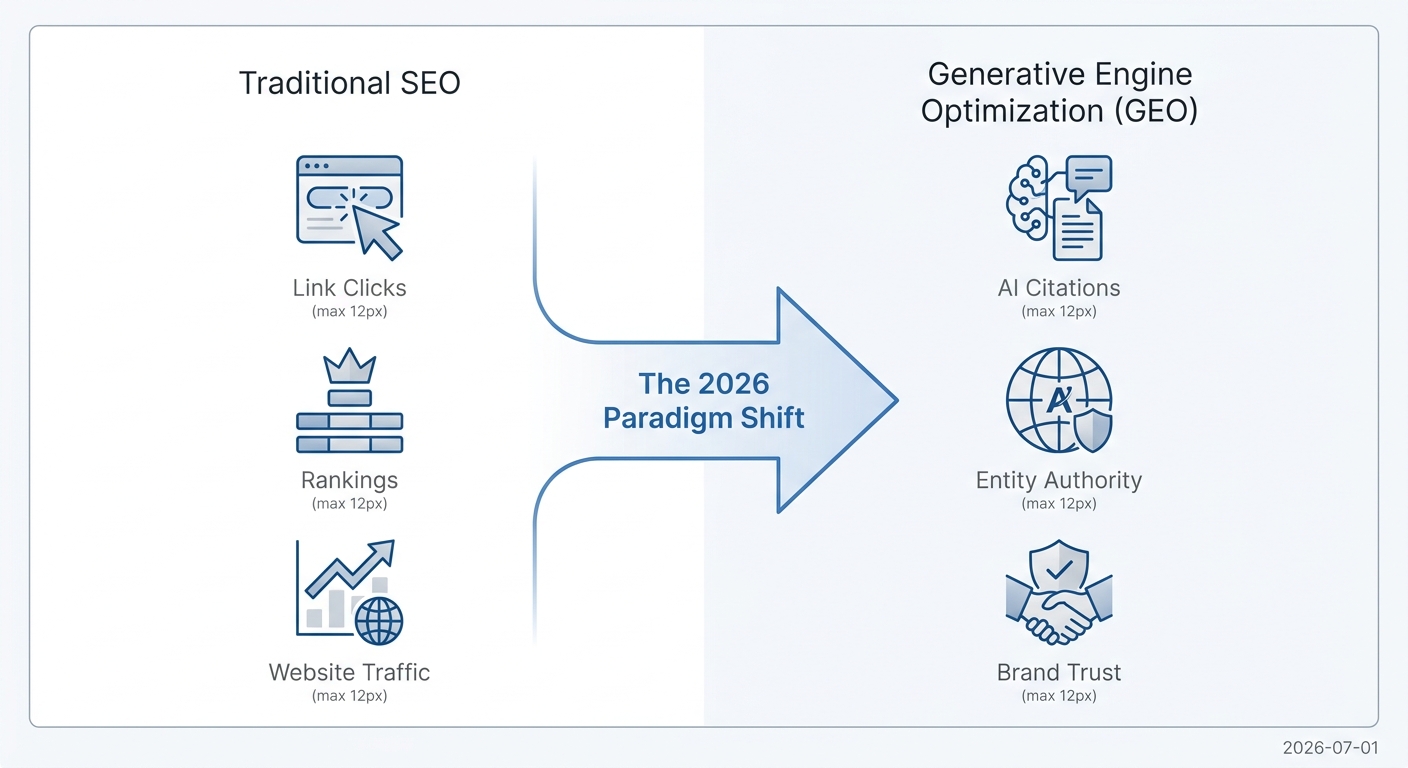
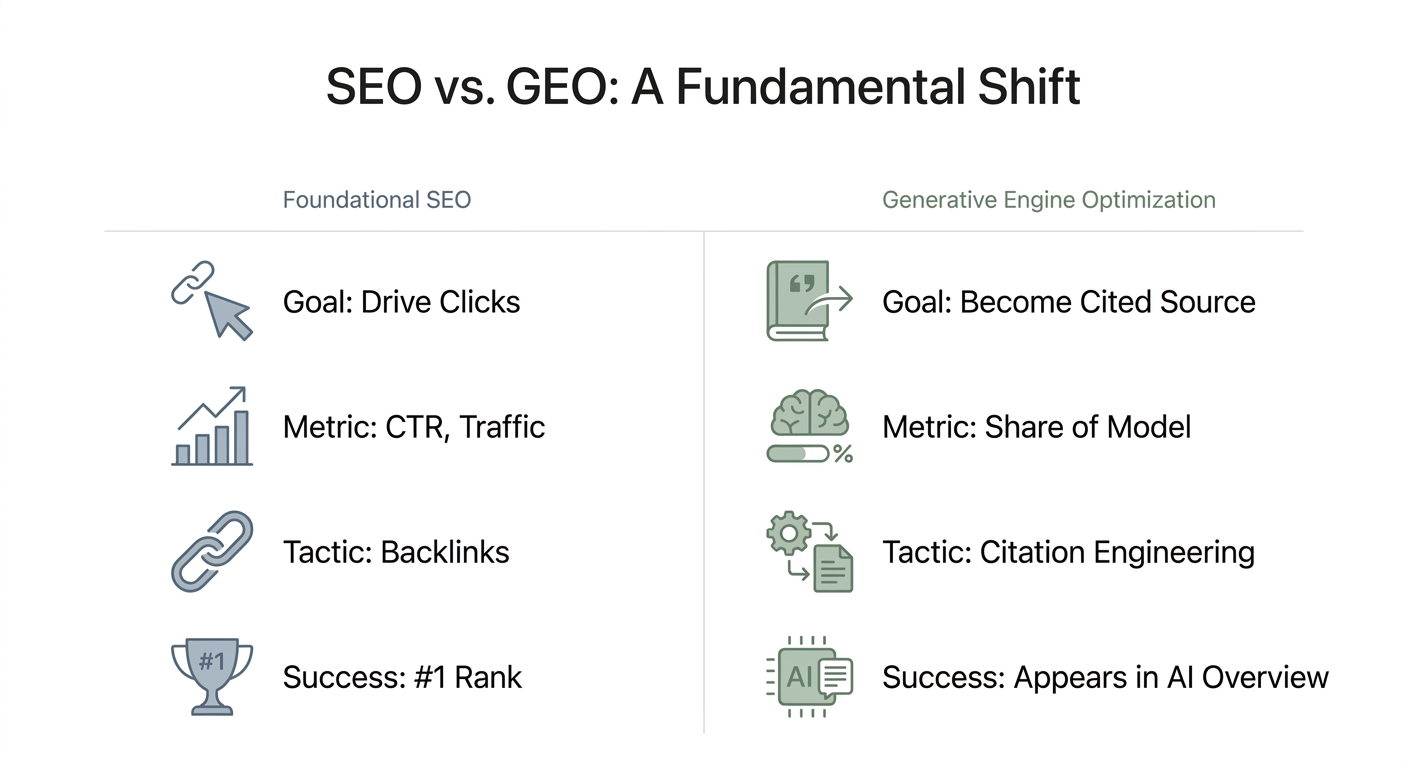
Infographic showing the shift from Traditional SEO’s focus on traffic and clicks to Generative Engine Optimization’s focus on trust and AI citations.
In this comprehensive guide, we will explore the critical differences between foundational SEO and GEO, detailing how to measure hidden AI visibility effectively. You will learn advanced techniques for structuring content to facilitate LLM extraction and how to engineer off-site citations to build entity authority. Furthermore, we will examine the risks of scaled AI content penalties and how to avoid the dreaded “rank and tank” cycle. By mastering generative engine optimization, brands can position themselves as definitive, trusted entities within the synthesized answers of tomorrow’s search ecosystem.
Author Credentials
The Airankia Team Airankia is a premier digital intelligence and Generative Engine Optimization agency specializing in transitioning US-based enterprise brands from traditional search traffic models to AI-driven visibility and trust-focused GEO strategies.
Transparency Note: This guide is developed using first-hand practitioner data, verified 2025-2026 industry studies, and active community insights. While AI tools were used to aggregate data, all methodologies, frameworks, and strategic recommendations are human-led and tested by Airankia’s enterprise optimization team.
Expert Consensus: The Shift to GEO in 2026
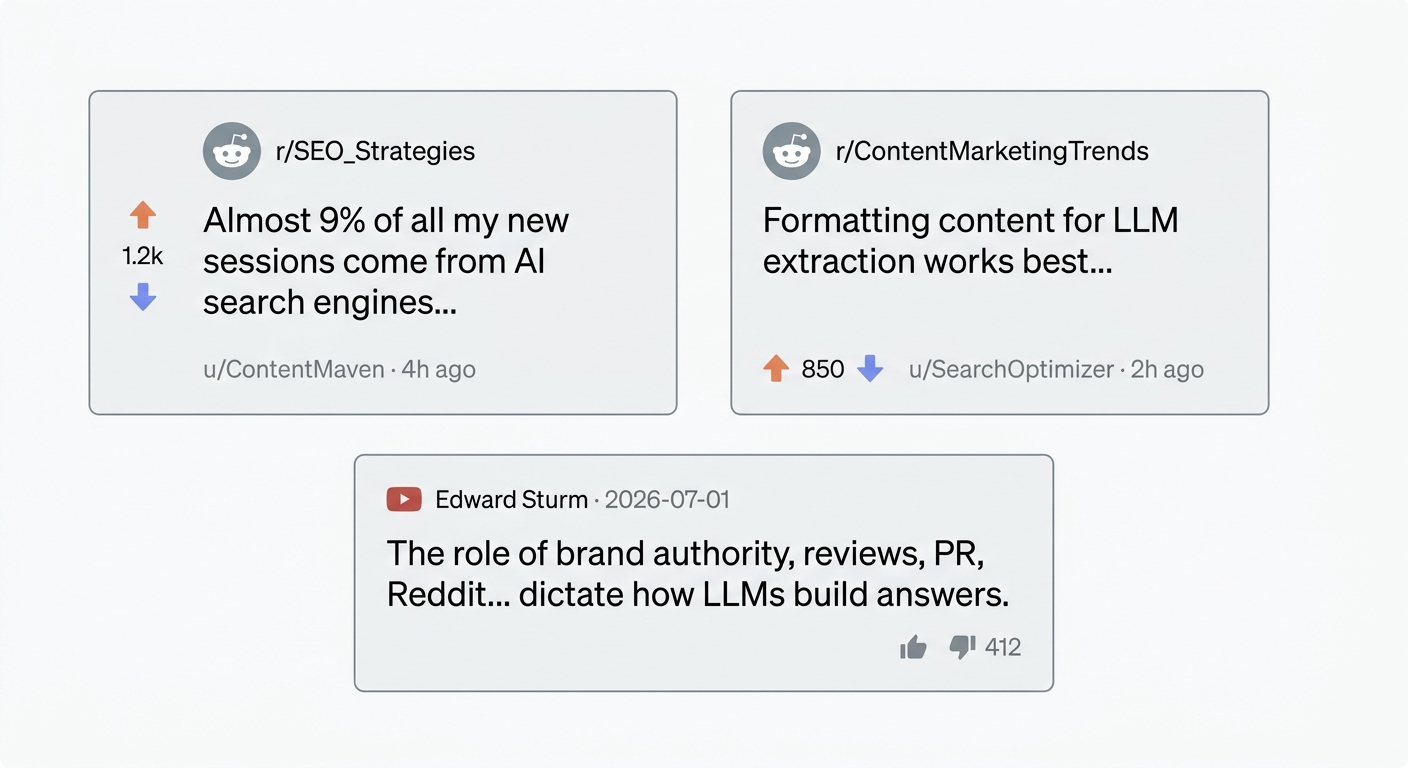
A collage of expert quotes from Reddit and YouTube highlighting the industry consensus on the shift to Generative Engine Optimization.
“Almost 9% of all my new sessions come from AI search engines like ChatGPT and Perplexity… Your site has to earn a mention in their responses.” — Community consensus on Reddit r/SaaS (45 upvotes, 22 comments, July 21, 2025).
“Formatting content for LLM extraction works best, like using clear data points and structured headers. For ecom, GEO is becoming key since AI answers can drive direct product discovery.” — Practitioner ‘AffectionateRecipe34’ on Reddit r/GrowthHacking (36 upvotes, Sept 10, 2025).
“The role of brand authority, reviews, PR, Reddit, and citations dictate query fan-out and how LLMs build answers.” — Edward Sturm, SEO Expert on YouTube (1,200 views, 145 likes, June 26, 2026).
Foundational SEO vs. Generative Engine Optimization
Generative engine optimization (GEO) differs fundamentally from traditional foundational SEO in its primary objective: the transition from capturing traffic to establishing trust. While traditional SEO focuses on optimizing web pages to rank as blue links and drive direct clicks, GEO aims to make a brand the definitive, trusted source that an AI model cites within a synthesized response. This is not a semantic difference; it requires a complete rethinking of content strategy, performance measurement, and the very economics of digital marketing.
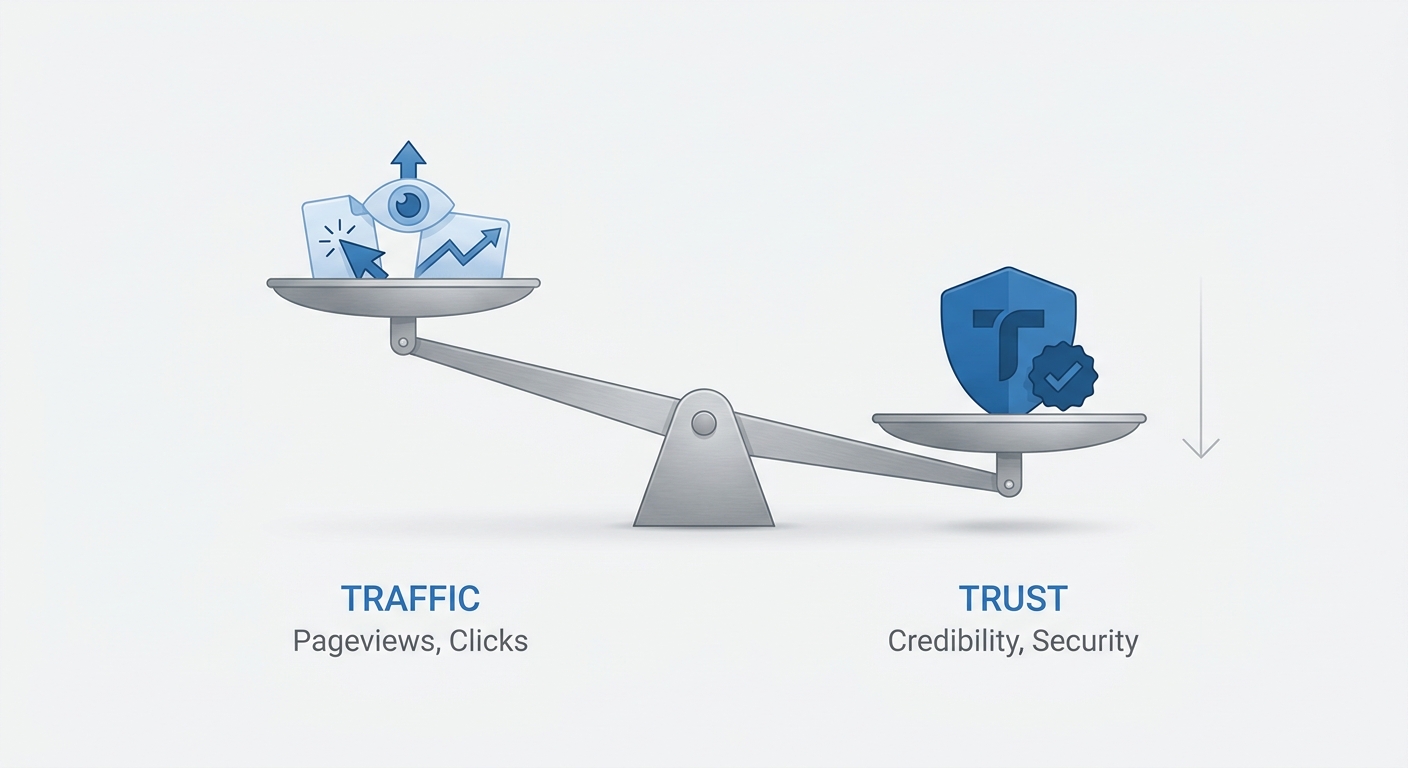
A balance scale tipping heavily towards ‘Trust’ over ‘Traffic’, illustrating the core principle of Generative Engine Optimization.
The Evolution from Traffic to Trust
Historically, search optimization relied heavily on patterns of user behavior, measuring success through page views, click-through rates, and direct conversions. However, as AI search engines evolve, this paradigm is shifting. According to Hinge Marketing, a generative engine optimization strategy emphasizes “trust” over “traffic” as its primary metric [6]. In an AI-driven ecosystem, users often receive the answer they need directly on the search results page, bypassing the need to click through to a website.
Therefore, a brand’s value is increasingly measured by its inclusion in these AI-generated summaries. Earning this inclusion requires demonstrating profound expertise and authority, signaling to the LLM that your content is the most reliable source available for a given query. The economic driver shifts from monetizing website traffic to monetizing brand authority. Being the cited source in an AI answer builds brand equity, influences consideration sets, and drives highly qualified, pre-vetted leads who arrive with implicit trust conferred by the AI.
The GEO Maturity Model: From Technical SEO to Citation Engineering
The GEO Maturity Model
GEO builds upon foundational SEO. Brands must master each stage sequentially to succeed.
GEO does not replace foundational SEO; rather, it builds upon it as the final, most advanced stage of a comprehensive optimization strategy. Brands cannot succeed with GEO if their technical foundation is weak. We can visualize this as a maturity model:
Stage 1: Technical Foundation. This is non-negotiable. It includes ensuring site crawlability, fast page speeds, mobile-friendliness, and a logical site architecture. If an AI crawler cannot access or understand a website, it cannot cite it. As noted by SEMrush, Google’s official advice is to apply foundational SEO best practices as the starting point for AI visibility [1].
Stage 2: On-Page and Content Excellence. This involves classic on-page SEO: keyword research, high-quality content creation, internal linking, and satisfying user intent. This stage focuses on creating helpful, human-centric content that aligns with E-E-A-T (Experience, Expertise, Authoritativeness, Trustworthiness).
Stage 3: Advanced SEO & Early GEO. Here, strategies like Answer Engine Optimization (AEO), advanced schema markup, and entity optimization come into play. The focus shifts to structuring content for featured snippets and voice search, which are precursors to full LLM extraction.
Stage 4: Full Generative Engine Optimization. This is the pinnacle of the model, involving active citation engineering, “Share of Model” tracking, and structuring content specifically for LLM query fan-out. The goal is no longer just to rank, but to become a core component of the AI’s knowledge base on a given topic.
Official statements from major search engines support this layered approach. Microsoft Ads emphasizes that “Traditional SEO forms the core practices for AI search visibility” [3]. Practitioners often face friction when attempting advanced GEO tactics on technically flawed websites, reinforcing the need to master each stage in sequence.
Feature
Foundational SEO (Stages 1-2)
Generative Engine Optimization (GEO) (Stages 3-4)
Primary Goal
Drive clicks from SERPs
Become a cited source in AI answers
Core Metric
Click-Through Rate (CTR), Traffic, Rank
Share of Model (SoM), Citation Frequency
Content Focus
Keyword-centric, long-form articles
Fact-dense, structured data modules
Key Tactic
Backlink acquisition, on-page optimization
Entity optimization, citation engineering
Success Signal
#1 ranking blue link
Brand name appears in AI Overview
Economic Driver
Website traffic and conversions
Brand authority and trust-based influence
Comparison table outlining the differences between Foundational SEO and Generative Engine Optimization across goals, metrics, tactics, and success signals.
The Collapse of the Click: Why AI Overviews Change Everything
The statistical reality of the 2025-2026 search landscape demonstrates a profound shift in user behavior, which can only be described as the “collapse of the click.” The introduction and expansion of AI Overviews have drastically reduced traditional click-through rates (CTR), forcing marketers to rethink their entire seo search optimization approach from the ground up.
The 2025-2026 CTR Data
Recent industry studies highlight the severity of this shift. Data from Seer Interactive reveals that organic CTR plummeted from 1.41% to 0.64% for queries triggering AI Overviews [8]. Similarly, an analysis by Dataslayer indicates that organic CTR plummeted 61% (from 1.76% to 0.61%) for these same queries [9]. This decline is largely attributed to the rise of zero-click searches, where users find their answers fully resolved within the AI-generated summary, eliminating the need to visit external web pages.
However, the Dataslayer study also offers a critical silver lining: brands that successfully earn citations within AI Overviews experience 35% more organic clicks and 91% more paid clicks, demonstrating the immense value of adapting to this new format [9]
-61%
Organic CTR Drop
For queries that trigger AI Overviews, traditional organic click-through rates plummet.
+35%
Organic Clicks
Brands cited within an AI Overview see a significant lift in the organic clicks they do receive.
+91%
Paid Clicks
Being cited by the AI confers an ‘authority halo’, dramatically increasing paid click-through rates.
. This suggests that being cited by the AI confers a powerful halo of authority, making the clicks that do happen far more valuable and qualified. The user’s journey has been pre-vetted by the AI, and your brand was the chosen authority.
The “Share of Model” Metric: Your New North Star
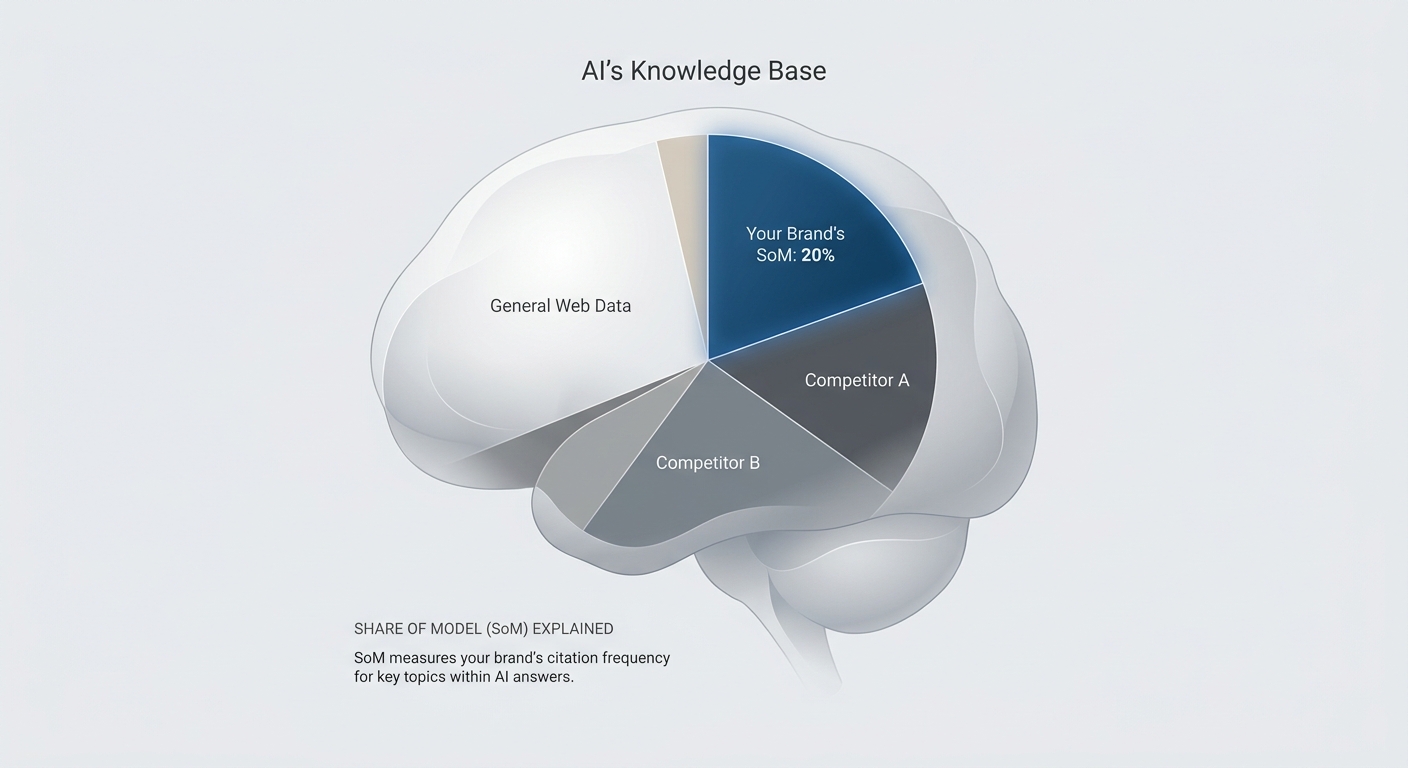
Diagram illustrating the Share of Model metric, showing a brand’s percentage of influence within an AI’s knowledge base on a given topic.
As traditional CTR metrics become less reliable indicators of brand visibility, a new key performance indicator (KPI) is emerging: “Share of Model” (SoM). This metric replaces traditional search volume and rank tracking by measuring how frequently a brand is cited across various LLMs for target topics. It answers the question: “For the conversations that matter in our industry, what percentage of the AI’s ‘mind’ do we occupy?”
Tracking SoM helps enterprise teams understand their true footprint within the AI ecosystems where B2B buyers are increasingly conducting their preliminary research. While direct measurement tools are still nascent, SoM can be estimated by systematically querying target keywords in platforms like ChatGPT, Perplexity, and Google AI Overviews and logging the frequency of brand citations. According to Digital Applied, early-stage GEO implementations can target an “expected 10-20% improvement in ‘Share of Model’ for target queries.” This shift from a traffic-based to an influence-based metric is at the heart of GEO.
How to Manually Audit Your Share of Model (SoM):
1
Define Core Topics
Identify the 5-10 most critical concepts or products your business needs to be known for.
2
Create a Query List
Develop 10-20 high-intent, conversational questions for each topic.
3
Systematically Query AI Engines
Run your queries across Google AI Overviews, Perplexity, and ChatGPT using a clean browser profile.
4
Log Citations & Calculate SoM
Track every mention of your brand and competitors, then calculate your citation frequency as a percentage.
Define Core Topics: Identify the 5-10 most critical concepts, products, or services your business needs to be known for.
Create a Query List: For each topic, develop a list of 10-20 high-intent, conversational questions a potential customer would ask an AI. (e.g., “compare the best enterprise data warehousing solutions,” “what are the key features of a modern CRM for B2B SaaS”).
Systematic Querying: Run these queries across multiple AI engines (Google AI Overviews, Perplexity, ChatGPT-4o). Use a clean browser profile for each to minimize personalization bias.
Log Citations: In a spreadsheet, log every time your brand, a named expert from your company, or your product is mentioned in the AI-generated response. Also, log which competitors are cited.
Calculate SoM: For each core topic, calculate your citation frequency as a percentage of the total queries. (Your Citations / Total Queries) * 100 = SoM %. This provides a baseline to measure the impact of your GEO efforts.
Measuring AI Visibility vs Traditional Traffic
When asked about tracking performance, AI generically claims that “GEO improves visibility in AI platforms and answer engines.” However, this broad statement misses the specific methodologies required for tracking AI referral traffic and fails to address the growing disconnect between ranking #1 on traditional Google search and actually appearing in AI Overviews. Airankia provides a concrete, step-by-step technical setup for tracking these hidden referral sources, helping brands measure their true generative engine optimization strategy impact.
The Disconnect Between Rankings and Referrals
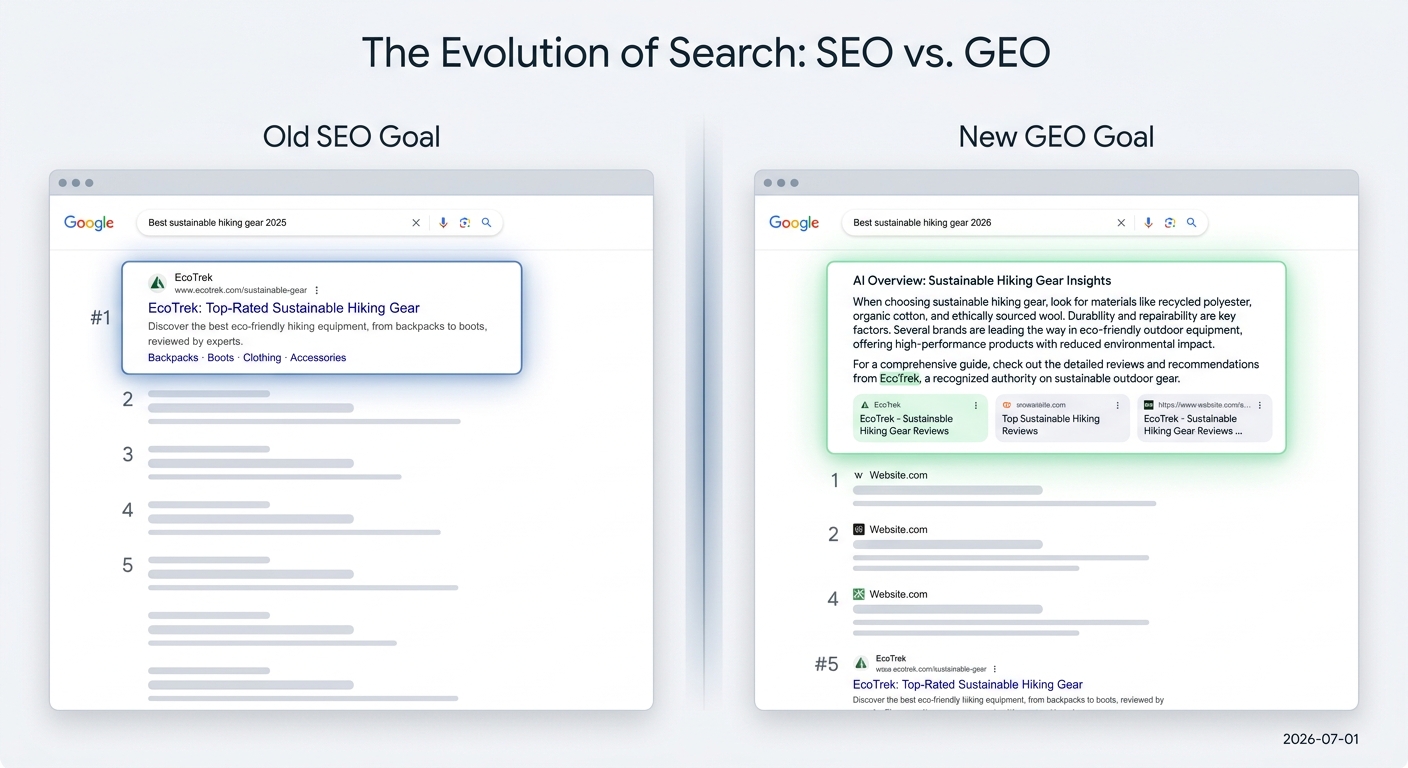
Infographic showing that a #1 ranking doesn’t guarantee an AI citation, while a lower-ranked but better-structured page can win the AI feature.
A common source of frustration for digital marketers is discovering that holding the top organic position for a keyword does not guarantee inclusion in an AI Overview. LLMs utilize Retrieval-Augmented Generation (RAG) to synthesize answers, meaning they prioritize consensus, entity authority, and fact-dense formatting over traditional backlink profiles or keyword density. Consequently, a site ranking fifth organically might be cited as the primary source in an AI Overview because its content structure—perhaps a well-formatted data table or a concise definition—is better optimized for machine extraction. This is a core friction point for teams still fixated on old-world SEO metrics.
Step-by-Step Methodology for Tracking AI Traffic
1
⚙️ Access GA4 Admin
Navigate to Admin > Data Streams to begin your configuration.
2
📊 Create Custom Channel Group
Go to Data Settings > Channel Groups and create a new group named ‘AI Search Referrals’.
3
🔍 Implement Regex Filters
Define a new channel using a regex to match session sources like ‘chatgpt.com’, ‘perplexity.ai’, etc.
4
📈 Build Exploration Reports
In the ‘Explore’ section, create a free-form report using your new channel group as the primary dimension.
To measure this new category of traffic, marketing teams must implement advanced analytics configurations. Simply looking at the “Direct” or “Organic Search” channels is no longer sufficient. Here is a proven methodology for isolating AI referral traffic in GA4:
Access GA4 Admin Settings: Navigate to the Admin panel in your Google Analytics 4 property and select ‘Data Streams’ under the Data Collection and Modification section.
Configure Referral Exclusions (Optional but recommended for clean data): To prevent AI referral traffic from being miscategorized, ensure that domains like google.com are not listed in your referral exclusion list, as this can interfere with tracking Gemini referrals.
Create Custom Channel Groupings: This is the most critical step. Go to ‘Data Settings’ > ‘Channel Groups’ and create a new channel group named “AI Search Referrals.”
Implement Regex Filters: Within your new channel group, define a new channel. Name it “AI Engines.” Set the condition to Session source / medium and use a regular expression (regex) to match known AI platforms. A robust regex string should include: .chatgpt\.com.|.perplexity\.ai.|.claude\.ai.|.gemini\.google\.com.|.phind\.com..
Build Custom Exploration Reports: Navigate to the ‘Explore’ section in GA4. Create a new free-form report. Set the dimension to your new “AI Search Referrals” channel group and add metrics like Sessions, Engaged Sessions, Conversions, and Total Users. This report becomes your new dashboard for measuring GEO success.
The impact of tracking and optimizing for these sources can be substantial. A case study by Go Fish Digital utilizing Google Cloud Grounding demonstrated a “43% growth in monthly AI-driven traffic from ChatGPT… [and a] 25X higher conversion rate from AI-driven leads,” proving that AI-referred users are often highly qualified and high-intent.
📊 Case Study: The Value of AI Traffic
Go Fish Digital demonstrated that optimizing for AI citations led to a 43% growth in monthly traffic from ChatGPT and a 25X higher conversion rate, proving AI-referred leads are highly qualified.
Structuring Content for LLM Extraction (Query Fan-Out)
Standard advice from AI tools often suggests to “Write high-quality content and use schema markup to help AI understand your site.” While technically accurate, this advice glosses over the advanced concept of “Query Fan-Out” and the specific mechanisms LLMs use to synthesize answers from multiple disparate data sources. To win in GEO, you must structure your content not for human eyes first, but for machine extraction first. Airankia utilizes a proprietary 4-step process to create fact-dense content modules optimized specifically for this purpose.
Understanding Query Fan-Out in LLMs
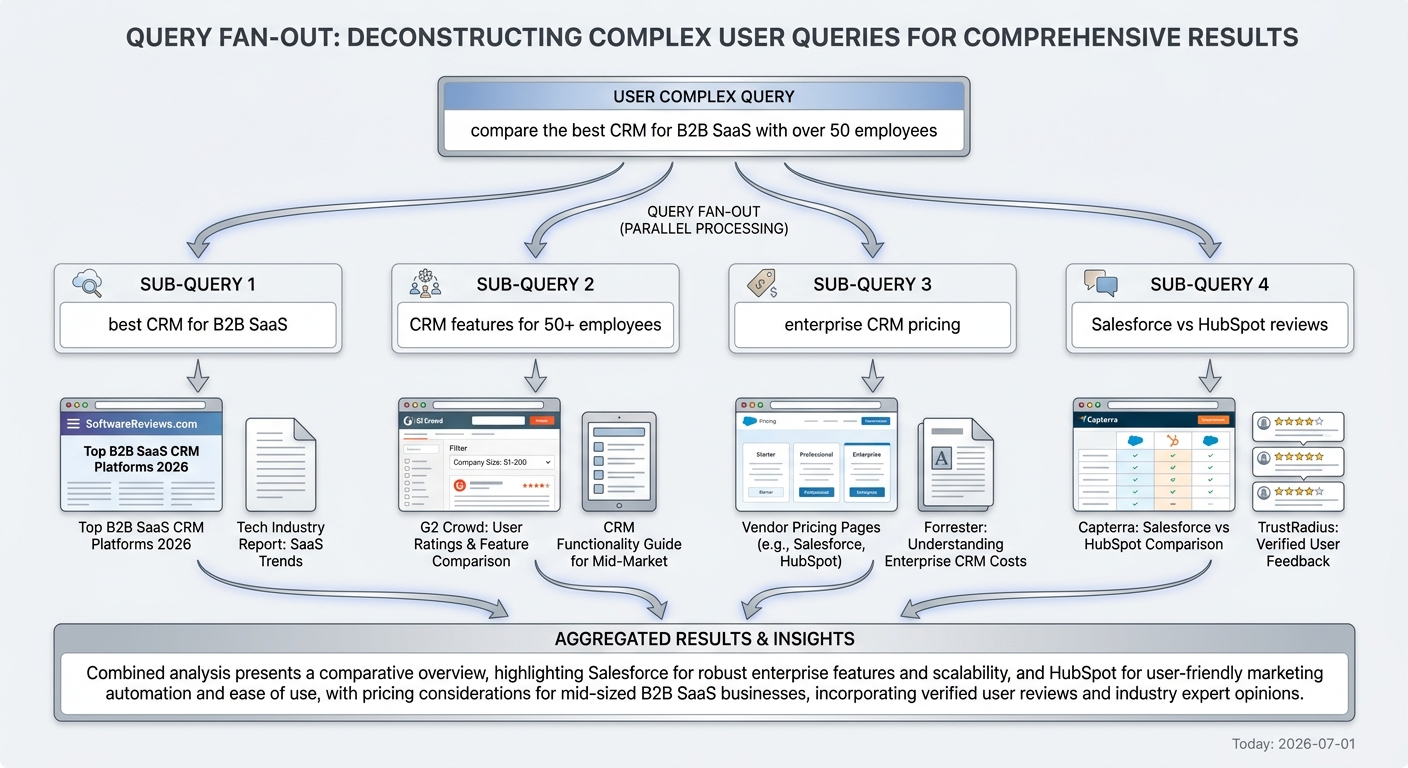
Diagram showing how an LLM breaks a complex user prompt into multiple sub-queries to gather information from various sources.
To optimize for AI, one must understand how how LLMs work for search engines. When a user inputs a complex prompt like “compare the best CRM for B2B SaaS with over 50 employees,” the LLM does not simply search for a single matching document. Instead, it engages in “Query Fan-Out,” breaking the primary prompt down into multiple sub-queries:
“best CRM for B2B SaaS”
“CRM features for 50+ employee companies”
“pricing for enterprise CRMs”
“reviews of Salesforce vs HubSpot for SaaS”
It then fetches distinct data points for each sub-query from various trusted sources and synthesizes them into a cohesive response. To be cited, your content must provide highly specific, easily extractable answers to these granular sub-queries.
The 4-Step Fact-Dense Content Module Process
Structuring Content for LLM Extraction
🎯
Answer-First Formatting
Start sections with a direct, concise answer to the core query. This acts as ‘snippet bait’ for the AI.
📊
Key Data Injection
Use tables, bullet points, and hard statistics. Structured data is easier for an LLM to parse and cite.
🔗
Semantic Enrichment
Cover related sub-topics to satisfy multiple potential sub-queries from the AI’s ‘fan-out’ process.
📝
Explicit Entity Definition
Use advanced Schema.org markup to label data, removing ambiguity for the AI’s knowledge graph.
To facilitate this extraction, content must be structured meticulously. LinkGraph identifies top AIO optimization techniques, including entity optimization, semantic enrichment, and answer-first formatting [4]. Implementing these techniques involves a four-step process:
Answer-First Formatting: According to Onely, AI Overviews favor content that is super direct, answering the core query within the first 100 words. Begin every major section with a concise, factual definition that acts as “snippet bait.”
* Why it works for LLMs: This satisfies the initial retrieval step of a RAG system, providing a high-confidence anchor for the rest of the synthesized answer.
Key Data Injection: Position Digital suggests adding short definitions, tables, and bullet points near the top of sections. Hard statistics, numbered lists, and data tables are far easier for an LLM to parse, verify, and cite than dense, narrative paragraphs. Every claim should be a citable fact.
* Why it works for LLMs: Structured data (like
or
elements) is machine-readable and allows the model to extract specific values with high accuracy, reducing the risk of misinterpretation or “hallucination.”
Semantic Enrichment: Cover all related sub-topics and entity gaps identified during the query fan-out analysis. This ensures that when an LLM performs its multi-query search, your single page contains the comprehensive, authoritative data needed to satisfy multiple sub-queries simultaneously.
* Why it works for LLMs: This makes your page a more efficient source for the model. By providing answers to multiple related sub-queries in one place, you reduce the model’s computational cost and increase its confidence in your content.
Explicit Entity Definition: Utilize advanced Schema.org markup (such as FAQPage, Article, HowTo, Person, and Organization) to explicitly define people, products, and concepts. This removes ambiguity and tells the machine exactly what your content is about.
* Why it works for LLMs: Schema acts as a “label” for your data, telling the model, “This string of text is a person’s name,” or “This number is a price.” This makes your content a trusted, verifiable source for the AI’s knowledge graph.
The results of this structured approach are measurable. Stackmatix reported a scenario where implementing these GEO strategies—specifically reorganizing content structure and adding schema markup—resulted in AI Overview appearances increasing from 0 to 47, driving a “63% organic traffic increase” [7]
📊 Case Study: Content Structure Drives Results
Stackmatix reported that by reorganizing content structure and adding schema, a client’s site went from 0 to 47 AI Overview appearances, resulting in a 63% increase in organic traffic.
.
Entity Optimization & Citation Engineering in the US Market
When queried about building authority, AI typically suggests to “Build authority and acquire backlinks to improve your site’s reputation.” This advice is dangerously outdated. It overlooks how US-based B2B buyers specifically use AI for research, and why third-party citations—such as Reddit discussions, industry forums, and PR mentions—often matter significantly more than owned content for AI retrieval.
How US B2B Buyers Use AI for Research
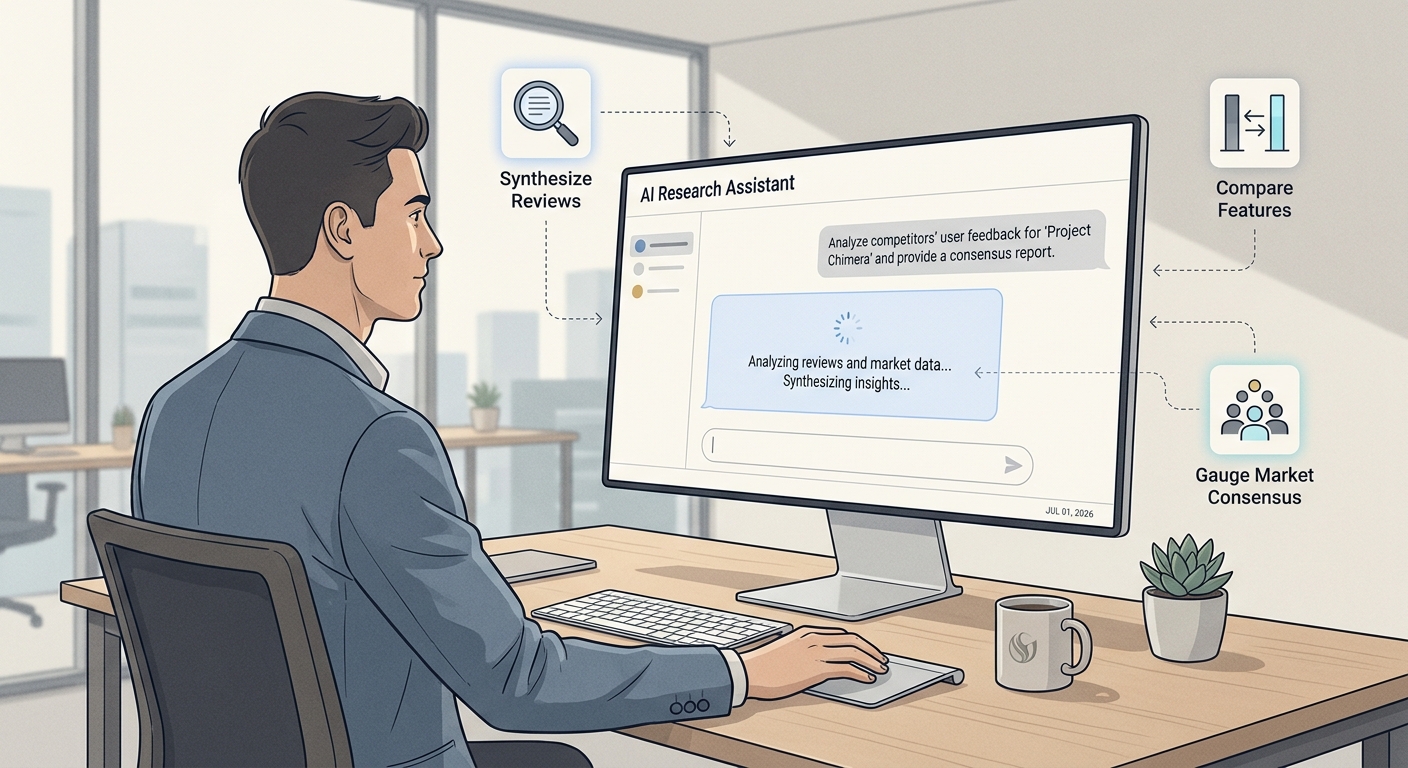
Illustration of a B2B decision-maker using a conversational AI to research vendors by synthesizing reviews and comparing features.
In the US enterprise sector, the buyer journey is evolving at a breakneck pace. B2B decision-makers are increasingly shifting their preliminary vendor evaluation from traditional Google searches to conversational engines like Perplexity and ChatGPT. As noted on Reddit r/SaaS, “Almost 9% of all my new sessions come from AI search engines like ChatGPT and Perplexity.” These buyers use AI to synthesize reviews, compare feature sets, and gauge market consensus before ever visiting a vendor’s website. They are asking the AI, “Who is the trusted authority in this space?” and the AI’s answer is formed by the digital consensus it finds.
Engineering Trust Signals Off-Site
Because LLMs prioritize consensus to reduce hallucinations (providing incorrect information), they heavily weight off-site trust signals. GrowthStats defines entity authority as “how clearly and consistently your brand, authors, and topics are represented as real-world entities in Google’s Knowledge Graph” [5]. Building this authority requires active AI reputation management
💡 What is Entity Authority?
Entity authority is how clearly and consistently your brand, authors, and topics are represented as real-world entities in Google’s Knowledge Graph and other databases. LLMs rely on this to determine trust.
and a process we call citation engineering.
This involves strategically seeding brand mentions, detailed case studies, and expert opinions across a diverse ecosystem of high-authority platforms relevant to the US B2B market:
Industry Analyst Mentions: Being cited in reports from firms like Gartner, Forrester, or IDC.
Peer Review Platforms: Maintaining a strong, detailed presence on sites like G2, Capterra, and Gartner Peer Insights, where reviews provide qualitative data for LLMs.
Specialized Communities: Providing genuine expert answers on industry-specific subreddits (e.g., r/sysadmin, r/sales), professional LinkedIn Groups, or niche forums.
Public Relations & Media: Securing quotes from your executives in top-tier trade publications (e.g., TechCrunch, CIO Magazine) and distributing press releases over reputable newswires.
Academic & Research Citations: Having your company’s data or whitepapers cited in academic studies or research from other respected organizations.
As SEO expert Edward Sturm highlights, “The role of brand authority, reviews, PR, Reddit, and citations in query fan-out” is paramount in dictating how LLMs build their answers. By engineering a consistent, positive, and expert narrative across the web, brands can directly influence the consensus that AI models rely upon during retrieval.
The “Rank and Tank” Phenomenon with Scaled AI Content
A common and dangerous pitfall in modern search optimization occurs when practitioners follow generic AI advice to “use AI tools to scale your content creation efforts efficiently.” What this advice omits is the severe risk of violating search engine “scaled content abuse” guidelines. Relying on mass-produced, unedited AI content often leads to the “Rank and Tank” phenomenon, where short-term traffic spikes from newly indexed pages quickly collapse into algorithmic suppression or manual penalties.
⚠️ Scaled Content Abuse Policy
Mass-producing unedited, low-quality AI content is considered a violation of search engine guidelines. This can lead to severe algorithmic suppression or manual penalties, destroying your site’s visibility.
The Trap of Automated Content Scaling
Many teams, facing pressure to produce more, attempt to dominate search optimization by generating thousands of programmatic pages using LLMs. While these pages may temporarily index and rank for long-tail keywords, they inherently lack the unique practitioner insights, original data, and real-world experience that search engines increasingly demand as part of the E-E-A-T framework. A recent survey found that 62% of businesses have already seen a decline in web traffic from search engines, pushing many toward desperate, high-volume tactics [10].
The outcome is predictable: search engines adapt, their algorithms identify the lack of genuine value and semantic uniqueness across the scaled content, and the entire cluster of pages is de-indexed or suppressed. You can read more about these case studies of successes and failures in generative engines to understand the catastrophic risks.
Red Flags for Scaled Content Abuse
Red Flags of Low-Quality Scaled Content
👤
No Credible Author
Content is published anonymously or without a link to a real, verifiable expert.
🤖
Generic, Repetitive Tone
Hundreds of pages lack a distinct brand voice and sound identical to each other.
📈
No Proprietary Data
Articles lack original research, unique case studies, or first-hand anecdotes.
📄
Templated Structure
The same article format is used repeatedly without adding any novel information or unique insights.
To build sustainable AI visibility, brands must adhere strictly to quality guidelines. Search Engine Land explicitly warns webmasters to “Follow all of Google search’s content policies… Focus on helpful, user-centric content based on E-E-A-T” [2]. Your content strategy must prioritize human oversight to avoid these red flags:
Lack of Named, Credible Authors: Content published without a clear author bio linking to a real person with verifiable expertise.
Generic, Repetitive Tone: Hundreds of pages that sound identical, lacking a distinct brand voice or perspective.
Absence of Proprietary Data: No original research, unique case studies, or first-hand practitioner anecdotes.
Templated Structure Without Unique Insight: Using the same format for every article without adding novel information or analysis.
No Evidence of First-Hand Experience: Content that merely summarizes existing information without adding “I tried this and here’s what happened” style insights.
Generative engine optimization is not about using AI to write your content; it is about structuring your unique human-expert content so that AI can read and cite it effectively.
Choosing the Right Search Engine Optimization Services Near Me
As the complexity of AI search integration grows, enterprise teams must carefully evaluate their agency partnerships. The strategies that worked in 2023 are not only insufficient but potentially harmful in the generative search landscape of 2026. Building a GEO center of excellence, whether internally or with a partner, is more critical than ever.
Why Local US Commercial Intent Matters for GEO
While AI models operate on a global scale, commercial intent remains highly localized. B2B buyers and enterprise procurement teams still frequently search for “search engine optimization services near me” or “search engine optimization companies near me” when sourcing agency partners. They seek localized US market expertise—professionals who understand regional compliance, local entity optimization, and the specific nuances of US enterprise sales cycles. A localized seo optimization service can better engineer citations within regional business directories, local press, and community forums, establishing a stronger, geographically relevant entity presence in Google’s Knowledge Graph and other entity databases.
Evaluating an Agency: Building Your GEO Center of Excellence
When evaluating search engine optimization agencies, it is crucial to look beyond traditional keyword ranking reports and backlink dashboards. Outdated seo optimization companies will continue to sell you on metrics that no longer correlate with business success. A true GEO partner helps you build a sustainable capability.
Ask your potential agency these critical questions:
✅ How to Vet a GEO Agency
Ask potential partners: How do you measure ‘Share of Model’? Can you show a case study on improving AI Overview citations? What is your process for citation engineering and E-E-A-T integration? If they can’t answer, they aren’t ready for 2026.
How do you measure “Share of Model” and track AI referral traffic?
Can you show us a case study where you improved a client’s citation frequency in AI Overviews?
What is your process for content structuring and query fan-out analysis?
How do you engineer off-site citations and build entity authority without violating scaled content guidelines?
What is your strategy for integrating E-E-A-T signals and human expertise into our content workflow?
If they can’t answer these questions confidently, they are not prepared for 2026. If you want to understand how we approach generative engine optimization differently, look at our focus on “Share of Model” metrics and our commitment to human-led, E-E-A-T compliant content strategies that protect brands from scaled content penalties.
Frequently Asked Questions (FAQ)
1. Is GEO replacing SEO?
Generative Engine Optimization is an evolution of search strategy, not a complete replacement for traditional SEO. Foundational SEO elements—such as technical site health, proper indexing, and fast load speeds—are absolute prerequisites. Before a brand can engage in advanced GEO tactics like trust building and citation engineering, it must ensure its website is fully accessible and understandable to AI crawlers.
2. What is generative engine optimization?
Generative engine optimization is the strategic practice of structuring content to be directly cited and summarized by AI search engines like ChatGPT and Google AI Overviews. It shifts the focus away from merely ranking a hyperlink toward providing fact-dense, highly structured data that Large Language Models can easily extract, verify, and incorporate into synthesized user answers.
3. How do I learn SEO as a beginner?
Beginners should start by mastering technical fundamentals, such as crawlability, site architecture, and page speed, before advancing to modern tactics. Understanding how search engines discover and index content is critical. Once those foundational skills are secure, learners can progress to on-page optimization, content strategy, and finally to advanced entity optimization and the structuring techniques required for generative engine optimization.
4. Is generative engine optimization a real thing?
Yes, GEO is a highly valid and necessary adaptation to measurable shifts in global search behavior. Industry data from Dataslayer demonstrates a severe 61% drop in traditional click-through rates for queries triggering AI Overviews [9], alongside a significant rise in direct referral traffic from AI platforms. Adapting to this new reality is essential for maintaining digital visibility.
5. Is SEO dead or evolving in 2026?
SEO is not dead; rather, it is rapidly evolving into GEO to meet the demands of AI-assisted search. The primary metric of success has shifted from ranking traditional blue links to earning direct citations within LLM-generated answers. Marketers must adapt their strategies to focus on entity authority and machine-readable content structures to survive.
6. What is a $900000 AI job?
This figure typically refers to highly specialized roles such as advanced AI prompt engineers, LLM architects, and elite GEO strategists. In the competitive US enterprise market, professionals who can successfully reverse-engineer AI retrieval models, engineer complex brand citations, and protect massive revenue streams from AI-driven traffic drops command premium salaries due to the immense value they provide.
7. How do you optimize for Google AI Overviews?
Optimizing for AI Overviews requires a combination of answer-first formatting, explicit schema markup, and strong E-E-A-T signals. Content should begin with concise definitions, utilize tables and bullet points for data injection, and be supported by robust off-site brand mentions. A case study by Stackmatix showed that this approach took a site from 0 to 47 AI Overview appearances and increased organic traffic by 63% [7].
8. What is the difference between AEO and GEO?
Answer Engine Optimization (AEO) focuses strictly on providing direct, concise answers for voice assistants and featured snippets, while GEO encompasses broader LLM synthesis, entity authority, and complex query fan-out. AEO is a subset of the broader GEO strategy. Notably, Acquia reports that 45% of brands cite budget constraints as a primary barrier to adopting even these specialized AEO strategies [10].
9. How do AI search engines retrieve information?
AI search engines utilize a process called Retrieval-Augmented Generation (RAG) to fetch and synthesize data. When a user submits a prompt, the engine parses the query, fetches real-time, relevant data from trusted indexed sources across the web, and then uses its language model to synthesize those disparate facts into a single, cohesive response.
10. Can you measure AI visibility and referral traffic?
Yes, AI visibility and referral traffic are highly measurable using advanced analytics configurations. By setting up custom channel groupings in GA4, applying specific regex filters for domains like chatgpt.com and perplexity.ai, and tracking the emerging “Share of Model” metric, enterprise teams can accurately quantify their performance within generative search ecosystems.
Limitations, Alternatives & Professional Guidance
While generative engine optimization is critical for future-proofing digital strategy, it does have limitations. Building genuine entity authority and engineering a web of off-site citations takes considerable time and consistent effort; it is not a rapid-fix solution. Furthermore, the AI models themselves are “black boxes” that constantly update their retrieval algorithms. This means visibility can fluctuate unexpectedly, and a tactic that works today may be obsolete tomorrow. This volatility underscores the need for a robust, diversified marketing portfolio rather than reliance on a single trick.
As an alternative for immediate US market visibility, brands should run traditional paid search (PPC) campaigns concurrently while their GEO efforts build long-term organic trust. PPC provides “air cover,” ensuring brand visibility and lead flow while the “ground forces” of GEO establish a defensible, long-term position of authority. There is a powerful synergy between the two: data shows brands cited in AI Overviews also see a 91% lift in paid clicks [9]. This “authority halo” effect occurs because users, having seen your brand validated by the AI, are more likely to trust and click your paid ad, viewing it not as an interruption but as a recommended next step. This dramatically improves paid campaign efficiency and lowers cost-per-acquisition for qualified leads.
Professional guidance is strongly recommended. The risks of miscalculation are high. Enterprise teams should consult with specialized search engine optimization agencies rather than attempting to manipulate AI models with scaled, automated spam. Proper guidance ensures compliance with search engine guidelines, protecting the brand from severe de-indexing penalties while steadily building the robust entity consensus required for consistent AI citations.
Conclusion
The US search market has definitively shifted from a model based on traffic to one fundamentally rooted in trust. As traditional click-through rates continue to decline in the face of AI-generated answers, Generative Engine Optimization has emerged as the mandatory framework for digital survival and dominance in 2026. Brands that cling to the old rules of SEO will become invisible, their voices drowned out in a sea of AI-synthesized consensus. This is not a distant future; it is the operational reality for every B2B and enterprise brand today.
The path forward requires a strategic pivot from chasing clicks to earning trust at scale. By mastering the GEO Maturity Model—building from a solid technical foundation to advanced citation engineering—your brand can secure its position as an authoritative entity within AI Overviews and conversational engines. Success is no longer about being the highest link; it’s about being the definitive answer.
✅ Your Next Step: Audit Your Visibility
The time to act is now, before your traffic collapses. Begin by auditing your brand’s ‘Share of Model’ for your most critical topics to establish a baseline and identify your biggest visibility gaps in the new AI-driven search landscape.
Do not wait until your traditional organic traffic completely collapses. The time to build your authority is now. We encourage B2B founders and enterprise marketing leaders to audit their current Share of Model and assess their readiness for this new era. Contact Airankia to explore our comprehensive generative engine optimization guide and learn how our specialized generative engine optimization services can help you implement a robust, future-proof citation strategy that wins in the age of AI.