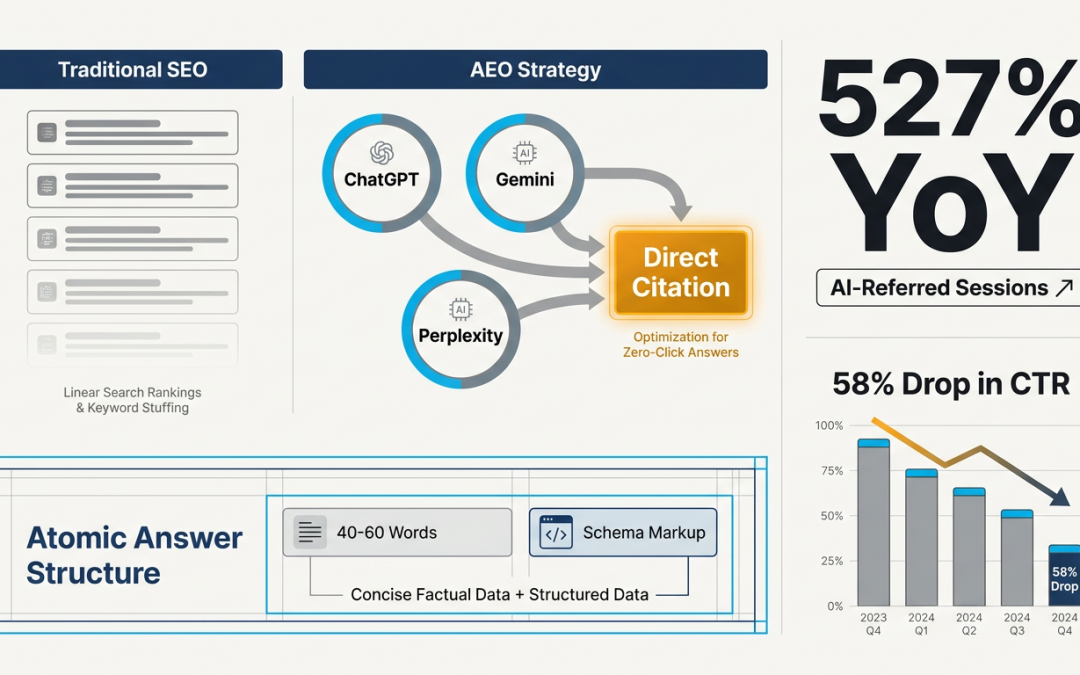
Key Takeaways for Executive Leadership
Answer Engine Optimization (AEO) is the strategic process of structuring and formatting digital content so AI models like ChatGPT, Gemini, and Perplexity can easily understand, trust, and cite your brand as a direct answer to user queries [1]. Unlike traditional SEO, which prioritizes ranking URLs for human clicks, AEO focuses on maximizing citation frequency and Share of Voice across 17+ generative engines. For enterprise teams, mastering AEO is the primary defense against the drop of up to 61% in organic click-through rate reported by Seer Interactive on results pages with AI Overviews, turning AI from a traffic threat into a powerful authority channel
📊 The Impact of AI Overviews
Seer Interactive data shows organic click-through rate falling by up to 61% on search results pages that include an AI Overview. Mastering AEO is the primary strategy to counter this traffic loss.
. The core practice involves creating clear, self-contained answers that machines can accurately parse and attribute to your expertise.
💡 What is Answer Engine Optimization (AEO)?
AEO is the strategic process of formatting content so AI models like ChatGPT and Gemini can understand, trust, and cite your brand as a direct answer. Unlike SEO which targets clicks, AEO targets citation frequency and Share of Voice in generative AI responses.
Introduction
The digital landscape is undergoing its most significant transformation in two decades, shifting from traditional link-based search engines to generative AI answer models. This transition introduces immediate confusion around the acronym “AEO.” For millions of consumers, “aeo” signifies American Eagle Outfitters, a retail giant known for its popular Jeans
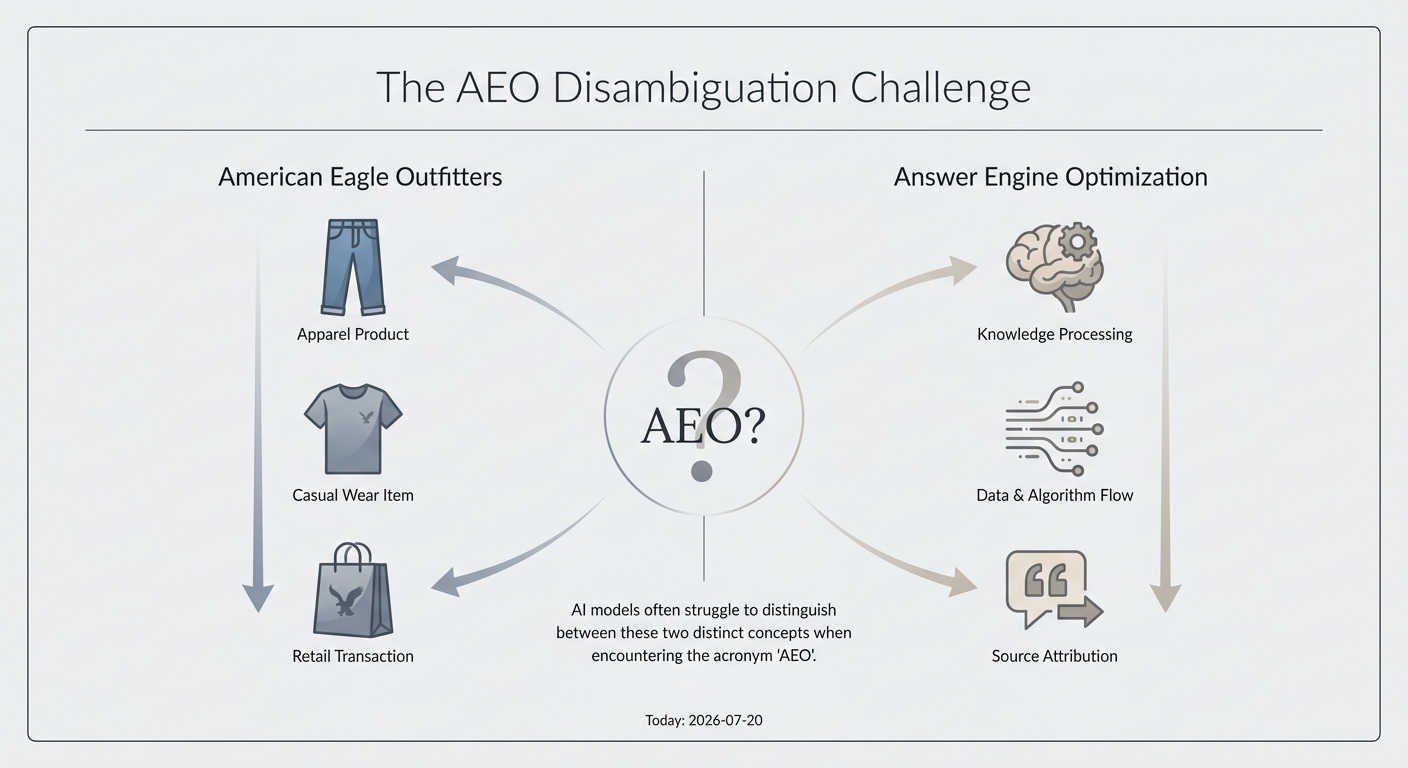
and the broader aeo brand. In stark contrast, for B2B marketers, “AEO” stands for Answer Engine Optimization—the discipline of creating accurate, extractable responses that position a brand as a citable authority, moving beyond simple link-ranking [1].
This paradigm shift is not gradual; it’s exponential. LLM-referred sessions to websites grew 527% between January–May 2024 and January–May 2025 (Search Engine Land), and ChatGPT was handling more than 2.5 billion messages daily by July 2025 (OpenAI) [2]
. As the digital economy becomes increasingly reliant on AI-driven discovery, marketing teams must adapt or risk becoming invisible. The era of competing for a blue link is over; the new competition is for a direct citation within a trusted, AI-generated answer.
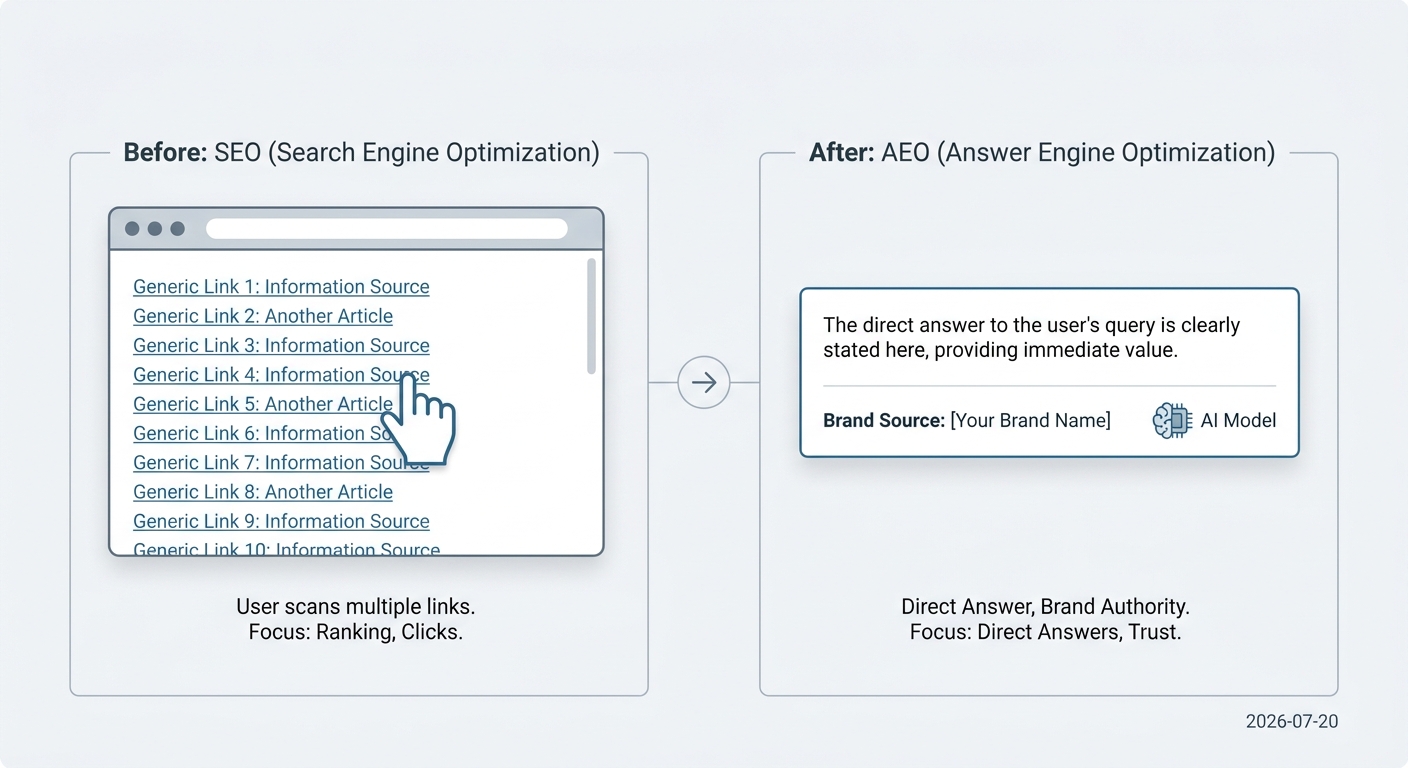
This guide provides a comprehensive framework for mastering AEO. We will dissect the architectural differences between SEO and AEO, explain how to disambiguate complex entities like “aeo inc” from consumer products, and detail how to structure content for LLM extraction. You will learn to track your brand’s visibility across 17+ AI models using AI Rankia, ensuring your organization not only survives but thrives in the new generative search ecosystem.
Transparency Disclosure
Disclosure: This guide is produced by the AI Search Analytics team at AI Rankia. It contains proprietary data from our 17+ model tracking platform and references third-party industry studies to provide a comprehensive view of Answer Engine Optimization. Our goal is to equip marketers with the data-driven strategies needed to navigate the complexities of AI search.
Expert Consensus: The Shift to AEO
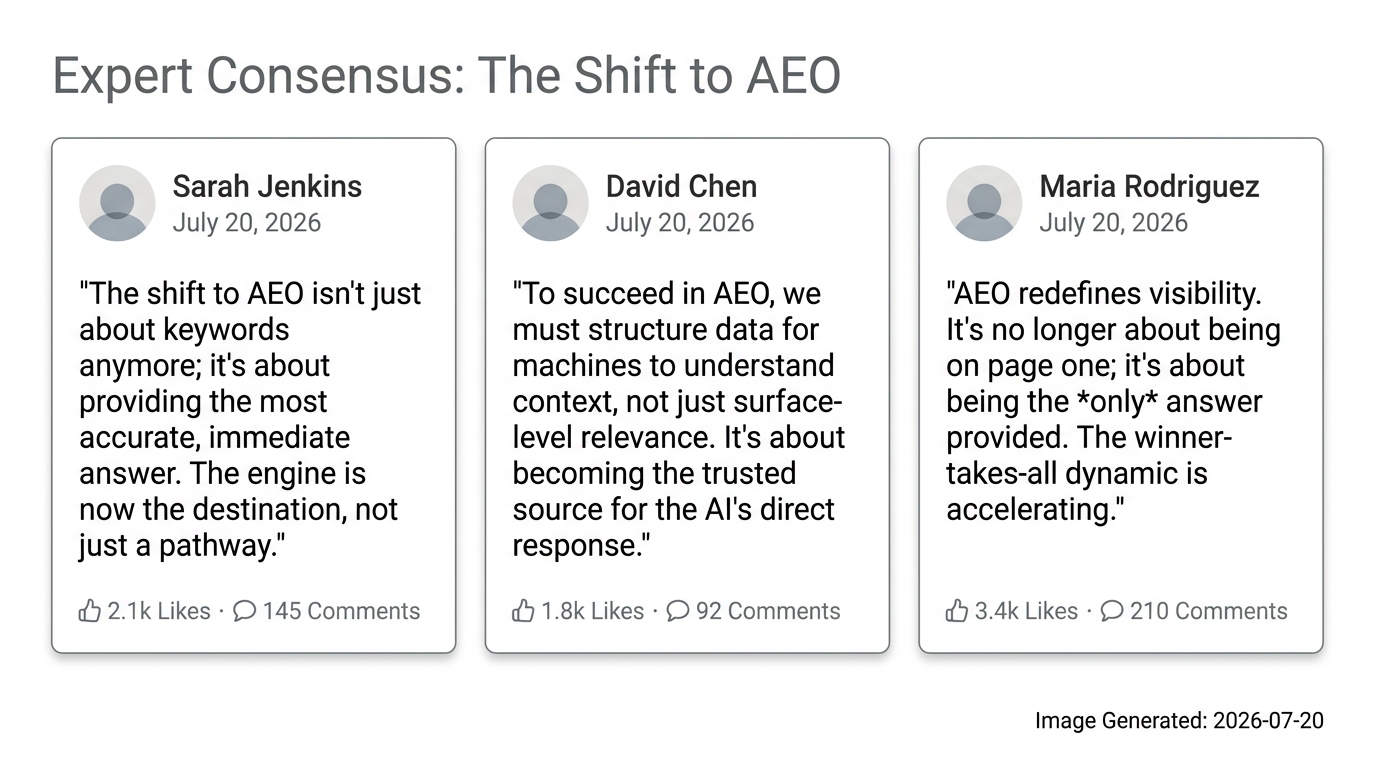
“SEO gets you found. AEO gets you cited. They operate in completely different layers of the same system.”
— Charlsie Niemiec, Writer & Editorial Strategist (LinkedIn)
“Visitors arrive through AI search at a conversion rate 4.4 times higher than those from traditional organic search.”
— Semrush 2025 Data Study via Coursera (LinkedIn, January 2026 – 2,105 likes, 455 shares)
The Difference Between AEO and SEO
The core difference between AEO and SEO lies in their architectural goals: SEO aims to rank a URL in a list of links, while AEO aims to become the citable source within a synthesized AI answer. This distinction is critical, as Seer Interactive reports organic click-through rate falling by up to 61% when an AI Overview is present in search results

. Ignoring AEO means fighting for a shrinking pool of clicks while your competitors become the voice of authority that AI platforms quote directly.
Traditional SEO focuses on signals like keyword density, backlinks, and HTML optimization to influence link-based ranking algorithms like PageRank. AEO, however, requires structuring data for an entirely different system: Retrieval-Augmented Generation (RAG). RAG is the process AI models use to fetch real-time, external information to ground their answers in facts. As industry analysis confirms, strong SEO is the foundation, but AEO is the essential AI-readiness layer built on top [10]. AEO targets accurate, extractable responses and brand citations rather than link-ranking, making it a fundamentally different discipline [1].
To visualize these differences, consider the following comparison matrix:
Comparison: Traditional SEO vs. Answer Engine Optimization (AEO)
| Option | Pros | Cons |
|---|---|---|
| Primary Goal | Maximizing Share of Voice and brand citations in AI answers. | Driving website traffic via clicks on blue links. |
| Core Architecture | Schema markup, entity databases, and RAG pipelines. | HTML parsing, crawlers, and link graphs (PageRank). |
| Success Metric | Citation frequency and inclusion probability across LLMs. | Keyword ranking positions (e.g., #1-10). |
| Content Focus | Clear, self-contained direct answers. | Long-form, keyword-optimized articles and pages. |
| Metric | Traditional SEO | Answer Engine Optimization (AEO) |
|---|---|---|
| Primary Goal | Driving website traffic via clicks on blue links | Maximizing Share of Voice and brand citations in AI answers |
| Core Architecture | HTML parsing, crawlers, and link graphs (PageRank) | Schema markup, entity databases, and RAG pipelines |
| Success Metric | Keyword ranking positions (e.g., #1-10) | Citation frequency and inclusion probability across LLMs |
| Content Focus | Long-form, keyword-optimized articles and pages | Clear, self-contained direct answers |
| Target System | Link-based search engine results pages (SERPs) | Generative AI models (ChatGPT, Gemini, Perplexity, etc.) |
The Anatomy of an AI Answer: Why Structure Matters
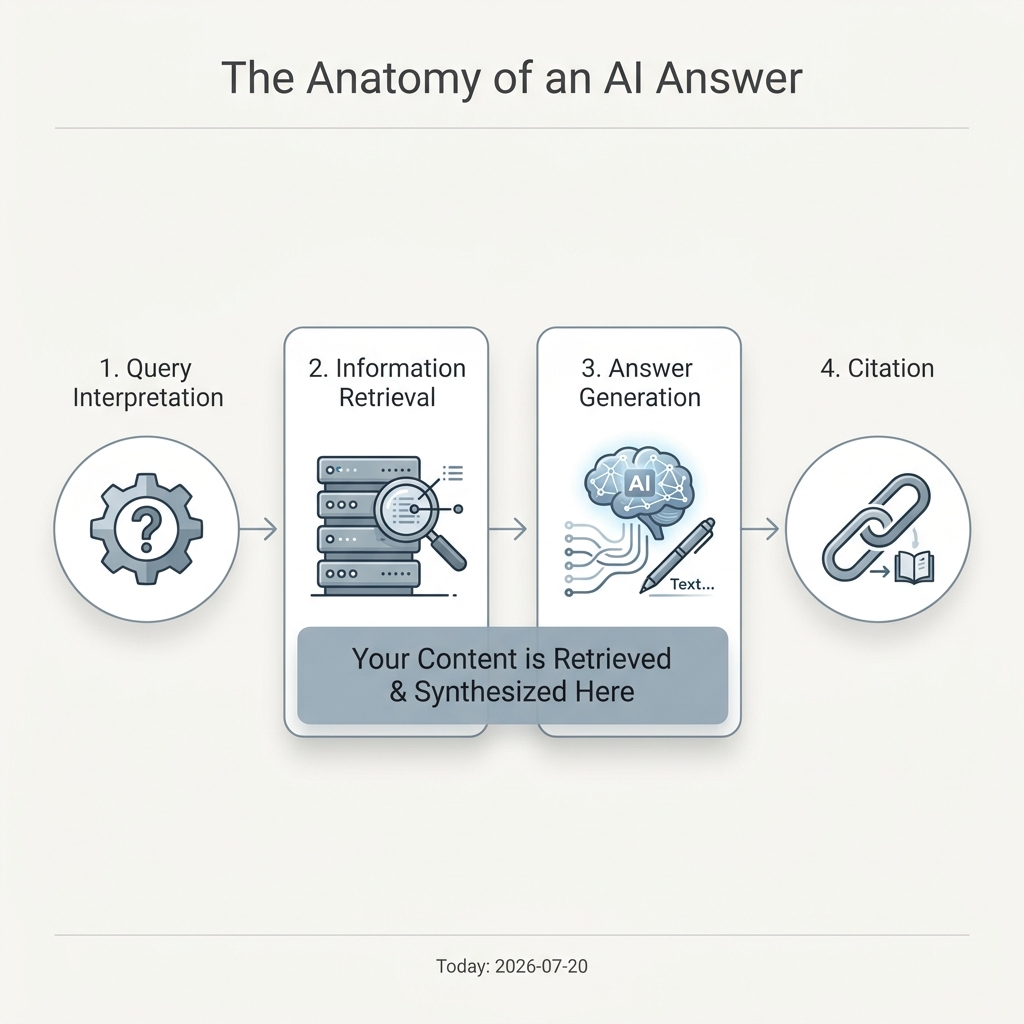
To master AEO, you must understand how an AI constructs an answer. When a user submits a query, the LLM initiates a RAG process:
- Query Interpretation: The AI first understands the user’s intent, including any nuances from the conversation history.
- Information Retrieval: The model then queries its internal knowledge base and external sources (like the Bing or Google index) to find relevant documents. This is where your website content is “retrieved.”
- Answer Generation: The LLM synthesizes the information from multiple retrieved sources into a coherent, conversational answer. It prioritizes content that is clear, concise, and factually verifiable.
- Citation: Finally, the model provides links to the sources it used, which is where your AEO efforts pay off.
Your content must be optimized for the “Retrieval” and “Generation” steps. If your information is buried in long paragraphs or lacks clear entity signals, the AI will either ignore it or misinterpret it.
The Entity Disambiguation Imperative
Entity disambiguation is one of the most significant AEO challenges. When an LLM encounters a query like “aeo,” it must determine if the user means the marketing discipline, the American Eagle Outfitters Stock Market
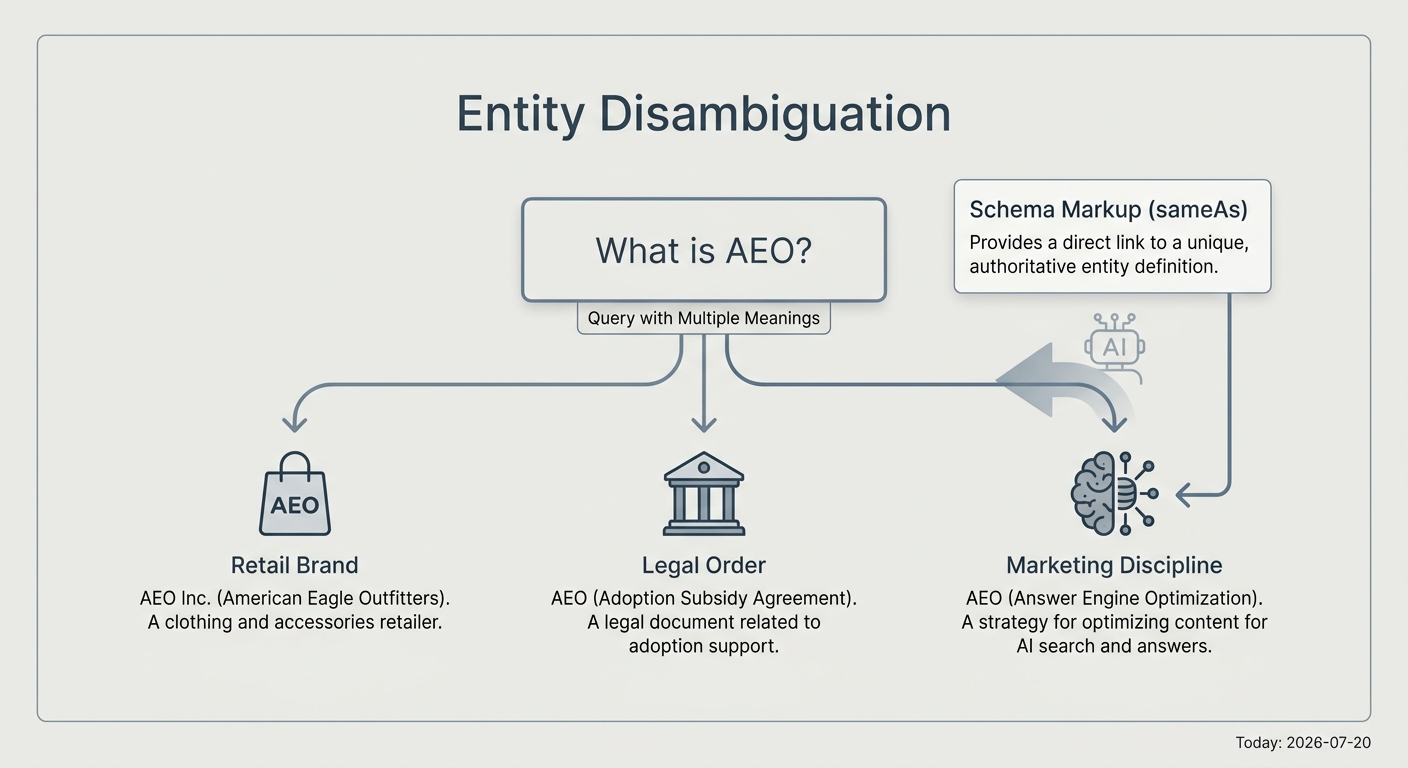
ticker, or the aeo ceo. Without clear signals, AI models conflate these concepts. To force correct interpretation, marketers must use schema markup (specifically sameAs properties linking to Wikidata and Knowledge Graph entries) to explicitly define their brand entity, preventing confusion with a retail giant. Understanding LLM integration is the first step in mastering these entity relationships.
This shift also clarifies the confusion between Generative Engine Optimization (GEO) and AEO. The term GEO was introduced in an academic paper by researchers from Princeton University and IIT Delhi, among others, focusing on the theoretical framework for influencing AI models [3]
💡 AEO vs. GEO: What’s the Difference?
Generative Engine Optimization (GEO) is the academic term for the theoretical framework of influencing AI models. Answer Engine Optimization (AEO) is the practical, in-the-field application of these principles by marketers to structure content and track citations.
. AEO, in contrast, is the practical, in-the-field application of these principles by marketers. As generative models intercept users before they ever click a link, AEO becomes a necessary defensive strategy, ensuring that when an AI synthesizes an answer, your brand is the trusted source it cites.
Tracking Your Share of Voice Across 17+ AI Models
You cannot use traditional rank trackers for AI search because AI responses are non-deterministic, meaning there is no fixed “#1” position to track. An LLM assembles its answer fresh every time, influenced by the query, conversation history, user location, and the specific model version [9]. Consequently, tracking static positions is futile. The new key performance indicator is Share of Voice
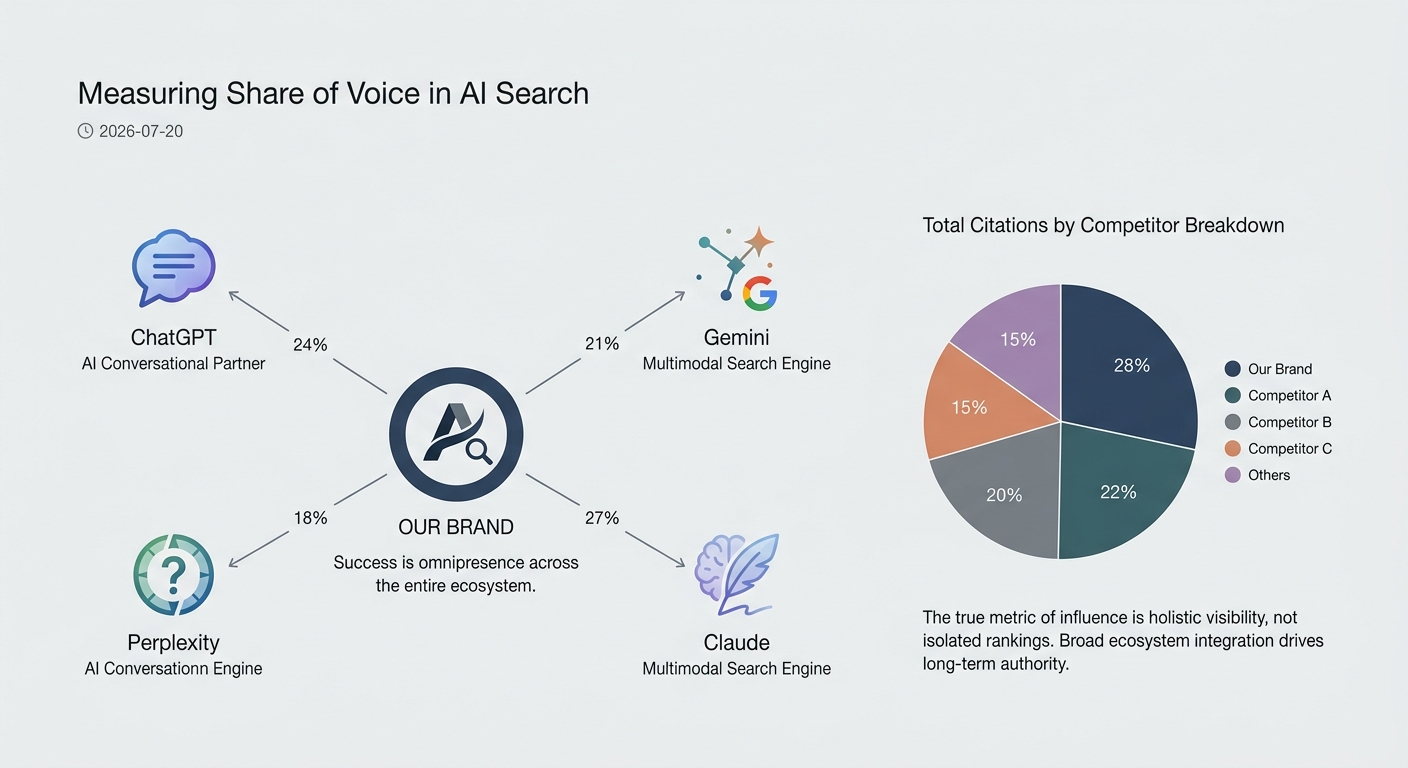
—the frequency your brand is cited as a source across the entire AI ecosystem.
Focusing solely on Google’s AI Overviews creates dangerous blind spots. The AI search market is fragmenting rapidly. Perplexity, for instance, has established itself as a major player for research-intensive queries [7]
⚠️ Avoid Dangerous Blind Spots
Focusing only on Google’s AI Overviews is a mistake. The market is fragmenting, with platforms like Perplexity and ChatGPT handling billions of queries. A comprehensive AEO strategy requires monitoring brand visibility across the entire AI ecosystem.
📊 Perplexity’s Role in AI Search
The AI search engine Perplexity has established itself as a major player for research-intensive queries and a critical platform to monitor for AEO.
. Simultaneously, ChatGPT was handling more than 2.5 billion messages daily by July 2025 (OpenAI), and many of its answers use web search [2]. To capture this distributed audience, you need tools that monitor brand mentions across all these distinct environments.
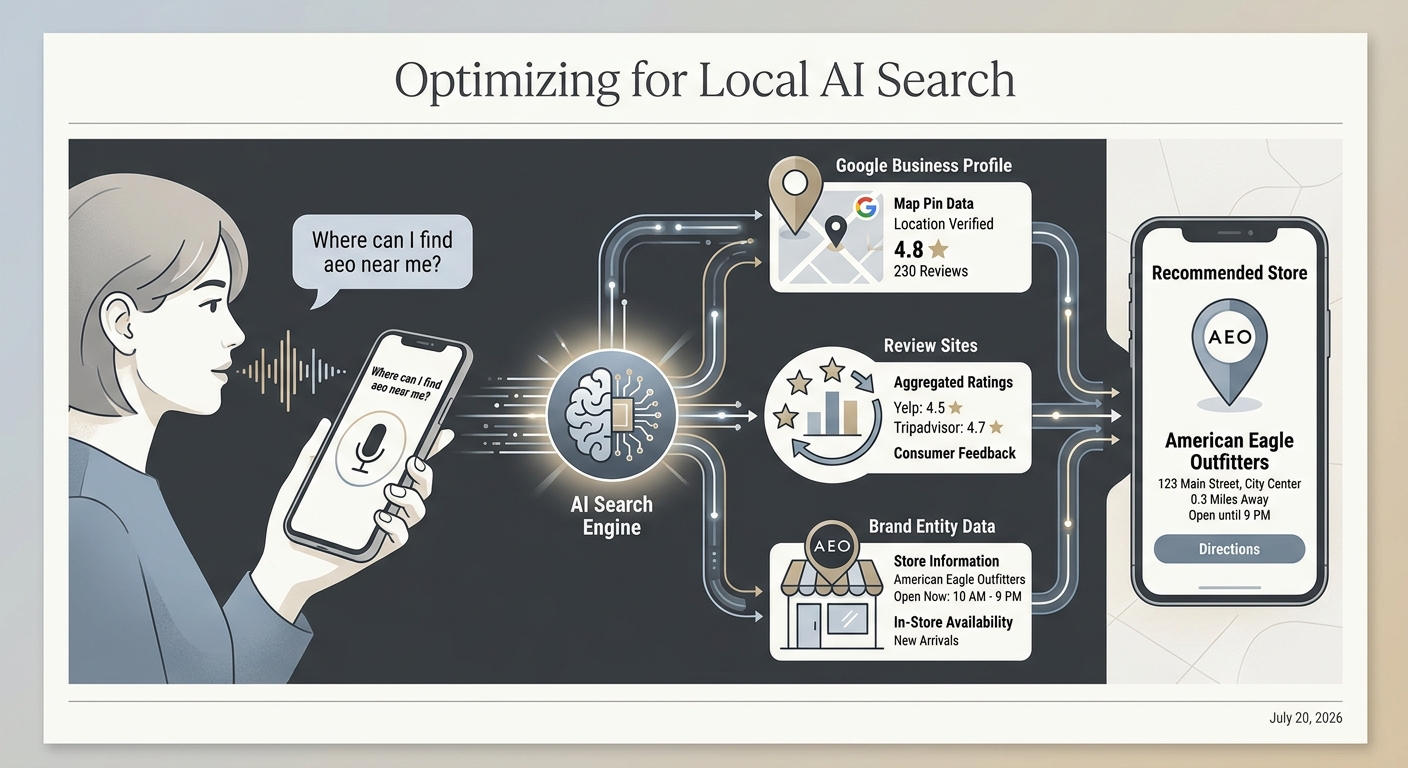
For businesses, this fragmentation extends to local AI search. When a user asks a voice assistant, “Where can I find aeo near me?”, spatial AI models synthesize location data from Google Business Profile, local reviews, and entity prominence to generate a recommendation. Without specific optimization for these local AI queries, brick-and-mortar locations become invisible. Using a tool like AI Rankia’s Local Tracker allows teams to monitor these spatial queries, ensuring their physical stores are cited accurately.
How to Conduct a Query Fan-Out Analysis
Select Target Queries
Choose a mix of informational, commercial, and navigational queries relevant to your brand.
Define Competitors
Identify the top 3-5 competitors you want to benchmark against.
Deploy Across Models
Run the queries simultaneously on ChatGPT, Gemini, Perplexity, and other key AI engines.
Analyze Citation Patterns
Aggregate the data to calculate your Share of Voice and see who gets cited.
Identify Optimization Gaps
Use the insights to surgically improve content and schema for specific LLM architectures.
The professional methodology for measuring this landscape is a Query Fan-Out Analysis. This involves taking a target query, mapping the multiple related sub-queries an AI engine generates from it, and benchmarking the resulting responses and citations across models.
- Select Target Queries: Choose a mix of informational (“what is aeo”), commercial (“best aeo tools”), and navigational (“aeo login”) queries relevant to your brand.
- Define Your Competitive Set: Identify the top 3-5 competitors you want to benchmark against.
- Deploy Across Models: Use a platform like AI Rankia to run these queries on ChatGPT (multiple versions), Gemini, Perplexity, Claude, and others. The platform should capture the full text of the answer and all cited sources.
- Analyze Citation Patterns: The software aggregates the data, calculating your Share of Voice. It identifies which models cite your brand, which cite competitors, and which fail to find relevant information.
- Identify Optimization Gaps: The analysis reveals which content needs better structuring for specific LLM architectures. For example, you might discover that Perplexity favors your competitor’s recent case study, while ChatGPT prefers your foundational guide. This insight allows for surgical content improvements.
This comprehensive approach to managing brand mentions and entity tracking provides a holistic and actionable view of generative search performance, moving beyond the outdated metrics of traditional SEO.
Structuring Content for ChatGPT, Gemini, and Perplexity
To be cited by an AI, content must be structured for machine readability, not just human consumption. The key is creating clear, self-contained answer blocks placed directly under question-based headers. This format minimizes the “cognitive load” for the LLM, making it easy to parse, validate, and extract your text during the Retrieval-Augmented Generation (RAG) process. Without this architecture, even the best content will be ignored.
Different AI platforms have distinct preferences, requiring a multi-pronged optimization strategy. Based on crawler data and empirical testing, we know:
How to Optimize for Top AI Engines
ChatGPT
Favors question-based headers, concise answers, and third-party validation. Can draw on several search providers, including Bing.
Perplexity
Prioritizes content with recent update timestamps, clear sourcing, and structured data like FAQ and HowTo schema.
Google Gemini / AI Overviews
Shows a strong preference for content from entities with high authority in Google’s Knowledge Graph.
- ChatGPT: Favors question-based H2s/H3s and concise, direct answers. It heavily weighs third-party validation (like reviews and media mentions) and can draw on several search providers (OpenAI), so ensuring your site is accessible to major search crawlers, including Bingbot, is useful [5].
- Perplexity: Functions as a research assistant, prioritizing content with recent update timestamps and clear source attribution. It responds exceptionally well to structured data like FAQ and HowTo schema.
- Google Gemini / AI Overviews: Shows a strong preference for content from entities with high authority in Google’s own Knowledge Graph. Aligning your site’s structured data with your Knowledge Graph panel is paramount.
The AEO Content Workflow: A 5-Step Process
🔍 Identify Question Clusters
Find and group the questions your audience is asking AI.
✍️ Create Atomic Answers
Write a direct, self-contained answer for each question.
💻 Structure with Semantic HTML
Use question-based headers (H2, H3), lists, and tables.
🏷️ Implement Precision Schema
Use FAQPage, HowTo, and Organization schema to add context.
📊 Publish, Monitor, and Iterate
Use a tracking platform to analyze citation performance and refine your content.
- Identify Question Clusters: Use tools to find the questions your audience is asking AI. Group related questions into thematic clusters (e.g., “AEO vs. SEO,” “AEO measurement,” “AEO tools”).
- Create Atomic Answers: For each question, write a direct, self-contained answer. This is the “atomic unit” of AEO. It should be factual, clear, and require no external context to be understood. Lead every section with a direct answer [2].
- Structure with Semantic HTML: Place each atomic answer directly below a question-based header (H2, H3). Use lists, tables, and blockquotes to further structure the data for easy parsing.
- Implement Precision Schema: Wrap your Q&A sections in
FAQPageschema. For processes, useHowToschema. For your organization, useOrganizationschema withsameAslinks to your Wikidata and social profiles to solve entity disambiguation. - Publish, Monitor, and Iterate: After publishing, use a platform like AI Rankia to run a Query Fan-Out Analysis. Monitor which answers get cited and which don’t. Use this data to refine your content and schema.
Common AEO Mistakes to Avoid
⚠️ Common AEO Mistakes
Avoid simply ‘stuffing’ keywords into old SEO content. The structure of the answer itself matters most. Also, failing to use Organization and ‘sameAs’ schema is the #1 reason for brand confusion in AI.
- “Stuffing” Conversational Keywords: Simply adding “what is” or “how to” to your old SEO content is not AEO. The structure of the answer itself is what matters.
- Ignoring Entity Signals: Failing to use
OrganizationandsameAsschema is the #1 reason for brand confusion. You must explicitly tell the AI who you are. - Relying on a Single FAQ Page: While a dedicated FAQ page is good, the most powerful strategy is to distribute contextual Q&A sections throughout your relevant service and product pages. For an e-commerce site optimizing for terms like aeo shorts, aeo dresses, or aeo underwear, this means adding a small Q&A section on the category page itself, answering common questions about sizing, materials, or care instructions.
- Forgetting Non-Text Content: Optimize image file names and alt text with descriptive, natural language. AI models are increasingly multimodal and use this data for context.
This tactical structuring has a dramatic impact on performance. Across the web, AI-referred sessions grew 527% between January–May 2024 and January–May 2025 [2]
📊 The Reward for AEO
AI-referred sessions across the web grew 527% between January–May 2024 and January–May 2025, showing how quickly AI-driven discovery is growing.
. By leading every key section with a direct answer and using tools to implement the correct schema, you are no longer just publishing content; you are creating a database of citable facts for the entire AI ecosystem. Utilizing specific Generative Engine Optimization tools can automate this process, ensuring your content is technically sound.
Measuring ROI and Lead Generation in Generative Search
To prove the value of AEO, marketers must abandon legacy metrics and adopt a new framework for measuring ROI. Since generative engines don’t provide stable click-through data, success is measured by Share of Voice and citation frequency. By tracking how often your brand is cited as the authoritative source for high-intent queries, you can directly correlate AEO efforts with downstream business goals.
A common mistake is trying to apply SEO’s ranking model to AI. AI responses are non-deterministic, meaning there is no permanent “#1” rank to achieve [9]. The answer is rebuilt fresh for every query. Therefore, any agency promising a “top ranking in ChatGPT” is misrepresenting how the technology works. Success is not a static position but a high probability of inclusion in the AI’s synthesized answer.
⚠️ Beware of False Promises
AI responses are non-deterministic, meaning there is no permanent ‘#1’ rank. Any agency promising a top ranking in ChatGPT is misrepresenting how the technology works. Success is measured by citation probability, not a static position.
Despite this variability, the business impact is tangible and measurable. In the original GEO research, some optimization methods improved visibility in generative engine responses by up to 40% in the experimental setting (GEO-bench)
📊 Research: Measured Visibility Gains
Research using GEO-bench found that some GEO (Generative Engine Optimization) techniques improved visibility in AI responses by up to 40% in the experimental setting.
. Traffic from AI answers is often highly qualified; the user arrives after the AI has already vetted the information and recommended your brand as the solution, leading to higher conversion rates.
Connecting AEO Metrics to Business KPIs
To build a compelling report for a CMO, you must connect AEO metrics to business outcomes. Use a tool like AI Rankia’s Citations Manager to track specific query clusters and map them to key performance indicators (KPIs).
| AEO Metric | Monitored Query Cluster | Corresponding Business KPI |
|---|---|---|
| Citation Frequency | “best [product] for [use case]” | Increase in Marketing Qualified Leads (MQLs) |
| Share of Voice | “[competitor] vs [your brand]” | Increase in Market Share, Improved Brand Preference |
| Citation for Support Queries | “how to return [product],” “[brand] customer service” | Decrease in Customer Support Ticket Volume |
| Entity Recognition Rate | “[brand name],” “[brand] stock” | Reduction in Brand Confusion, Improved Investor Relations |
By tracking commercial intent queries like aeo promo code, aeo coupons, aeo coupon code, or aeo sale, you can directly demonstrate influence on revenue. Similarly, monitoring customer experience queries like aeo customer service or aeo returns quantifies how AEO reduces support costs by providing users with instant, accurate answers. By presenting Share of Voice data alongside these targeted query clusters, you can translate abstract AEO concepts into the language of ROI, lead generation, and market penetration that leadership understands.
Frequently Asked Questions (FAQ)
- What does AEO mean?
AEO stands for Answer Engine Optimization. It is the digital marketing practice of structuring website content so that artificial intelligence models, like ChatGPT and Perplexity, can easily read, extract, and cite the information as direct answers to user queries, rather than just providing a list of links.
- What is AEO vs SEO?
AEO focuses on getting cited by AI engines, while SEO focuses on ranking links in traditional search engines. SEO relies on backlinks, keyword density, and domain authority to drive traffic. AEO requires conversational formatting, schema markup, and entity disambiguation to become the source data for generative AI answers.
- What is the difference between AEO and GEO?
AEO is the practical application, while GEO (Generative Engine Optimization) is the academic theory. GEO was defined in a research paper by researchers from Princeton University and IIT Delhi, among others [3], describing the theoretical model of influencing AI. AEO is the term used by marketers for the hands-on work of structuring content and tracking citations.
- What is AEO in medical terms?
In medical terms, AEO typically refers to Arrhythmogenic Eosinophilic Overlap or similar specific clinical abbreviations, completely unrelated to marketing. When optimizing for Answer Engines, it is critical to use schema markup and context to disambiguate your brand so AI models do not confuse marketing acronyms with medical terminology.
- What is AEO payment?
An AEO payment usually refers to an Attachment of Earnings Order in the UK legal and financial system. This is a mechanism where debt repayments are deducted directly from a person’s wages. In the context of AI search, disambiguating this financial term from the marketing acronym is essential for accurate entity recognition.
- What is the abbreviation AEO?
The abbreviation AEO most commonly stands for American Eagle Outfitters (the retail brand), Answer Engine Optimization (in marketing), or Authorized Economic Operator (in international trade). Because the acronym has massive search volume across different industries, marketers must use strict entity tracking to ensure their specific brand is understood by AI.
- Is AEO a real thing?
Yes, AEO is a highly critical and real marketing discipline in 2026. As search engines transition to generative AI overviews, organic click-through rate has fallen by up to 61% on results pages with AI Overviews, according to Seer Interactive. Answer Engine Optimization is now a mandatory strategy for enterprise brands to ensure they are cited as authoritative sources by LLMs.
- How long does AEO take to show results?
AEO results can appear faster than traditional SEO, sometimes within days or weeks. Once your content is re-indexed by search engines like Bing or Google, it can be immediately available for citation. However, building foundational authority and consistently winning citations for competitive queries is an ongoing process that takes months.
- How do I optimize for Answer Engines?
To optimize for Answer Engines, you must structure your content with clear, direct answers beneath question-based headers. Additionally, implement strict FAQ and Article schema, ensure your brand entities are clearly defined in the Knowledge Graph, and focus on third-party validation and authoritative citations.
- Does ChatGPT use AEO?
ChatGPT relies heavily on AEO principles to formulate its responses. When a user asks a question, ChatGPT’s web browsing capabilities scan the internet for clearly structured, authoritative data. Websites that utilize Answer Engine Optimization are much more likely to be extracted and cited as sources in ChatGPT’s output.
- How do you track AI search rankings?
You track AI search performance by measuring “Share of Voice” and citation frequency across multiple LLMs using specialized platforms like AI Rankia. Because AI responses are non-deterministic, traditional rank trackers fail. You must use tools that run your queries across 17+ models to measure true visibility.
Limitations, Alternatives & Professional Guidance
While Answer Engine Optimization is critical for future visibility, it is not a silver bullet. AEO is a layer that sits on top of a healthy technical SEO foundation; if your site cannot be effectively crawled and indexed by traditional search bots, it will remain invisible to the AI models that rely on those indexes [10]. AEO complements, rather than replaces, core SEO practices like site speed, mobile-friendliness, and building a strong backlink profile, as these are all signals of trust and authority that LLMs inherit.

Furthermore, practitioners must acknowledge the inherent limitations of the technology. AI models can “hallucinate”—misinterpret data or generate plausible but incorrect information. This makes it even more crucial to control the source narrative through precise AEO. Relying on manual tracking is impossible due to the sheer scale and non-deterministic nature of generative search. A single query can yield different results moments apart, making automated, large-scale monitoring essential.
For enterprise teams, professional guidance and automated tracking are non-negotiable. The only viable alternative to flying blind is to utilize a dedicated platform. An AI Rankia 17+ model tracking platform allows you to conduct a comprehensive LLM Readiness Audit, ensuring your brand’s entities—from high-level concepts to specific products like aeo boxers, aeo hoodie, aeo sweater, aeo shirt, and aeo cologne—are accurately interpreted and cited by artificial intelligence.
Conclusion
The transition from traditional search to generative Answer Engines is the most disruptive shift in digital marketing in the last 20 years. As we’ve explored, Answer Engine Optimization is no longer an experimental tactic but a mandatory architectural layer for any brand aiming to survive the drop of up to 61% in organic click-through rate that Seer Interactive reports on results pages with AI Overviews. The principles are clear: disambiguate your brand from entities like aeo aerie or aeo com, structure content into clear, extractable answers for models like ChatGPT, and optimize for local AI discovery.
However, strategy without measurement is guesswork. Implementing AEO without precise, multi-model tracking is like navigating a new city without a map. Because generative AI responses are non-deterministic and the market is fragmented across dozens of models, legacy SEO tools are completely obsolete for this task. You cannot win a game you cannot see. You need a platform built specifically for the AI era to track citations, monitor Share of Voice, and prevent costly entity confusion.
Are you ready to stop guessing and start measuring your true AI search visibility? See exactly how your brand performs across ChatGPT, Gemini, Perplexity, and 14 other critical models. Access a Free Trial of AI Rankia’s Starter plan, starting at just $29/mo, and run your first LLM Readiness Audit today. For more AI search resources
✅ Start Measuring Your AI Visibility
Stop guessing and start measuring your true performance in AI search. A dedicated tracking platform allows you to run an LLM Readiness Audit and monitor your Share of Voice across ChatGPT, Gemini, Perplexity, and more.
, explore our comprehensive guides on navigating the generative landscape.
References
[1] What is answer engine optimization (AEO)? Understanding AEO for the future of search
[2] Answer Engine Optimization: Complete AEO Guide [2026]
[4] What Are Answer Engine Optimization AEO Best Practices 2026?
[5] How to Optimize Blog Content for ChatGPT, Perplexity, and Gemini
[6] Update: AI Overviews Reduce Clicks by 58%
[7] AI Search Engine Market Share 2024: ChatGPT vs Perplexity Stats
[8] Generative Engine Optimization (GEO) Case Study: 3X'ing Leads