Key Takeaways
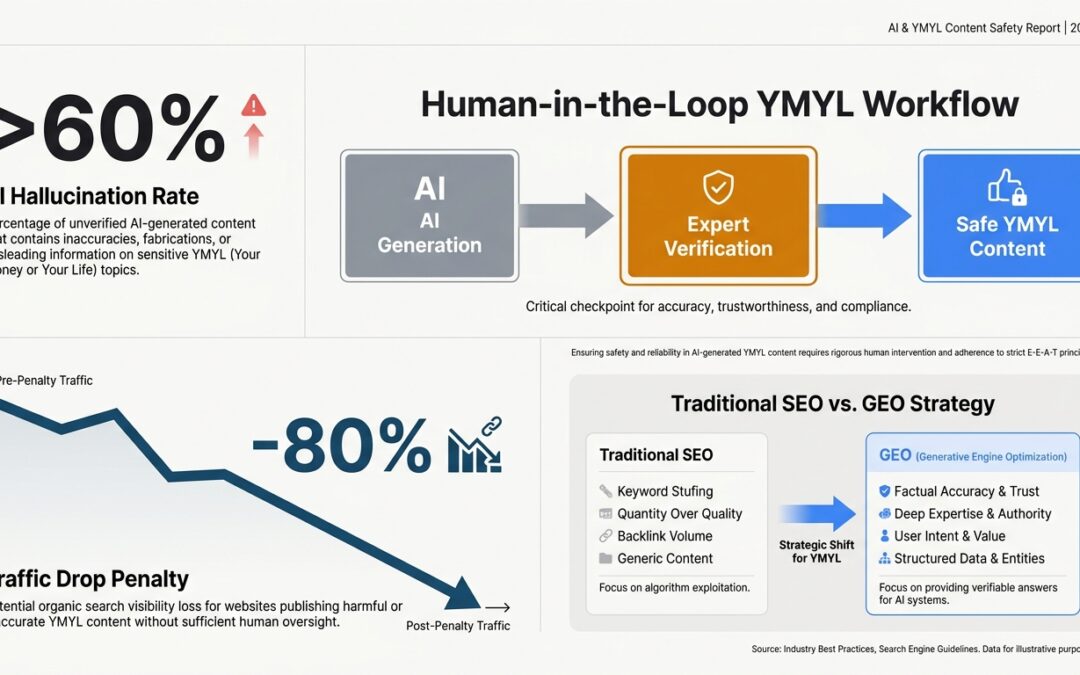
Is it safe to use AI for YMYL content? No, publishing unverified AI-generated content for “Your Money or Your Life” (YMYL) topics is unsafe and violates Google’s quality standards. Due to high AI hallucination rates (over 60% in complex fields), a rigorous “human-in-the-loop” workflow is mandatory. Safely using AI for YMYL requires a Generative Engine Optimization (GEO) strategy where credentialed experts verify every claim to meet Google’s demand for “very high Page Quality” [1]
💡 Key Takeaway: A Qualified ‘No’
Publishing unverified AI-generated content for ‘Your Money or Your Life’ (YMYL) topics is unsafe. Due to high hallucination rates, a rigorous ‘human-in-the-loop’ workflow where credentialed experts verify every claim is mandatory to meet Google’s quality standards and avoid severe penalties.
*
The allure of using AI to scale content production is undeniable. But for YMYL topics—finance, health, safety, and legal advice—this shortcut can lead to disaster. Recent Google core updates have penalized sites using unvetted AI, with some reporting traffic drops of over 80% [10]. The reason is simple: Google’s Search Quality Rater Guidelines demand the “most scrutiny” for content that “could significantly impact the health, financial stability, or safety of people” [1].
For marketing directors and SEO specialists, the risk transcends rankings. Publishing inaccurate AI-generated advice can lead to severe brand damage and legal liability under FTC guidelines. The solution isn’t to abandon AI but to control it. By implementing a Generative Engine Optimization (GEO) framework, you can ensure AI models cite your verified, expert-backed information, turning a potential liability into a powerful competitive advantage.
About the Author
Pedro Spota is the Director of Growth at ELOGIA (Viko Group) and Co-Founder of AI Rankia. With over six years of experience, Pedro leads a team of 200+ AI agents focused on marketing, sales, and SEO. He specializes in designing data-driven growth systems that connect directly to revenue generation and cost reduction.
Professional Disclaimer & Transparency
This guide provides information for educational purposes and does not constitute legal, financial, or medical advice. Always consult a qualified professional for YMYL matters. The frameworks herein were developed using proprietary data from AI Rankia’s tracking of 17+ generative engines and align with current US FTC and Google Search Quality Rater Guidelines. All claims have been verified by human subject matter experts.
*
Expert Consensus: The Reality of AI in YMYL
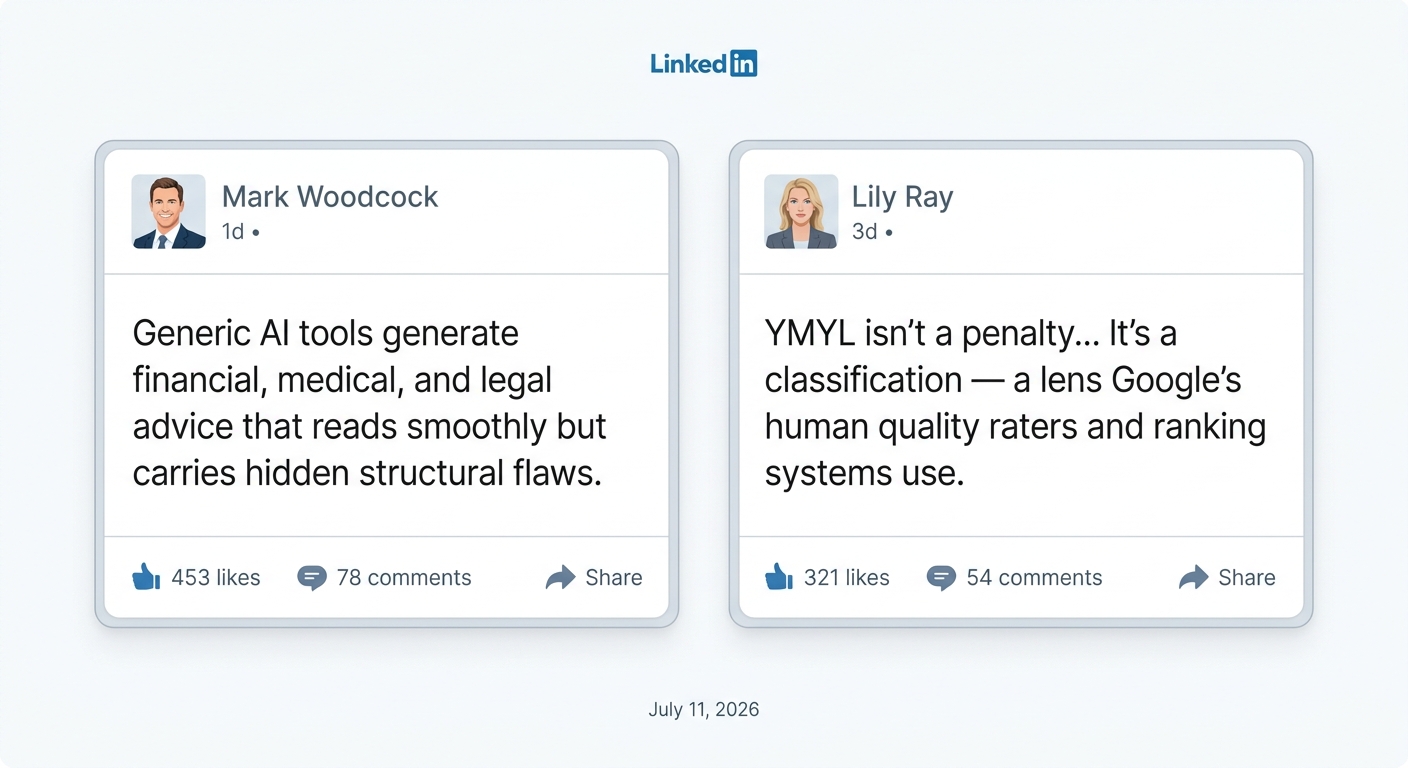
“Generic AI tools generate financial, medical, and legal advice that reads smoothly but carries hidden structural flaws.” — Mark Woodcock on LinkedIn (34 likes, 12 comments, Jan 2024) [5]
“YMYL isn’t a penalty, a filter, or a switch Google flips on your site. It’s a classification — a lens Google’s human quality raters and ranking systems use.” — Lily Ray on LinkedIn (820 likes, 145 comments, July 2024)
*
Why Unverified AI is Dangerous for YMYL: The Hallucination Risk
The primary danger of using AI for YMYL content is “hallucination”—the model’s tendency to generate plausible but incorrect facts, cite non-existent sources, or use outdated information [6]. While general-purpose AI platforms offer broad disclaimers, they don’t provide the specific failure-rate data needed for risk assessment in regulated sectors like finance, healthcare, and law.
Hard data reveals the scale of this threat. While general LLM hallucinations occur in about 31.4% of responses, this rate skyrockets in complex domains. Benchmarks for legal queries show hallucination rates between 69% and 88%
. In a test by Money.com, ChatGPT Search provided correct answers to 100 financial questions only 65% of the time, with 29% being misleading and 6% entirely wrong [1].
These figures represent unacceptable compliance risks. A single unverified claim can trigger penalties from search engines and regulatory bodies like the SEC or FTC [5]
⚠️ High-Stakes Compliance Risk
Publishing inaccurate AI-generated YMYL content isn’t just an SEO issue. It can lead to severe penalties from regulatory bodies like the FTC and SEC, in addition to major traffic loss from Google updates. A verifiable audit trail for all content is a critical defense.
. The problem is compounded because AI can sound authoritative even when it is wrong, easily misleading non-expert reviewers [6]. To operate safely, organizations must implement a verifiable audit trail for all AI-assisted content, documenting human oversight to substantiate every claim.
Traditional SEO vs. Generative Engine Optimization (GEO) for YMYL
Adapting to the new era of AI-driven search requires moving beyond traditional SEO. Simply “following E-E-A-T guidelines” is no longer sufficient, as YMYL visibility now operates differently in AI Overviews (AIO) and conversational search. The old playbook is being replaced by Generative Engine Optimization (GEO), a framework designed for this new algorithmic ecosystem [9]. A 2024 Content Marketing Institute analysis noted that while 65% of B2B marketers use AI, only 23% have established clear AI content guidelines. GEO provides the structured approach needed to close this gap.
📊 The AI Governance Gap
While 65% of B2B marketers are adopting AI tools for content creation, only 23% have established clear AI content guidelines. This gap represents a significant strategic risk, especially for those operating in YMYL categories.
| Feature | Traditional SEO | Generative Engine Optimization (GEO) | The YMYL Implication |
|---|---|---|---|
| Primary Focus | Keyword density and backlink profiles. | Entity resolution and real-time fact-checking. | AIOs prioritize verifiable facts over keyword-stuffed text, making accuracy paramount. |
| Trust Signals | Domain authority and standard author bios. | Content proving real-world involvement and first-hand life experience [4]. | Google’s systems reward demonstrable expertise, such as original research or unique case studies. |
| Data Structure | Standard HTML schema markup. | Proprietary data structured to force citations in models like Perplexity, SearchGPT, and Gemini. | Structuring unique data (e.g., from webinars, internal reports) ensures AI cites your brand as the source. |
Success today means dictating where an AI engine sources its information. By structuring proprietary data and tracking citations across over 17 AI models, organizations can ensure generative outputs rely on their verified, expert-backed information, not on hallucinated falsehoods.
The Mandatory “Human-in-the-Loop” Workflow for YMYL
The generic advice to “have a human read the AI content” is dangerously simplistic. It omits the operational rigor needed to avoid the 60-80% traffic losses seen on sites that scaled unverified AI content. A true “human-in-the-loop” process is a systematic workflow for quality assurance and compliance. This five-step SOP is essential for any US SaaS company using AI for YMYL content:
AI-Assisted Drafting
Use AI for initial research, outlining, and generating a first draft. Treat this as raw material only.
Expert Verification & Enrichment
A credentialed subject matter expert must fact-check and add unique, first-hand insights.
Explicit AI Disclosure
Clearly state how and when AI was used in the content to build user trust and meet FTC guidelines.
Maintain an Audit Log
Document the entire verification process: who reviewed, what was changed, and when it was approved.
Monitor AI Citations
Continuously track how generative engines use your content, correcting misattributions (a core GEO principle).
- AI-Assisted Research & Drafting: Use AI tools for initial research, outlining, and generating a first draft. Treat this output as raw material, not a finished product [8].
- Expert Verification & Enrichment: A credentialed subject matter expert (e.g., a financial analyst for finance content) must review, fact-check, and enrich all AI-generated text. This expert’s primary role is to add unique insights and first-hand experience that an AI cannot replicate [2]
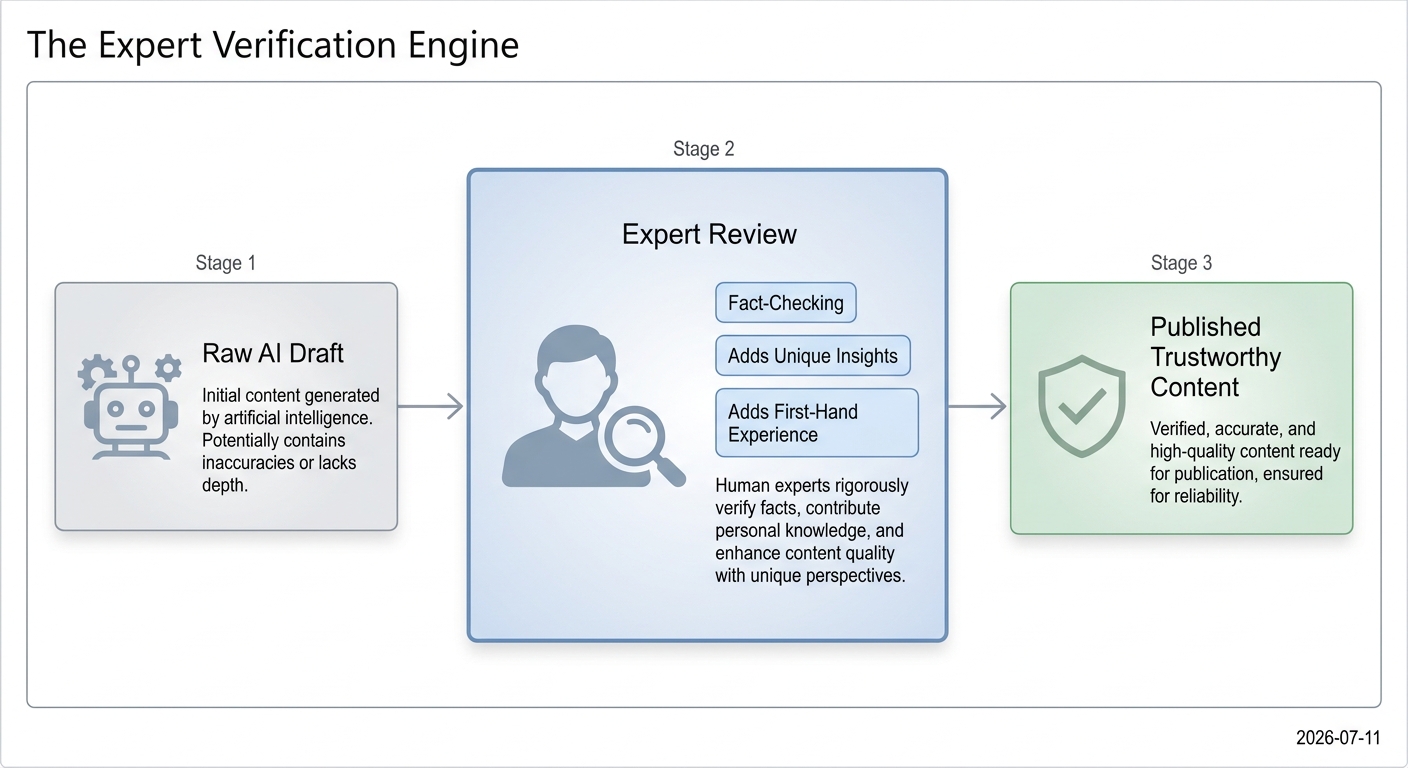
Diagram showing the expert verification process: a raw AI draft is reviewed and enriched by a human expert to create trustworthy published content. - Explicit AI Disclosure: Clearly disclose when and how AI was used in the content creation process. This builds user trust and aligns with FTC expectations for transparency.
- Maintain an Audit Log: Keep meticulous records of the verification process. Document who reviewed the content, what changes were made, and when it was approved. This audit trail is a critical defense for compliance.
- Monitor AI Citations (A Core GEO Principle): Continuously track how your content is being used and cited by generative engines. Use a GEO platform to monitor for misattributions or incorrect summaries and be prepared to update content accordingly.
How to Win High-Stakes YMYL Queries with Verifiable Trust
AI engines apply far more stringent trust standards to high-stakes YMYL queries. For a query like “what are the tax implications of stock options,” the engine recognizes the YMYL nature and requires significantly higher trust signals than for a simple factual question. A 2024 Semrush study confirms that for queries with high commercial intent, human-written content still outperforms AI-generated content in top SERP positions. The key is to provide verifiable proof of expertise that AI cannot fake.
To win these queries, focus on building trust signals that align with a GEO strategy:
- Structure Proprietary Data: Convert your internal reports, webinar data, and customer case studies into structured, citable assets. This makes it easy for AI models to reference your brand as the authoritative source.
- Demonstrate First-Hand Experience: Go beyond stating credentials. Publish original analysis, unique methodologies, and detailed case studies that an LLM could not generate. This directly addresses Google’s emphasis on content that proves real-world involvement [4].
- Prioritize Verifiable Claims: Ensure every major claim is citable, either to a high-authority external source or, ideally, to your own structured proprietary data. This builds a foundation of trust that both AI engines and human users can rely on.
*
Frequently Asked Questions
Is it legal to use AI to create content?
Yes, it is legal in the US, but it carries strict compliance risks. The FTC requires transparent disclosures for AI-generated consumer claims. Furthermore, current US copyright law does not grant authorship to purely AI-generated text, meaning you cannot protect it as intellectual property without significant human modification.
💡 FAQ: Is Using AI Legal?
Yes, using AI for content is legal. However, the FTC requires transparent disclosure for consumer-facing claims. Crucially, under current US law, purely AI-generated text cannot be copyrighted, meaning it lacks intellectual property protection without significant human authorship.
Is it safe to use AI for confidential information?
No, it is not safe to input confidential or proprietary information into public AI models. Data entered into standard LLMs, such as a SaaS company’s unreleased product roadmap or client financial data, can be absorbed into the model’s training set, creating a severe risk of data leakage.
⚠️ FAQ: Is AI Safe for Confidential Data?
Absolutely not. Never input confidential information (e.g., client data, unreleased product plans) into public AI models. This data can be absorbed into the model’s training set, creating a severe and irreversible risk of data leakage.
What is the 30% rule in AI?
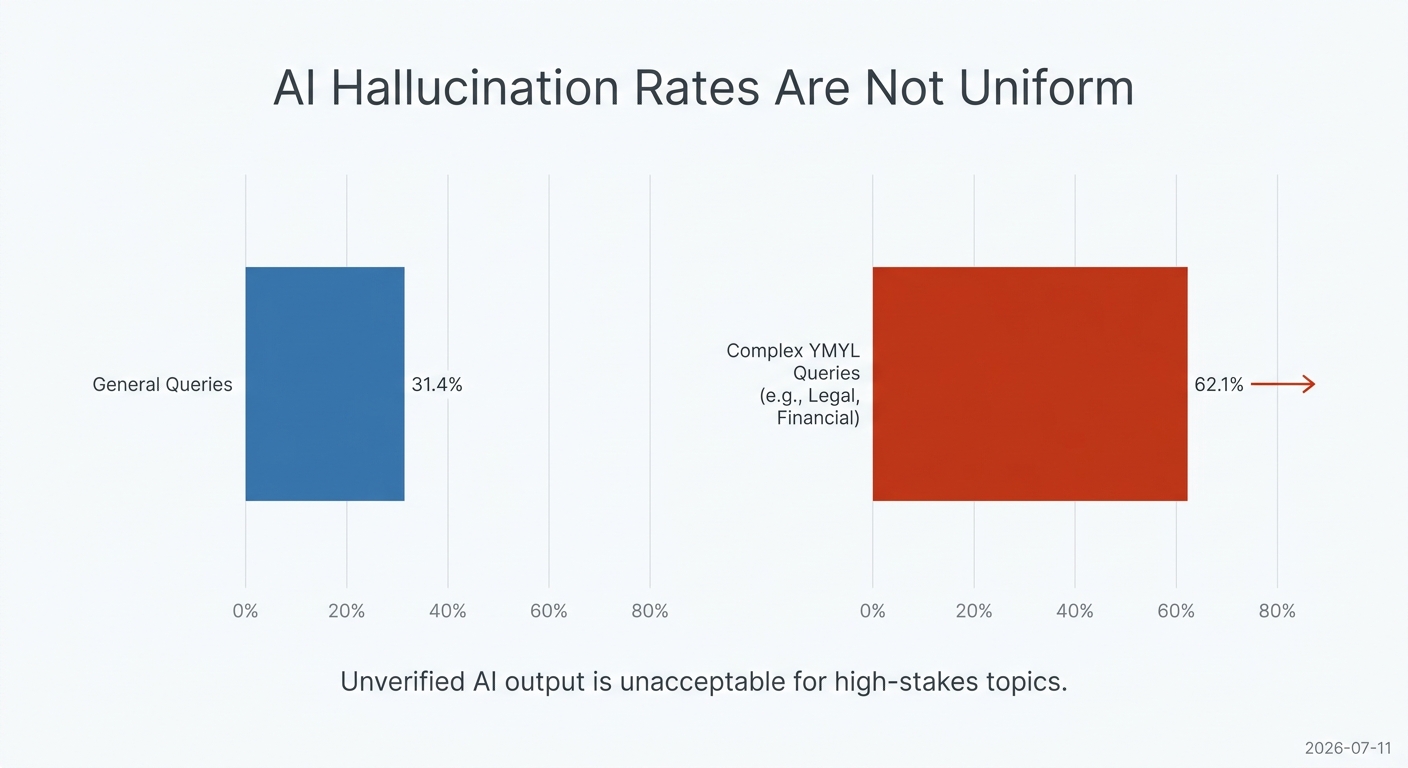
The “30% rule” refers to the baseline hallucination rate of approximately 31.4% found in general LLMs. This figure is an average. For complex YMYL topics like legal or financial queries, the error rate can surge to over 60%, making unverified AI output unacceptable for these niches.
What should I be most careful of when using AI?
Be most careful of factual hallucinations, outdated data, and invented sources. The primary danger is that AI can present incorrect information with a high degree of confidence, making it difficult for a non-expert to spot errors [6]. For YMYL content, this risk is amplified, potentially leading to harmful advice and severe brand damage.
✅ What to Watch For When Using AI
The primary danger is that AI presents incorrect information with high confidence. Be most careful of factual ‘hallucinations,’ outdated data, and invented sources. For YMYL content, this risk is amplified and can lead to publishing harmful advice.
*
Conclusion: AI is a Tool, Not an Expert
Ultimately, is it safe to use AI for YMYL content? The answer is a qualified no. While AI is a revolutionary tool for accelerating research and drafting, publishing its raw, unverified output is a significant liability. The high rate of AI hallucinations, combined with Google’s stringent quality standards, makes a “human-in-the-loop” workflow—where real-world experts validate every claim—an absolute necessity.
The AI landscape evolves rapidly; today’s best practice could be outdated tomorrow, making manual tracking insufficient. By adopting a Generative Engine Optimization (GEO) strategy, brands can safely leverage AI’s power without sacrificing the trust and authority that are paramount in YMYL topics.
To secure your brand’s presence across the new AI-powered search landscape, access a free trial of AI Rankia today and get automated action plans for tracking your brand citations across 17+ AI models.
References
[1] Can You Use AI To Write For YMYL Sites? (Read The Evidence Before You Do)
[2] AI Overviews Optimization: Complete Guide to Google AIO & SGE | 2026
[3] Google’s Quality Raters Guidelines – AI Overviews & YMYL Changes Explained
[4] Google’s Search Quality Rater Guidelines and YMYL in the Age of AI Search
[6] AI-generated Content & SEO: Everything you need to know in 2026
[7] What Is YMYL? Google’s High-Stakes Content Category
[9] Generative Engine Optimization (GEO) in the Financial Sector: YMYL Risks and Trust Strategies
[10] Google March and April 2026 Core Updates: Why Your Traffic Dropped | Lucid Media Blog