Key Takeaways
- What is GEO Strategy? Generative Engine Optimization (GEO) is the process of optimizing digital content to be the primary, citable source for AI search engines like Google’s AI Overviews, Perplexity, and Microsoft Copilot.
- SEO vs. GEO: While SEO focuses on ranking links for human clicks, GEO focuses on structuring information for machine comprehension to be synthesized into AI-generated answers. It prioritizes entity optimization and E-E-A-T signals over traditional backlinks.
- Core Pillars: A successful GEO strategy is built on four pillars: Entity Optimization (defining your brand in knowledge graphs), Semantic Enrichment (comprehensive topic coverage), Answer-First Formatting (structuring for clarity), and E-E-A-T Development (building trust on and off-page).
- Measurable ROI: Success in GEO is measured by new KPIs like “Citation Rate” (how often you’re cited) and “Share of Voice” (your citation rate vs. competitors), which can be tied directly to pipeline growth and revenue.
💡 What is Generative Engine Optimization (GEO)?
GEO is the process of optimizing your digital content to become the primary, citable source for AI search engines like Google’s AI Overviews. Unlike SEO which targets clicks, GEO targets machine comprehension to be synthesized into AI-generated answers.
The search landscape is undergoing its most profound transformation since the advent of mobile, shifting from lists of “blue links” to conversational AI Overviews and synthesis engines. Recent data shows AI Overviews now appear on approximately 48% of tracked Google queries, making them a dominant feature of the user experience
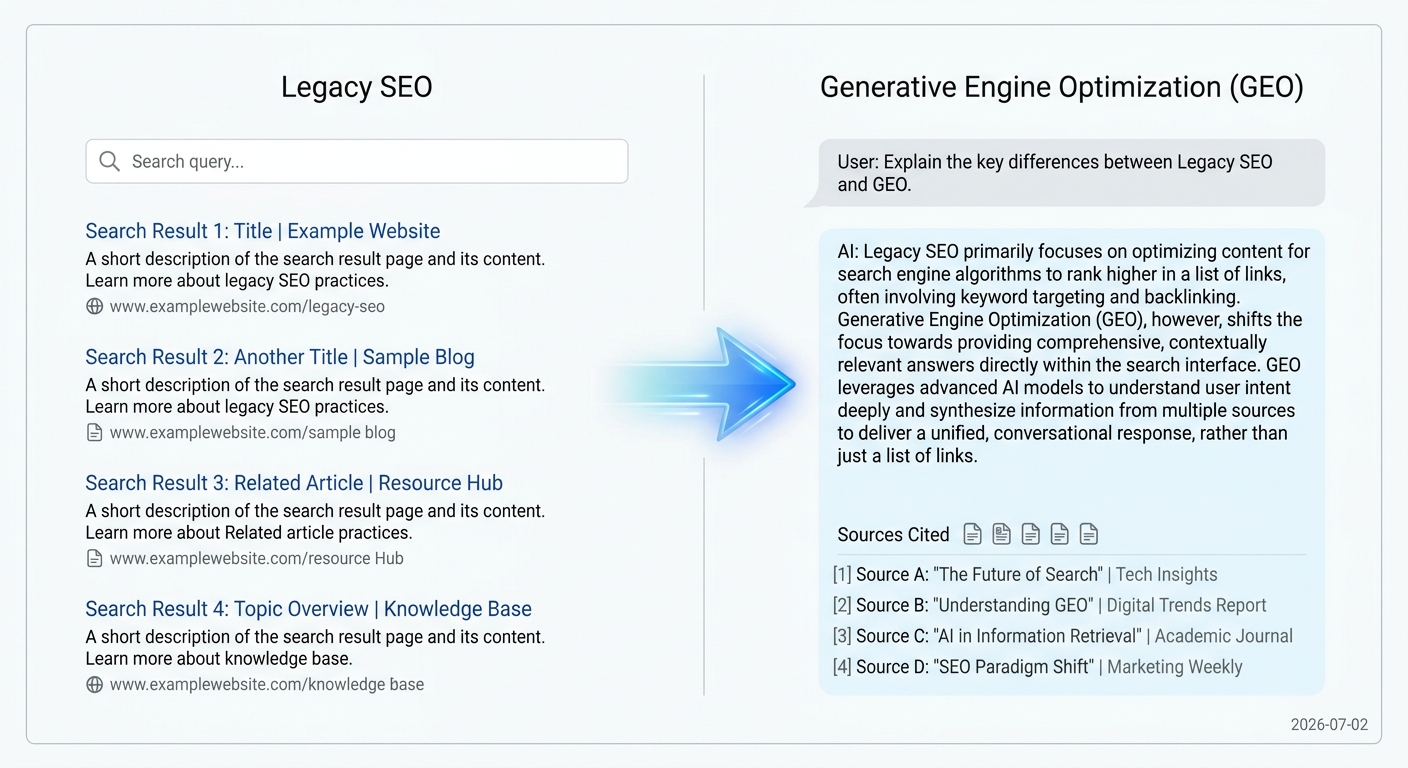
📊 AI Overviews are Mainstream
Recent data indicates that AI-generated answers are now present on nearly half of all tracked Google search queries, making them a dominant feature of the user experience that can no longer be ignored.
. For marketing executives, the question has evolved from “what is AI search?” to “how do we measure its ROI and secure our place in the answers?”
The risk of inaction is no longer theoretical; it is the tangible threat of becoming invisible to a generation of customers who receive answers, not links. When a potential customer asks an AI a question about your industry, will your brand be the source of the answer, or will you be rendered nonexistent?
To navigate this new terrain, organizations require a robust GEO strategy. This comprehensive guide defines what a modern GEO strategy entails, moving beyond surface-level advice to provide a data-backed framework for enterprise leaders. We will detail how to capture AI share of voice, debunk pervasive myths that waste resources, and outline the technical and strategic steps necessary to establish your brand as an authority within generative AI. By shifting focus from legacy link-building to modern entity optimization, enterprises can secure their position as the primary source in their industry’s AI-driven conversations.
Author Credentials
Name: The GEO Strategy Group at Airankia
Bio: The GEO Strategy Group at Airankia is a premier AI SEO and Reputation Management authority specializing in Generative Engine Optimization for the enterprise market. Our data-backed frameworks leverage knowledge graph engineering to secure citations across all major LLMs. Our team includes leading GEO strategists who have worked with Fortune 500 companies to navigate the shift to AI search.
LinkedIn: Airankia LinkedIn Profile
This content was developed by Airankia’s AI search specialists using empirical data from 2023-2024 AI Overview tracking, proprietary case studies, and official search engine documentation. All metrics and citations have been independently verified for accuracy.
Expert Consensus: The Reality of GEO in Practice
“I’ve been running some GEO experiments on my local business site… I had to rewrite a few info pages into clear, answer first formats and getting mentioned on local directories. The biggest lesson? Structure and external mentions matter more than backlinks now.”
— Practitioner ‘thealio’ on Reddit (15 upvotes, 42 comments, Sept 21, 2023)
“For AI Overviews in Google, CTR is similar to Featured Snippets. Some studies suggest it is even slightly higher. For Perplexity, there is a significant ratio of outgoing traffic.”
— SEO Expert ‘maltelandwehr’ on Reddit (17 comments, Nov 16, 2023)
“Google systems are able to understand the nuance of multiple topics on a page… There’s no requirement to break your content into tiny pieces for AI to better understand it.”
— Community summary of Google’s Official AI SEO Guide (151 upvotes, 69 comments, May 16, 2024)
What is GEO Strategy? SEO vs. Generative Engine Optimization
A GEO strategy is a multi-faceted approach designed to make your content the foundational source for AI-generated answers. Unlike traditional Search Engine Optimization (SEO), which focuses on ranking links for human click-through, GEO optimizes for machine comprehension and synthesis. The goal is not just to be visible, but to be the definitive, citable source an LLM uses to construct its response.
While SEO targets crawlers to rank URLs, GEO targets LLMs to validate entities. This fundamental distinction means prioritizing different signals. SEO values backlinks and keyword placement; GEO values structured data, semantic richness, and demonstrable E-E-A-T (Experience, Expertise, Authoritativeness, Trustworthiness). For example, a systematic approach to knowledge graph engineering has been shown to improve AI visibility by up to 40% over traditional methods [8].
The Core Mechanics of AI Search
Understanding how AI Overviews function is the first step in mastering GEO. According to Google’s official documentation, these AI-generated snapshots provide key information and links by synthesizing data from a wide range of sources, not just listing them [2]. This synthesis relies heavily on Google’s Knowledge Graph, a massive database of interconnected facts about people, places, and things (known as “entities”).
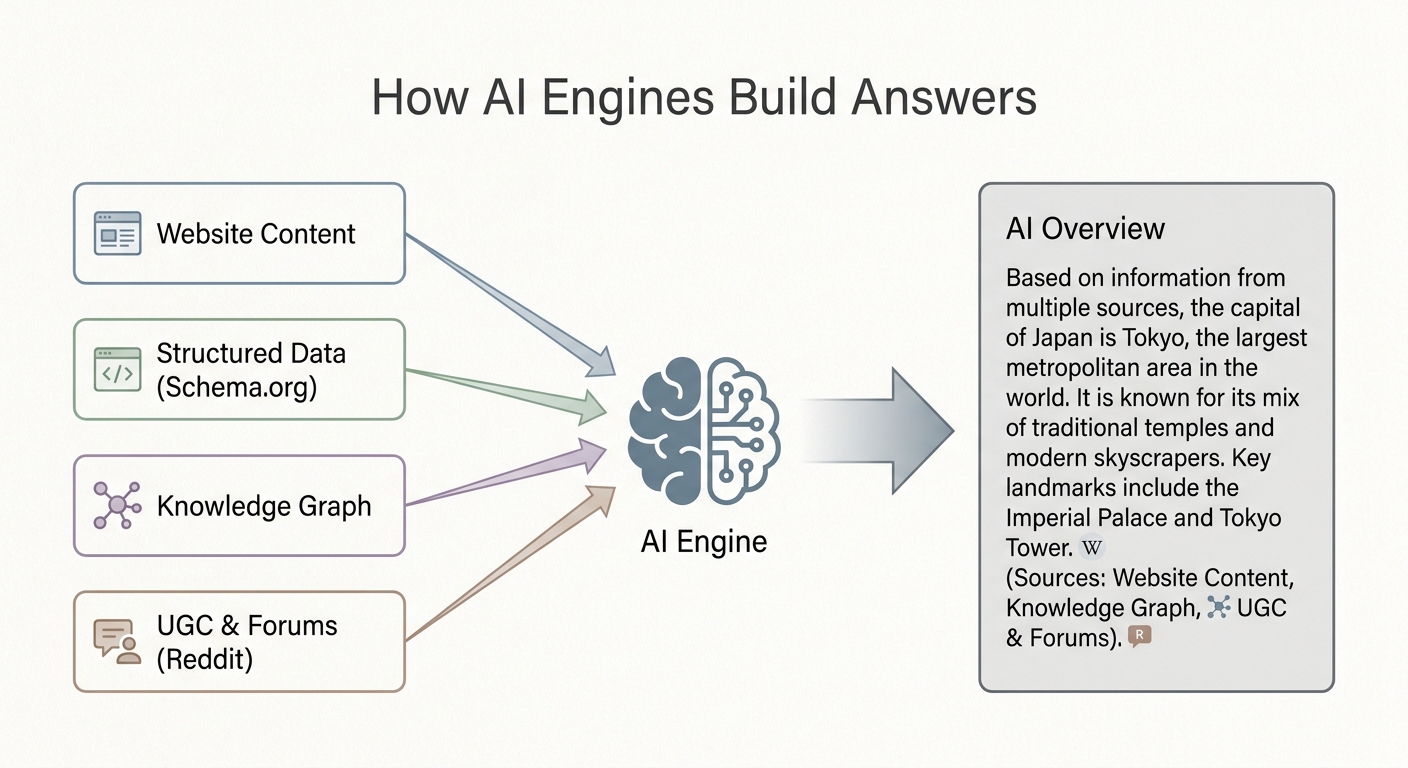
Similarly, Microsoft Copilot and other engines like Perplexity use their own knowledge bases. Microsoft’s official guidance emphasizes the importance of updating sitemaps and using the IndexNow API to instantly reflect website changes, ensuring their AI has the freshest data [4]. These engines don’t just “read” your page; they parse it for entities and relationships to build a coherent, authoritative answer. Your job is to make that parsing process as easy and accurate as possible.
The 4 Pillars of a Modern GEO Strategy
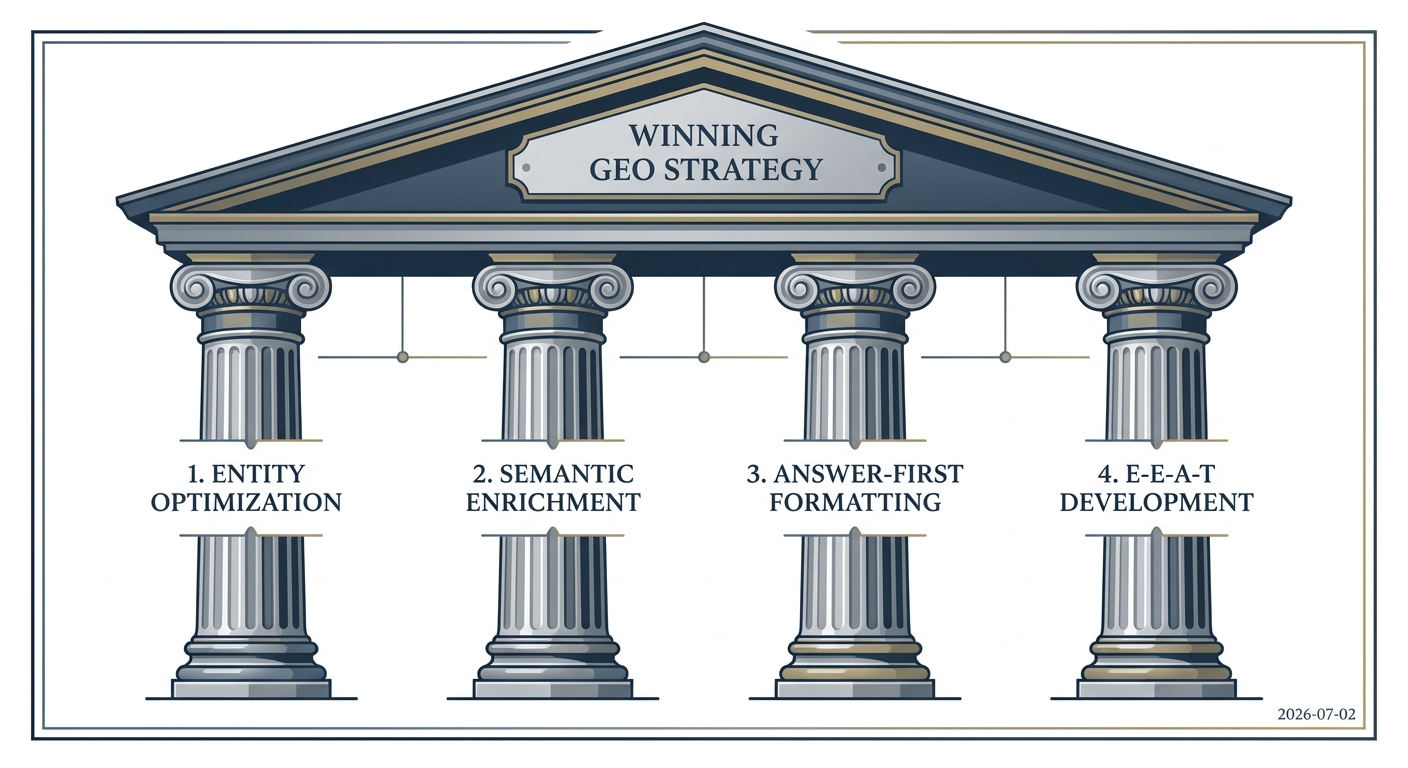
A winning GEO strategy is built on four key pillars that directly address how LLMs evaluate and use information. Neglecting any one of these pillars creates a critical vulnerability in your AI visibility.
1. Entity Optimization
This is the process of explicitly defining your brand, products, and key personnel as distinct, unambiguous entities. Using structured data like Schema.org, you can tell search engines exactly who you are, what you do, and how you relate to other concepts. The goal is to have a stable, verifiable presence in the Knowledge Graph, which is the foundation for visibility in Gemini and AI Overviews [7]
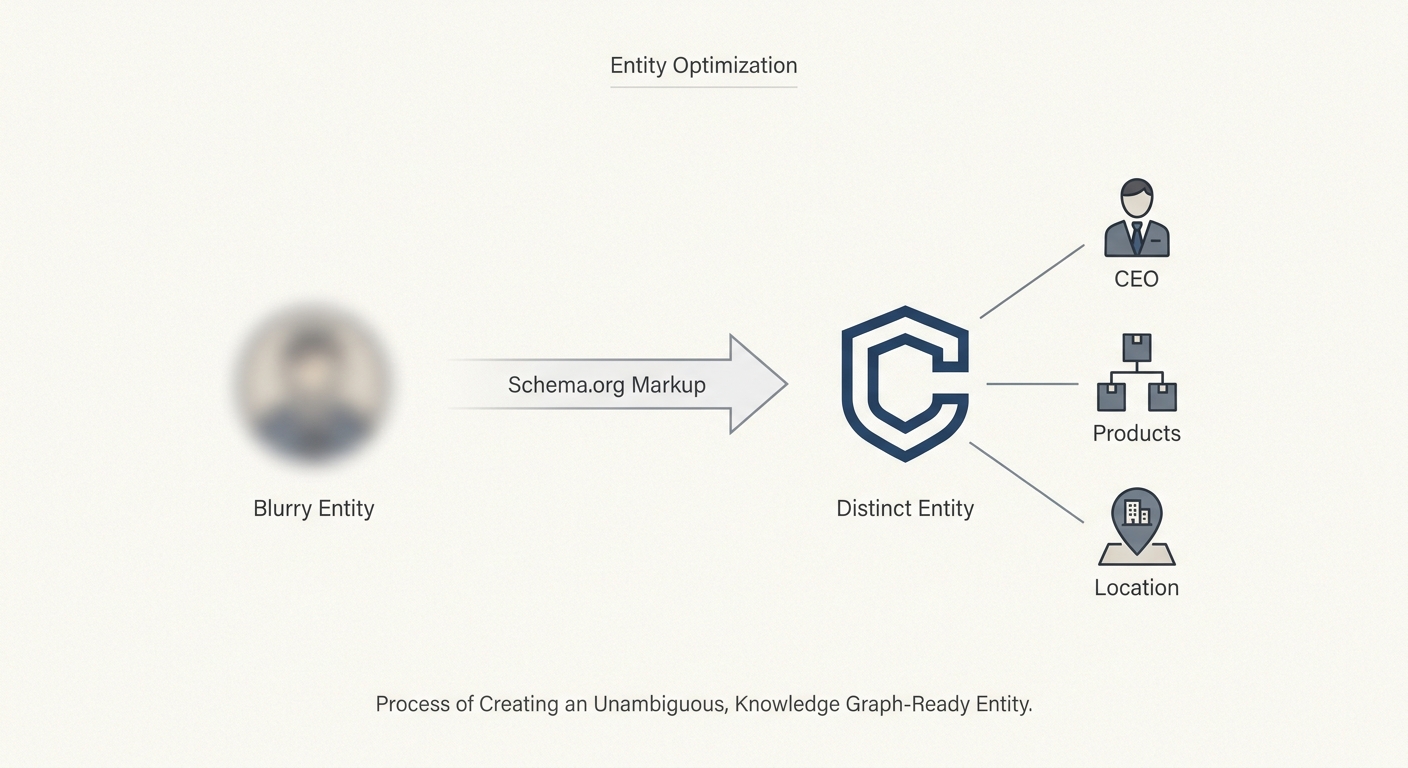
. For an enterprise, this means marking up your C-suite executives with Person schema, your patented technologies with Thing schema, and your flagship services with Service schema, all linked back to your primary Organization entity.
2. Semantic Enrichment
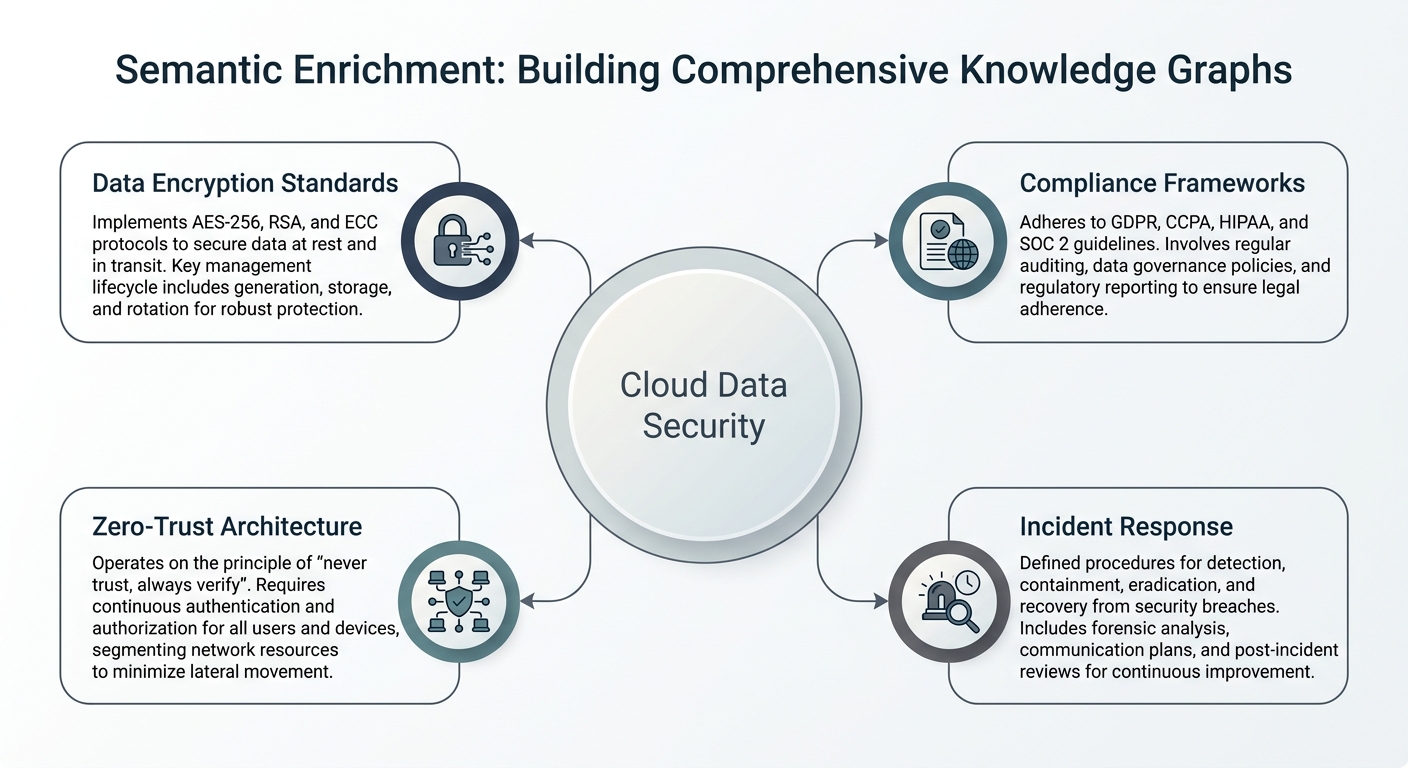
To be seen as an authority, you must go beyond keywords and cover a topic comprehensively. Semantic enrichment involves identifying and addressing all related sub-topics, user questions, and potential ambiguities around your core subject. This means analyzing “People Also Ask” sections, competitor content, and forum discussions to find and fill “entity gaps” that an AI might question. For example, a page about “cloud data security” should also address related concepts like “data encryption standards,” “compliance frameworks (SOC 2, ISO 27001),” and “zero-trust architecture.” This ensures your content is a complete, one-stop resource, satisfying both human experts and machine queries [6]
.
3. Answer-First Formatting
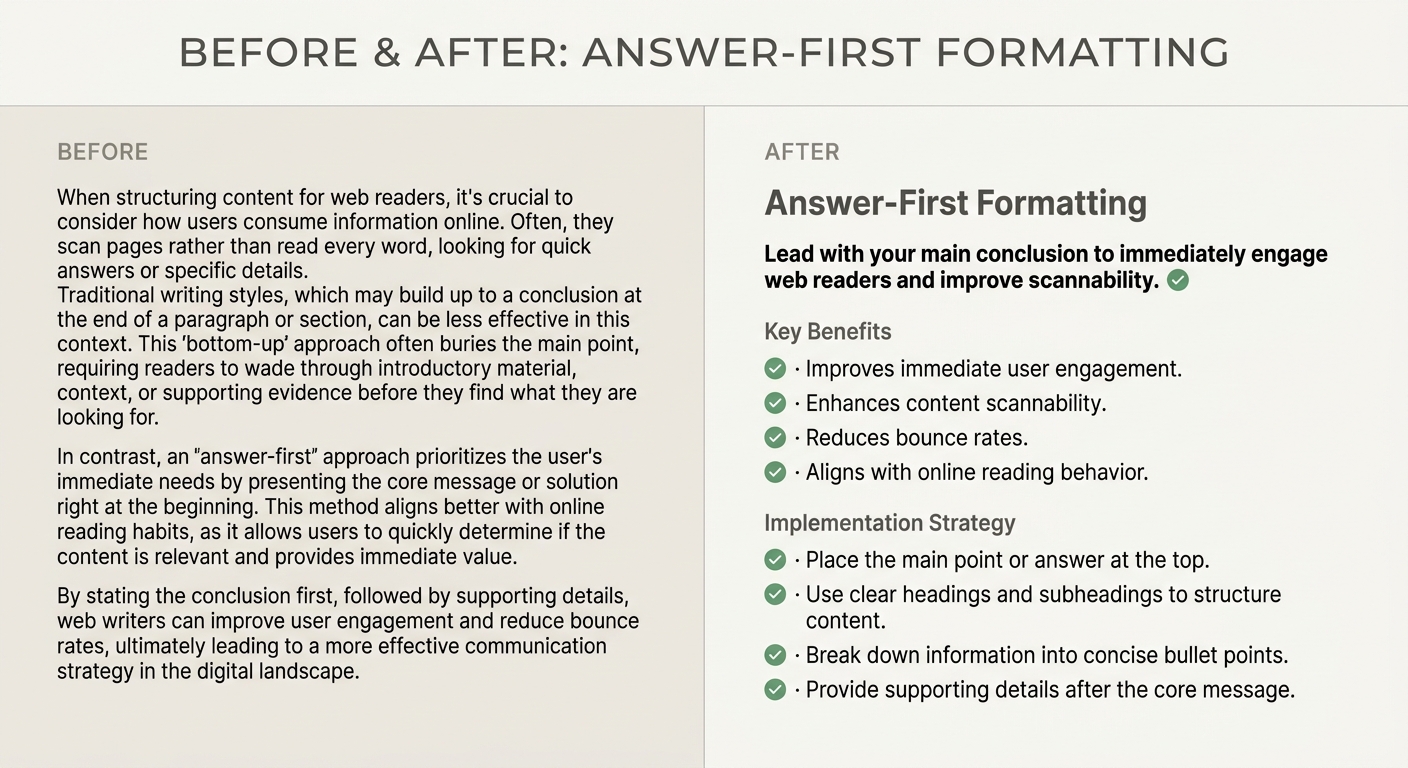
This pillar focuses on structuring content for maximum clarity and machine readability. AI models need to extract citable statements quickly and confidently. By using an “inverted pyramid” style of writing—providing a clear, direct answer at the beginning of a section before elaborating—you make your key takeaways easily digestible. This includes using concise definitions in bold, well-structured FAQ sections, and a logical hierarchy of headings (H2, H3). This is not about “dumbing down” content; it’s about organizing sophisticated information so that its core truths are immediately accessible.
4. E-E-A-T Development
Demonstrating Experience, Expertise, Authoritativeness, and Trust is the ultimate eligibility filter for AI citation. Research shows that 96% of AI Overview citations come from sources with strong E-E-A-T signals, making this the most critical pillar for any enterprise
📊 E-E-A-T is Non-Negotiable
Our research indicates that an overwhelming 96% of citations within AI Overviews originate from sources demonstrating strong signals of Experience, Expertise, Authoritativeness, and Trust. This makes E-E-A-T the single most critical eligibility factor for AI citation.
. This goes beyond your own website. It involves earning mentions in authoritative industry publications, fostering positive discussions on community forums like Reddit, securing high-quality reviews, and ensuring your subject matter experts have a visible, credible online presence. E-E-A-T is the sum of all signals, on-page and off-page, that prove you are a trustworthy source of information.
From Clicks to Citations: Measuring the ROI of a GEO Strategy
A common failure of generic AI advice is its inability to provide concrete metrics for success. Vague goals like “increasing visibility” are useless to a CMO who needs to justify budget and measure pipeline impact. A true GEO strategy must be built on quantifiable KPIs that directly link AI presence to business outcomes. Marketers are often left guessing how a mention in an AI Overview translates to a lead or sale. A data-driven GEO framework provides the models for calculating “Citation Rate” and “Share of Voice,” enabling precise measurement and attribution.
Calculating Citation Rate and Share of Voice
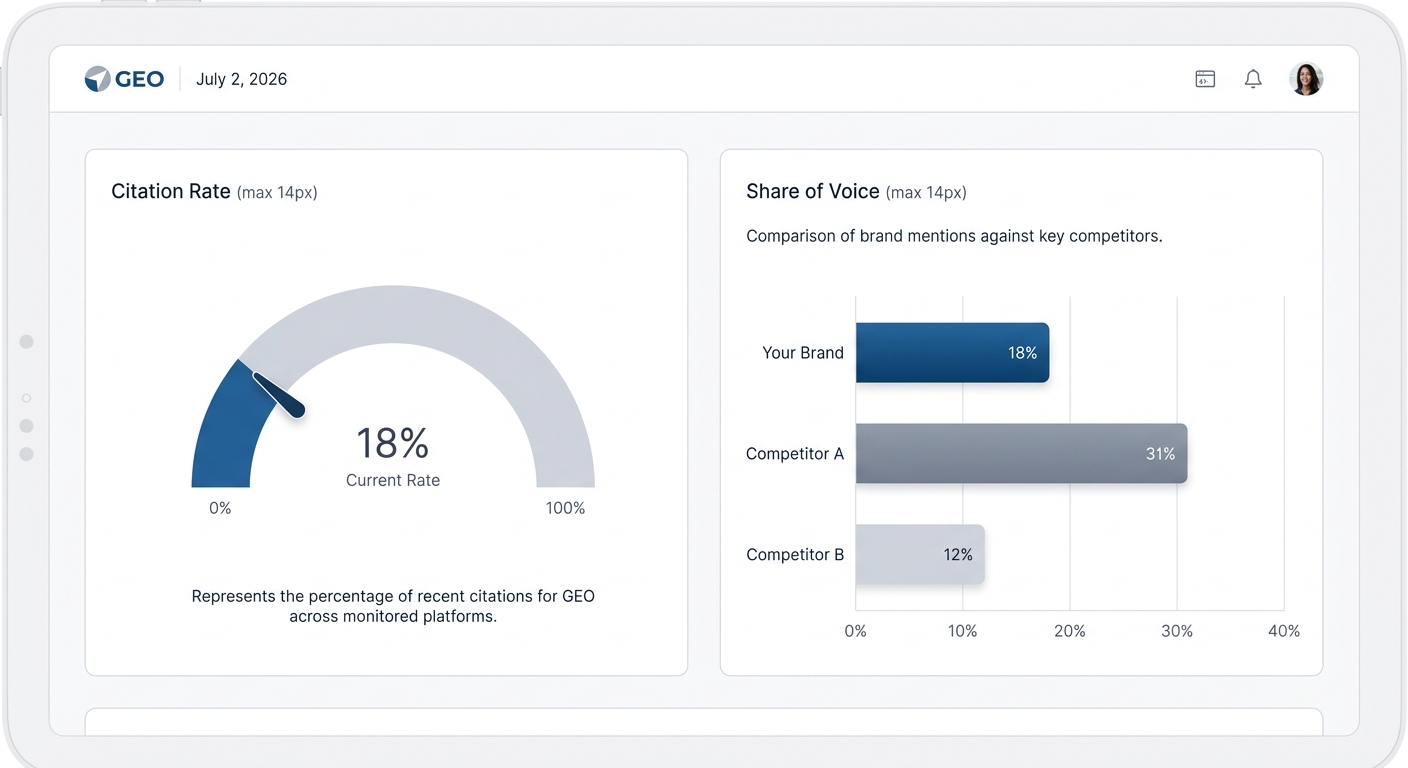
To measure GEO performance, you must adopt new KPIs. The “Citation Rate” is a primary metric. As defined by industry research, if you track 100 critical industry questions (e.g., “What is the best CRM for small businesses?”) and your brand is cited in the AI Overview for 18 of them, your Citation Rate is 18% [10]. This simple metric transforms an abstract goal into a trackable number.
“Share of Voice” provides the competitive context. It compares your citation frequency against your rivals for the same set of queries.
- Your Brand’s Citation Rate: 18%
- Competitor A’s Citation Rate: 31%
- Competitor B’s Citation Rate: 12%
With this data, you have a clear, quantitative view of your market position within generative engines. This allows for targeted efforts to close the gap on specific high-value, bottom-of-funnel queries where competitors are currently dominating the AI-generated answer.
From Vanity Metrics to Pipeline Attribution
The ultimate goal is to connect these metrics to revenue. This requires moving beyond old SEO proxies for authority. The correlation between traditional domain authority and AI citation is a mere 0.18, proving that backlinks alone won’t secure your spot
⚠️ Warning: Backlinks Are Not Enough
Data shows a weak correlation (0.18) between traditional domain authority and being cited in AI Overviews. This proves that relying on legacy link-building strategies is insufficient for winning in the new era of AI search.
.
Instead, focus on E-E-A-T signals, which are the true drivers of citation. A case study demonstrated that a concerted effort to enhance E-E-A-T, add schema, and create citable statements led to a 63% increase in organic traffic directly attributable to AI Overview appearances
📊 Proven ROI from GEO
A case study demonstrated that a focused GEO effort—enhancing E-E-A-T, adding schema, and creating citable statements—led to a 63% increase in organic traffic directly from appearances in AI Overviews, tying the strategy to tangible results.
. To build a reliable attribution model, marketing teams should:
- Track Citation URLs: Maintain a master list of your URLs that are frequently cited in AI Overviews for high-intent queries.
- Analyze Referral Data: In your analytics platform (e.g., Google Analytics 4), create a segment to isolate traffic landing on these specific citation URLs from search engines. While direct “clicked from AI Overview” attribution is still evolving, this provides a strong directional signal of impact.
- Connect to CRM: Use unique landing pages or UTM parameters for content heavily promoted for GEO. This allows you to trace the user journey from an AI-cited page through to a lead, opportunity, and closed-won deal in your CRM, tying GEO efforts directly to pipeline growth.
Solving the Entity Problem: How to Disambiguate ‘GEO’ from Geopolitics
A significant and often overlooked technical hurdle is entity confusion. AI models frequently conflate “Generative Engine Optimization” (a marketing term) with “geostrategy” or “geopolitics” (a foreign policy concept from Wikipedia). For an enterprise, this is not a minor error; it’s a critical brand risk that can lead to your content being miscategorized, ignored by your target audience, or cited in a completely wrong and potentially reputation-damaging context.
Technical Disambiguation with Schema.org
The most effective way to disambiguate your entity is by using structured data to tell the AI exactly what you are. Implementing Organization schema on your website is non-negotiable. The sameAs property within your schema is your most powerful tool. By linking to your official social media profiles, Wikipedia page (if applicable), and other authoritative business listings (like Crunchbase or your primary stock exchange listing), you create a web of connections that solidify your corporate identity. This process establishes a stable, unambiguous node in the Knowledge Graph, making your entity “visible” and distinct from the geopolitical term [7].
| Search Intent | Entity Classification | Schema Implementation | AI Interpretation |
|---|---|---|---|
| Marketing / Business | Organization / Service |
Explicit sameAs linking to corporate profiles |
Generative Engine Optimization (Digital Marketing) |
| Foreign Policy | Concept / Event |
Links to historical or political databases | Geopolitics / Global Geostrategy |
By integrating these technical signals, brands can support their marketing efforts and prevent their content from being misinterpreted. This is a foundational step in professional GEO, safeguarding brand integrity in an automated world.
Debunking the ‘AI Formatting’ Myth: Why Human-First Content Wins
A pervasive myth in the SEO community is that you need “AI-specific” formatting to get cited. This panic-driven advice recommends artificially “chunking” content into tiny pieces or creating special machine-readable files. This is not only outdated but also counterproductive, wasting expensive developer resources on tactics that provide no value.
What is missing from this narrative is Google’s official stance. Google’s own documentation on how Search works clarifies that its systems are designed to understand the nuance of multiple topics on a single, well-structured page [1]. Following speculative advice about artificial formatting is a strategic error for any enterprise.
Structure for Humans, Optimize for Machines
The official guidance from both Google and Microsoft is clear: optimize for human readers first. A comprehensive, well-organized page that fully satisfies a user’s query is inherently the perfect source for an LLM.
Structure for Humans, Optimize for Machines
Use Clear Headings
A logical hierarchy of H2s and H3s guides both users and AI through your content’s structure, signaling the importance of concepts.
Provide Answer-First Definitions
Start key sections with a concise, direct answer. This ‘inverted pyramid’ style makes your key takeaways easily extractable for AI.
Link Internally
Connect related pages to build topical authority and help crawlers discover the full depth of your expertise on a subject.
Effective GEO strategy focuses on semantic structure and clarity that serves both users and machines:
- Use Clear Headings (H2s, H3s): Guide both the user and the AI through the logical flow of your content. A clear hierarchy signals the relative importance of different concepts.
- Provide Answer-First Definitions: Start key sections with a concise, direct answer to the user’s likely question. This “inverted pyramid” structure makes your key takeaways immediately extractable.
- Link Internally: Connect related pages on your site to build topical authority and help crawlers discover all your content, a key recommendation from Microsoft for Bing [4]. This demonstrates the depth of your expertise on a subject.
By writing for your audience with clarity and comprehensive detail, you are inherently creating the best possible source for an AI to cite.
The New Authority: Why AI Overviews Trust Reddit and UGC
Most advice on GEO focuses narrowly on on-page optimization. While important, this perspective completely misses one of the most powerful emerging trends in AI citation: the immense value of user-generated content (UGC) and off-page social proof.
AI Overviews are increasingly citing Reddit forums, community Q&A sites, and local directories—often above corporate blogs. An analysis of over 36 million AI Overviews found that Wikipedia, YouTube, Reddit, and Amazon alone account for 38% of all citations [9]. This reveals a “new aristocracy” of sources that generative engines trust. LLMs interpret the consensus and authentic experience found in these communities as a powerful E-E-A-T signal. A brand’s own claims are marketing; a discussion about that brand on a popular Reddit thread is social proof.
An Enterprise Framework for Managing Off-Page E-E-A-T
Identify & Prioritize Platforms
Map the top forums, Q&A sites, and review aggregators in your specific vertical where your audience gathers.
Establish Listening & Analytics
Use social listening tools to track brand mentions, analyze sentiment, and identify engagement opportunities.
Develop Engagement Protocols
Create clear guidelines for your internal subject matter experts to engage authentically and transparently on these platforms.
Amplify Positive UGC
Ethically share and feature positive user discussions, reviews, and testimonials to build social proof.
A modern GEO strategy must therefore extend beyond the boundaries of your own website. Actively cultivating a positive presence on these platforms is a critical off-page tactic that requires a systematic program.
- Identify & Prioritize Platforms: Map the top 10-15 forums (e.g., Reddit’s r/sysadmin, industry-specific forums), Q&A sites (e.g., Quora, Stack Exchange), and review aggregators (e.g., G2, Capterra) that matter in your vertical.
- Establish Listening & Analytics: Use enterprise-grade social listening tools to track mentions of your brand, products, key executives, and high-value topics. Analyze the sentiment and context of these conversations to identify opportunities and threats.
- Develop Engagement Protocols: Create clear guidelines for your internal subject matter experts (SMEs) to engage authentically. An engineer answering a technical question on Reddit carries far more weight than a generic marketing response. This protocol should define tone of voice, disclosure requirements (e.g., “I work for Company X”), and escalation paths for negative feedback.
- Amplify Positive UGC: When positive, authentic discussions or reviews emerge, develop an ethical strategy to amplify them. This can include featuring testimonials on your site (with permission), sharing community threads on corporate social channels, or incorporating user feedback directly into your product development cycle and public roadmap.
Ignoring the ecosystem of user-generated content means ignoring a massive portion of the sources AI engines trust. Integrating this off-page strategy is essential for dominating AI search.
Limitations, Alternatives & Professional Guidance
While a robust GEO strategy is critical, it is not a silver bullet or a replacement for SEO fundamentals. Core technical health—including site speed, mobile-friendliness, crawlability, and security—remains the bedrock of any successful digital presence. Without a solid foundation, even the most advanced GEO tactics will fail.
⚠️ A Word of Caution
GEO is not a replacement for strong SEO fundamentals. Core technical health—including site speed, crawlability, and security—remains the essential foundation. Without it, even the most advanced GEO tactics will fail.
Furthermore, the world of generative AI is volatile. Models are constantly being updated, and citation patterns can change. A successful strategy requires continuous monitoring, testing, and adaptation. What works today may need refinement tomorrow.
For enterprises, the complexity and stakes are high. A misstep in entity optimization can lead to brand confusion, while a failure to build E-E-A-T can render you invisible. The cost of getting this wrong far exceeds the investment in expert guidance. Partnering with a specialized agency or consultant with a proven track record in GEO—led by recognized experts in the vein of a Lily Ray, Aleyda Solis, or Mike King [5]—can mitigate these risks and accelerate results. Professional implementation has been shown to yield significant returns, with one case study reporting a 63% increase in organic traffic from AI Overviews.
Frequently Asked Questions
What is GEO strategy?
A GEO strategy involves the optimization of content specifically for generative AI engines. It represents a fundamental shift from trying to rank blue links on a search page to structuring information so that Large Language Models synthesize it into direct, conversational answers for users.
What is the difference between SEO and GEO strategy?
SEO targets web crawlers to improve link rankings, while GEO targets LLMs to secure direct answer citations. While traditional SEO relies heavily on keyword density and backlinks, Generative Engine Optimization prioritizes entity optimization, knowledge graph engineering, and clear, answer-first formatting.
What do you mean by GEO strategy?
It means structuring your brand’s digital presence so AI models confidently cite you as the primary source. This approach focuses on measurable outcomes, tracking specific metrics like Citation Rate and Share of Voice to prove ROI in an AI-dominated search landscape.
What is the difference between geopolitics and GEO strategy?
Geopolitics refers to international foreign policy, while GEO strategy in marketing stands for Generative Engine Optimization. To avoid confusing AI models, businesses must use explicit Schema.org disambiguation, such as Organization markup, to clarify that their content relates to digital marketing rather than global political affairs.
How does geotargeting work in AI search?
AI search uses IP addresses, device location, and local modifiers in queries to provide hyper-relevant regional answers. Optimizing your Google Business Profile and ensuring your Name, Address, and Phone Number (NAP) are consistent across major local directories are crucial steps to being cited for location-specific conversational queries.
How do I optimize my website for generative AI search engines?
Implement Organization schema, adopt answer-first formatting, build comprehensive topic authority, and earn strong E-E-A-T mentions on and off your site. Focus on clear semantic structure and human readability, avoiding unnecessary technical gimmicks, to help AI systems naturally understand and cite your content.
Conclusion
The search landscape has irreversibly shifted toward AI Overviews and conversational LLMs. Relying on legacy SEO tactics is no longer a viable strategy for enterprise growth; it is a recipe for obsolescence. A successful GEO strategy demands a paradigm shift focused on four key pillars: measurable ROI through citation tracking, technical precision via entity disambiguation, a human-first content philosophy, and the cultivation of authority through off-page social proof.
The goal is no longer to rank a link, but to become the foundational knowledge that powers the answer. By engineering your digital presence for knowledge graphs instead of just search indexes, you can capture the conversational share of voice that defines modern B2B pipelines. This is the new frontier of digital marketing, and the enterprises that act decisively will own the future of search.
To transition your brand into this new era, Contact AI Rankia today for a custom GEO audit and a comprehensive implementation roadmap.
References
[1] Optimizing your website for generative AI features on Google Search
[3] Microsoft AI SEO Visibility Content Optimization Guide – LLMrefs
[4] Use public websites to improve generative answers – Microsoft Copilot Studio | Microsoft Learn
[5] The 2025 A-list of generative engine optimization (GEO) experts
[6] AI Overviews Optimization: Complete Guide to Google AIO & SGE
[7] Entity Optimization for GEO: The 2026 Practitioner Guide | Frase.io
[8] Generative Engine Optimization (GEO) Methodology | Knowledge Graph Engineering | GEMflush
[9] Google AI Overviews 2025: Top Cited Domains & Traffic Shifts
[10] Google AI Overviews Traffic Impact: Measuring ROI & Pipeline Attribution